19 Years Ago: The Satya Humane Meat Discussion of 2006

On the 12th of October 2006, Satya magazine held an open gathering at the Jivamukti Yoga Studio Café, New York City. On the same date, I took notes and wrote this synopsis. This version is slightly condensed for clarity. It constitutes my observations only, and is not meant to be a comprehensive recording of the meeting.

Why, you might ask, would we revisit a 2006 discussion today? In retrospect, it shines a light on a major fork in the road of advocacy. Career advocates needed to choose a direction, and the dominant group endorsed the “practical” approach instead of radical opposition to capitalism’s claim on animal bodies.

So I’m leaving it to the reader to decide whether, and to what extent, this meeting had meaning. This is not tale-telling; nor is it an exposé. Everyone who attended had the knowledge that the Humane Meat Discussion would be the focus of public commentary. The discussion was promoted and hosted by journalists, and this synopsis itself was circulated after the event. Each person and each charity named in this synopsis shared their perspective voluntarily and publicly.

The staff of Satya magazine hosted the Humane Meat Discussion. Publisher Catherine (Cat) Clyne introduced the Satya staff and some contributors and groups present at the session.

Clyne said:

We all have one thing in common: we all care—deeply—about animals.

Gene Bauston [now Gene Baur] of Farm Sanctuary commented as the question-and-comment session began. Bauston said that the attendees could be divided into two main classes: There are those of us, Bauston said, who have “hands-on” experience, and those who approach advocacy from an academic—let’s say a theoretical—perspective. Bauston’s choice of words was apparently establishing Bauston as within the “hands-on” class.

It is common, of course, to hear animal-rights advocates and vegans being dismissed as idealist, ivory-tower, and so forth. Animal husbandry concessions are invariably justified by the claim that they are realistic, pragmatic, or derived from good business sense.

This dichotomy reflects (and does not challenge) the status quo: Veganism, although gaining ground, is indeed an ideal. Animal products are indeed a business.

By the latter half of the 1970s, we saw a point of view, most strongly associated with Peter Singer, that both breeding and killing (quintessential acts of domination) could co-exist with compassion. N. L. (employee of Friends of Animals) suggested that if activists had kept doing vegan advocacy rather than swap it for a strategy of concessions, animal rights would appear more realistic today.

An attendee named Chris was visibly upset due to the co-opting of the specific word “compassion” by animal agribusiness. Chris likened the use of the word “compassion” by an enterprise enslaving and killing animals to “a knife in my heart.”

Dan Piraro (a vegan cartoon artist) agreed that words are important but said activists ought to get used to them being distorted, because that just happens. For example, the “Clear Skies Initiative” takes an environmentalist idea, clear skies, and turns it into a plan that might be better termed “clearing the skies of birds.” In any case, Piraro insisted, things aren’t going to change, so activists should do anything they can. Piraro would like to see a vegan society, but: “It will never happen—certainly it will never happen in my lifetime. Think about those guys on death row.” Piraro said they’d appreciate better conditions.

Let’s take a closer look at Piraro’s claim. Nonhuman animals won’t be on death row insofar as they aren’t desired as consumer products. That’s the very point of vegan advocacy. Moreover, serious human-rights advocates do not accept the idea that people on death row should be killed humanely nor do the advocates negotiate rules on how to kill them.

One participant said it is not sensible to insist on veganism if it won’t work for people with babies and children. Cat Clyne suggested that it’s debatable whether breast milk is vegan but suggested reading The Way We Eat by Peter Singer and Jim Mason. [A clarification for the confused reader: Human breast milk is vegan.]

Others pointed out that Dr. Benjamin Spock had given veganism the clearance for babies and children, and so had the professional dieticians of the American Dietetic Association.

Someone said we’re all speciesist so let’s not say we’re not; after all we are not blocking the trucks now. Then the participant added: “And I am not out there doing it for humans either.”

Friends of Animals [the group I worked for at the time] provided a sheet for participants to pick up from the information table, listing facts about Whole Foods Market’s latest major promotion. We noted that the grocery chain designed a foundation “to assist and inspire ranchers and meat producers around the world to achieve a higher standard of animal welfare excellence while maintaining economic viability.” We noted that Whole Foods Market stock hit a record high the day the company announced the hiring of agribusiness expert Anne Malleau to direct the Animal Compassion Foundation.

Lee protesting at Whole Foods Market (Devon, Pennsylvania) on a snowy day in January 2005, holding up a handmade sign saying Whole Foods Myth.

Advertised with posters depicting the silhouettes of a cow, pig, and chicken, and designated First Global Five Percent Day, the final Tuesday in January 2005 represented the investment of $550,000 out of the company’s global receipts into the new foundation.


Several Friends of Animals employees, and a few supporters, leafletted on Global Five Percent Day at five Whole Foods locations, asking shoppers to reconsider the idea of funding a concept involving research on animals in agribusiness and the unveiling of yet another line of animal products. 

On 20 January 2005, Friends of Animals published an open letter to Whole Foods Market CEO John Mackey, taking issue with the grocery chain’s Animal Compassion Foundation, observing that “we have the ability to decide whether to keep bringing other animals into existence simply to be sold as food, while using up land and water resources that could be left to animals who really could have free and full lives.”

Next, Whole Foods Market posted and circulated a statement in the form of a letter from Animal Rights International (ARI) to John Mackey, dated 24 January 2005, with the release titled Animal Rights Groups Express Support for Animal Compassion Foundation.
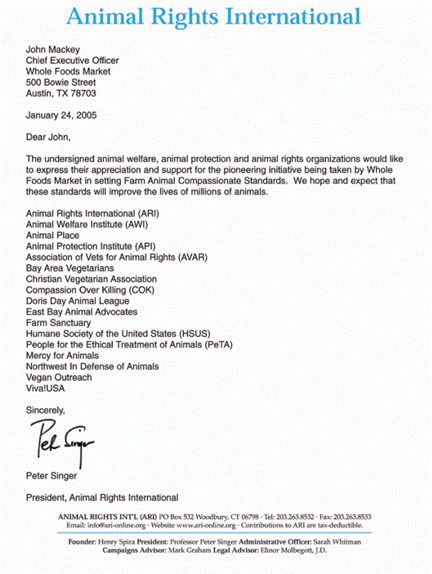
The endorsement was signed by 17 animal-protection groups, following Peter Singer, ARI president. Co-signers included the Animal Welfare Institute, Animal Place, the Animal Protection Institute, the Association of Veterinarians for Animal Rights, Bay Area Vegetarians, the Christian Vegetarian Association, Compassion Over Killing, East Bay Animal Advocates, Farm Sanctuary, Mercy for Animals, Northwest In Defense of Animals, and Vegan Outreach, as well as groups that had served Whole Foods Market as consultants more than a year in advance. Attending meetings with Whole Foods and ARI in December 2003 were animal welfare scientists Ian Duncan of the University of Guelph and Renee Bergeron of the University of Laval, and representatives from the Humane Society of the United States, People for the Ethical Treatment of Animals, Vegetarian International Voice for Animals! (Viva! USA), and the Animal Welfare Institute.

Gene Bauston of Farm Sanctuary acknowledged that, as of the date Satya held its open discussion in late 2006, there were still no actual “compassion standards” in place.

Nevertheless, as I stated in the Satya discussion, the corporation was touting its social responsibility promotions, including its Global Five Percent Day, with an enormous billboard in the expensive Kensington district of London, at the construction site of its new branch. Just across from Hyde Park, the selected site was Barkers of Kensington, west London’s oldest department store, bought out by Whole Foods Market CEO John Mackey for England’s first named branch of the grocery chain.

Mackey had already acquired London’s “niche retailer” Fresh & Wild. The Fresh & Wild chain was not animal-free before the takeover, but at least it hadn’t been using a false sense of kindness to animals to sell its products. “Sausages made from humanely treated animals,” the Guardian Observer announced in early 2006, summing up the hype surrounding John Mackey’s entrance into Britain.

Those of us from Friends of Animals reminded the Satya meeting attenders that support for family farms and pasture-based businesses would promote the idea of taking yet more space on Earth for agribusiness, leaving less space to exist at all for free-living animals.

Bauston countered:

If we really believe that free-range farming is bad because it uses more space, the next step in that argument would support concentrating animal commerce in factory farms!

We replied:

No, it would not.

The next step in the argument is vegan advocacy.

Farmer-activist Harold Brown stood up and talked about what it’s like to speak to agriculture students. Brown would say: “I’m against all animal agriculture. Now, let’s talk.” Students didn’t shrink from such forthright communication.

Brown said there’d be no point in lecturing about “animal welfare”—which is actually husbandry. Husbandry is already in the textbooks; it needs no promotion. The more we insist on taking other animals seriously, the more industry will respond with husbandry adjustments in an effort to pacify activists and the public. But it’s not our job to compromise our views and meekly request reforms, said Brown. We can’t dismantle animal use by compromising with it.

Brown recounted having recently read an article that said one thing industry cannot fight is the moral argument. So, Brown continued, advocates must regain or develop clarity of thought and purpose. Brown said:

We have the truths. The Orwellian Big Lie is that we need the market to drive ethical attitudes.

Of the letter signed by 17 groups supporting Whole Foods’ Animal Compassion Foundation, Gene Bauston countered, none of those groups actually endorsed the concept of humane animal products.

James LaVeck, filmmaker with Tribe of Heart, then read from the letter itself.

Dear John, The undersigned …would like to express their appreciation and support for the pioneering initiative being taken by Whole Foods Market in setting Farm Animal Compassionate Standards …

LaVeck asked if anyone could argue that it was anything other than an endorsement.

Lauren Ornelas got up to recount what it was like to promote the concept of the compassion foundation with Mackey in the first place, and how hard it was to be at the table and be sure that “animal rights groups” could be trusted to behave themselves. Ornelas also claimed to have persuaded Mackey to go vegan.

Disturbed by this, I got up to say this invocation of “vegan” was both a misuse of language and a distortion of vegan activism. Is Mackey vegan? No one is vegan who eats goat cheese and eggs. Moreover, as an international marketer of animal secretions and flesh, Mackey cannot possibly claim to be striving to opt out of animal agribusiness, which is what a vegan does.

Ornelas then said:

Well, Mackey was vegan.

Let’s take a closer look at that claim. Prior to unveiling the Animal Compassion Foundation, Mackey publicly said:

Technically, I am not a pure vegan because I eat eggs from my own chickens.

But there are no pure and impure vegan categories. Veganism doesn’t make allowances for eggs produced through backyard hen-keeping. With eggs featured in so many groups’ free-range farming promotions (including campaigns of many of the groups listed on the support letter to Mackey), I stated, Mackey’s words had special significance in co-optation dynamics.

Eddie Lama of Oasis Sanctuary had this to say about purportedly seeking animal rights by campaigning for husbandry adjustments:

If I want to grow figs, I do not plant an apple tree. If I want to eat pears, I do not plant a chestnut tree.

The grand focus of the animal-rights perspective is being lost, warned Lama, who compared scenes from FaunaVision [Lama’s video presentations, involving the fates of nonhuman beings in agribusiness] to how the vegan might view many of the aisles of Whole Foods.

Lama went on:

I’m so hurt. When I’m in Whole Foods Market, and I see the miles of bodies, all dolled up. Then they have these posters advertising their supposed humanely treated animals. They show the pictures of them, their former selves, grazing in the field.

Those animals, on their way to a terrible end, I see so many. I would buy them to save them.

Let husbandry changes come where they will, urged Lama, but don’t waste time entrenching animal use.

Bauston then said we have to understand reality and stop living outside of the real world. Bauston referred to the importance of pushing Proposition 204 in Arizona. [That proposal entailed a seven-year phase-in of a new minimum size for pig and calf containment. Farm Sanctuary’s website described itself as “committed to passing a measure on the ballot that would simply allow animals such as these enough room to turn around and extend their limbs.” The Farm Sanctuary page also condoned animal agribusiness for children: “Prop 204 is only about massive factory farming operations, not 4-H kids. Not only does Prop 204 specifically exempt county fairs and exhibitions, but 4-H kids do not confine pregnant pigs in gestation crates.” Such campaigns play well to conservative ideas of traditional business and family values, yet completely ignore veganism. The campaigners in fact argued that their goal was no threat to animal agribusiness: “There is no evidence to support this claim whatsoever, and in counties which have already banned both gestation crates and veal crates, there are still pork and veal industries.”]

One meeting participant replied to Gene Bauston:

You mentioned that we all need to get into the real world. There is no real world, other than what we make of it. You, telling us to get into the real world, remind me of someone from the 60s with a crew cut saying Cut your hair and grow up!

Bauston said:

I didn’t mean it to come out that way. What I mean is that you have to understand business.

Cat Clyne ended the meeting with a prepared concluding statement, which cited Australian rescuer Patty Mark’s insistence that 30 years of animal husbandry reform has done very little to help animals.

Juxtaposed against this, Clyne also invoked Peter Singer, who had recently urged activists to start thinking about other tactics that will lead not necessarily to a vegan world but to a world without factory farming.

By reframing animal advocacy as a counterpoint to high-tech, industrial farming, Singer demoted what vegans have long promoted: animal liberation.

Veganism is not an attempt to derive our power from the corporate world. It has always called on people to abolish exploitive industries through conscientious objection and replace them with animal-free initiatives.

—Lee Hall, October 2006

Post script, June 2015: A decade after PETA became involved in rolling out Whole Foods Market’s “compassionate” marketing scheme to sell very expensive animal products, PETA filed a legal challenge against Whole Foods, questioning whether the grocery chain is adhering to “animal welfare” standards.

The answer, of course, is no (regardless of the outcome of the litigation).
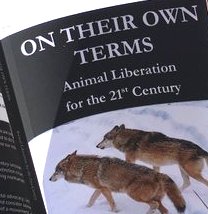
A New Animal Liberation: Why?

On Earth Day weekend 2016, the Cleveland Animal Rights Alliance invited me to the Cleveland Heights library to offer a presentation (public; free vegan pizza and homemade dishes) on Why We Need an Animal Liberation for the 21st Century.
So we focused on the subtitle and reasons to recharge the phrase animal liberation.

Discussions of rights so often veer into questions about who qualifies. We laud certain animals for demonstrating (often at great cost to the animals themselves) that they can decipher and respond to our cues, or adapt to our domestic environments, or act like us. Our assessments of what animals deserve can trap them again. As Catharine MacKinnon observed more than a decade ago, the model that “makes animals objects of rights in standard liberal moral terms—misses animals on their own terms.”

And lately I’ve beenKai and Candice leaning to liberation as our real objective: it evokes those living on nature’s terms, autonomous, free.
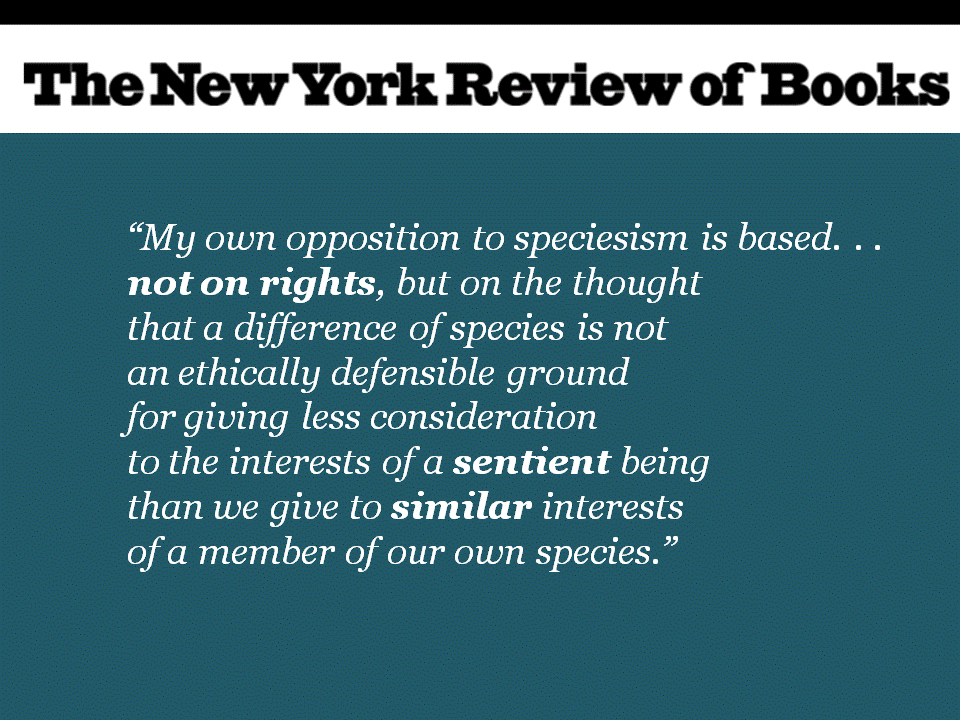
We can credit Peter Singer as a catalyst for a rising conversation, in the English-speaking world, of animals’ interests and human responsibility. Singer personally underscored this in the New York Review of Books three decades after having published Animal Liberation.

The thing is, the theme of Peter Singer’s 1975 book was not so much liberation as pain management.

Slide4

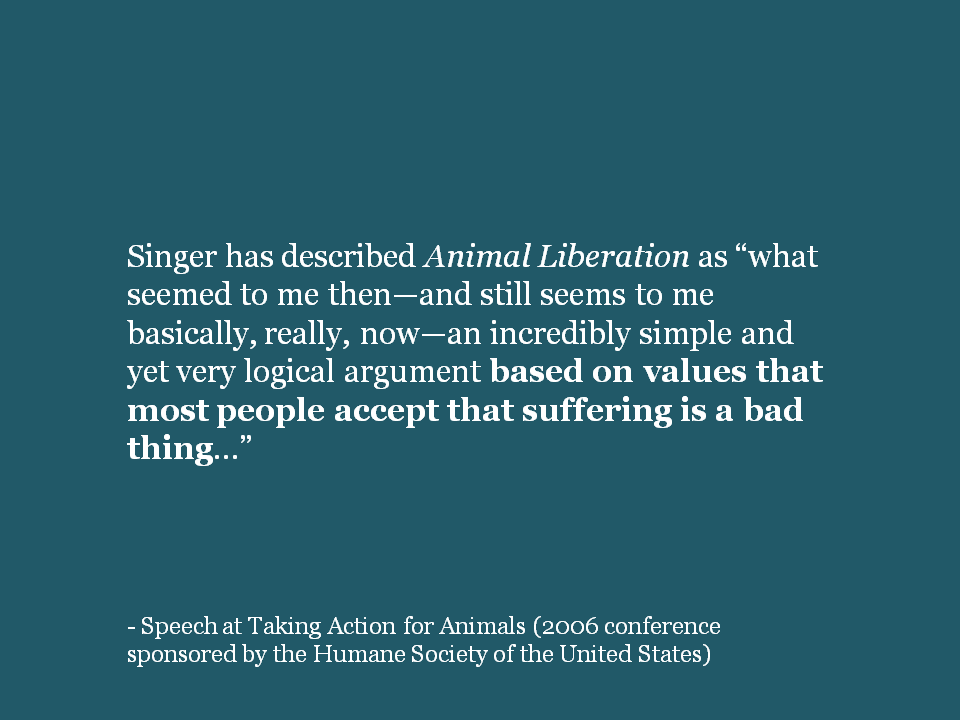
To Singer, Animal Liberation promotes a principle that most people already accept: we should minimize suffering. This became the keynote argument for the animal-rights advocacy that followed.

The next slide, quoting Singer at Taking Action for Animals (sponsored by the Humane Society of the United States, 2006), highlights a point of contention. While many advocates agreed with Singer’s opinion that pain sensitivity is what draws our ethical consideration, some wouldn’t wave off our role in their deaths this readily. Slide5

Many advocacy groups followed Singer, though, and never established precepts against killing. The Animal Legal Defense Fund wrote up a Bill of Rights for Animals that accepts killing though livestock must be stunned into unconsciousness prior to slaughter.

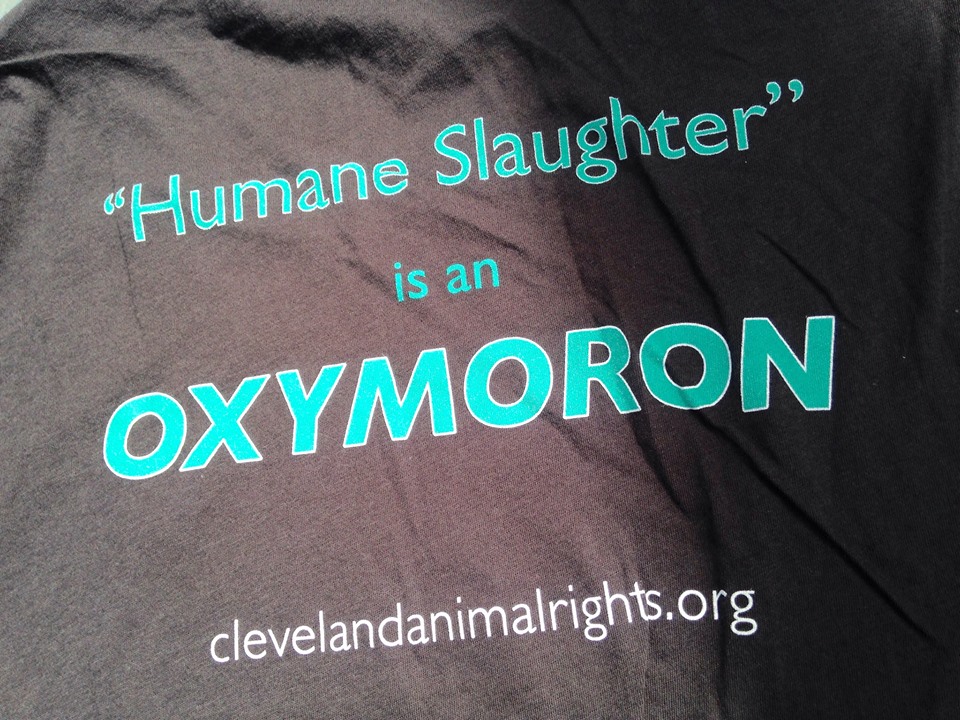
Humane slaughter is an oxymoron

Yes!

The idea that causing a conscious being’s death is allowable under the “liberation” banner is bizarre, yet taken for granted in a lot of advocacy. To this day, exposés don’t decry the killing so much as the way animals are killed.

Peter Singer’s “equal consideration” for nonhuman interests will essentially regard animals as containers of pain and pleasure. To cut down on the most suffering, the activist is urged to oppose glaring abuses in animal husbandry. Here’s the point as originally stated in Singer’s Animal Liberation:Slide6

To a large extent, even rights advocacy (while taking great pains to differentiate itself from Singer’s brand of utilitarianism) reflects Singer’s model.

Slide8

– Peter Singer. nybooks.com/articles/2003/05/15/animal-liberation-at-30/

Singer, who wrote Animal Liberation during a key decade for human equality movements, says equal consideration ought to be extended to nonhuman animals. But according to Singer this consideration will only the cover interests we deem similar to those we seek to protect for ourselves.

This might seem logical on its face, but I’m not convinced it’s a fair (or even relevant) way to judge the interests of other animals who have no need for our assessments.

Nautical Dogs and Sterile Deer

Animal-advocacy theorists have presented hypothetical emergencies to justify our preference for putting humans first. Picture a lifeboat that can’t carry an entire group of humans and a dog to safety. Who gets to stay in the boat?

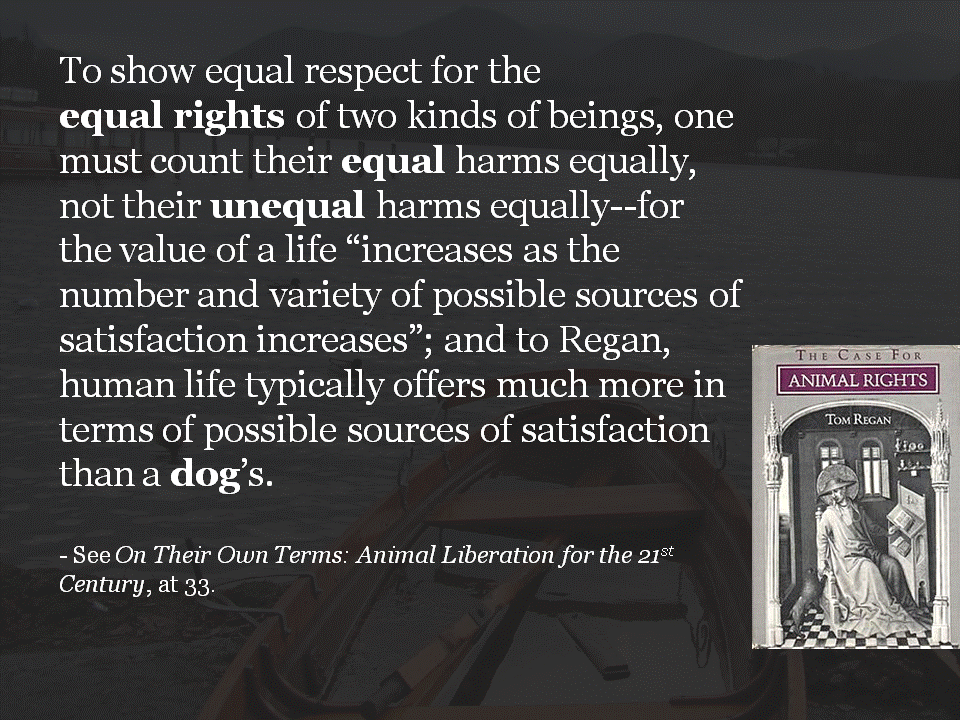
Tom Regan’s Case for Animal Rights came out in 1983. In Regan’s version, the dog loses. Regan assigns a human and dog equal moral significance: we all experience our lives. Yet Regan distinguishes the value of the lives lived by the humans and dog from the value of beings themselves. And then allows the sacrifice of any number of dogs to save the human. Slide10

This assertion was repeated quite recently by Gary L. Francione and Anna Charlton, who, in Eat Like You Care: An Examination of the Morality of Eating Animals (2013), say they “will not challenge these widely-shared moral intuitions” that “may tell us that in situations of genuine conflict between humans and animals, humans win. But our intuitions also tell us that in situations in which there is no conflict, we cannot inflict suffering on animals simply because we get enjoyment from doing so.”

Here’s the message the 21st century is sending to animal advocacy: There is hardly any uncontested space on this planet. There are more than seven billion of us, and everywhere, humans are “winning” while everyone else is disappearing.

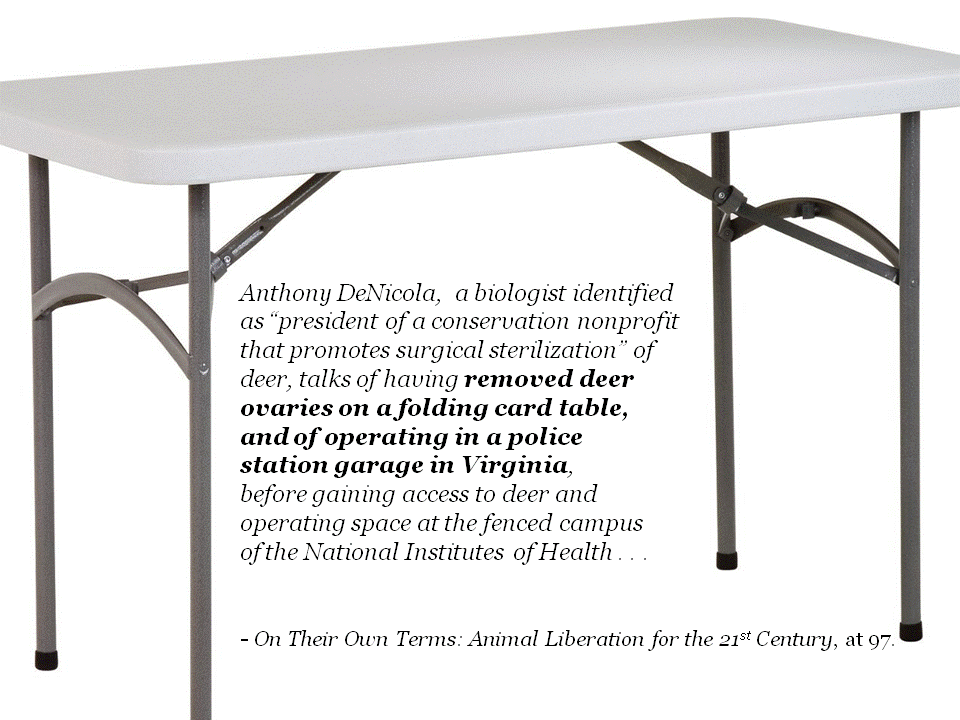
People now impose contraception on deer so we can CLE Leespread ourselves out without having to deal with the “conflict” of animals in our way. Or we oust untamed animals in the name of human rights. In India, a Tribal Rights Bill was introduced to redress discrimination by allocating land to several million indigenous forest-dwellers—while annihilating the region’s last few hundred tigers. Is erasure of tigers acceptable because the tigers would have had less possible sources of satisfaction than the indigenous people? Or does ethical decision-making require a thought process more complex than that?
Under new global climate patterns, lifeboat scenarios will happen a lot. Environmental crises are unfolding more quickly than could have been predicted when many animal-rights texts were written.

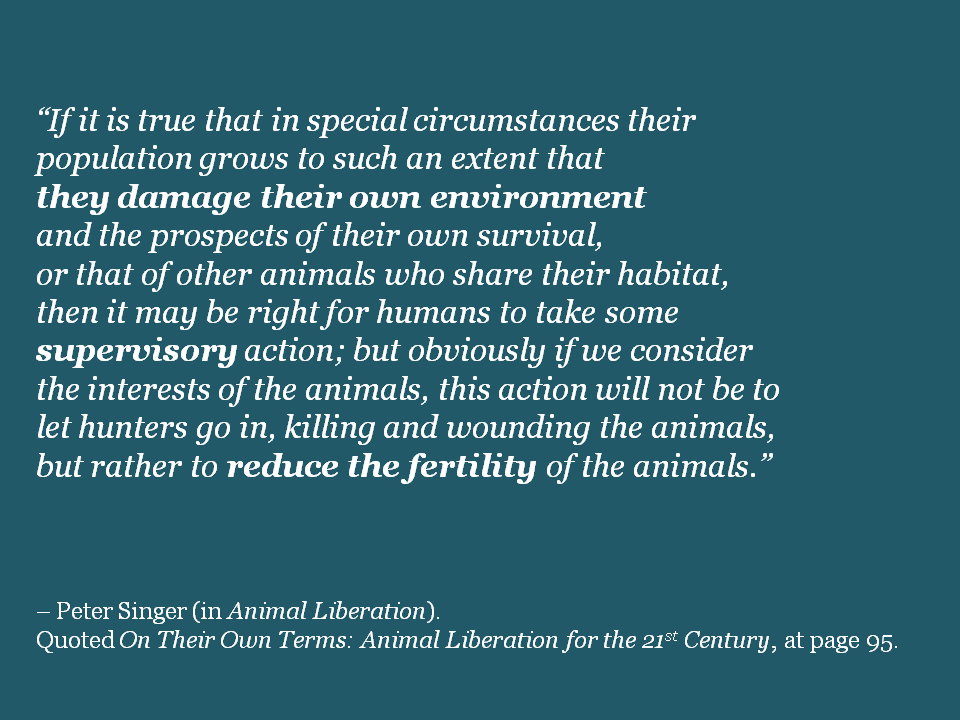
Chapter Nine of On Their Own Terms: Animal Liberation for the 21st Century reviews advocates’ agreement to control the fertility of free-living animals over the years. In 1975, Singer suggested that animals have an interest in our research and development of fertility control over free-living communities.Slide16

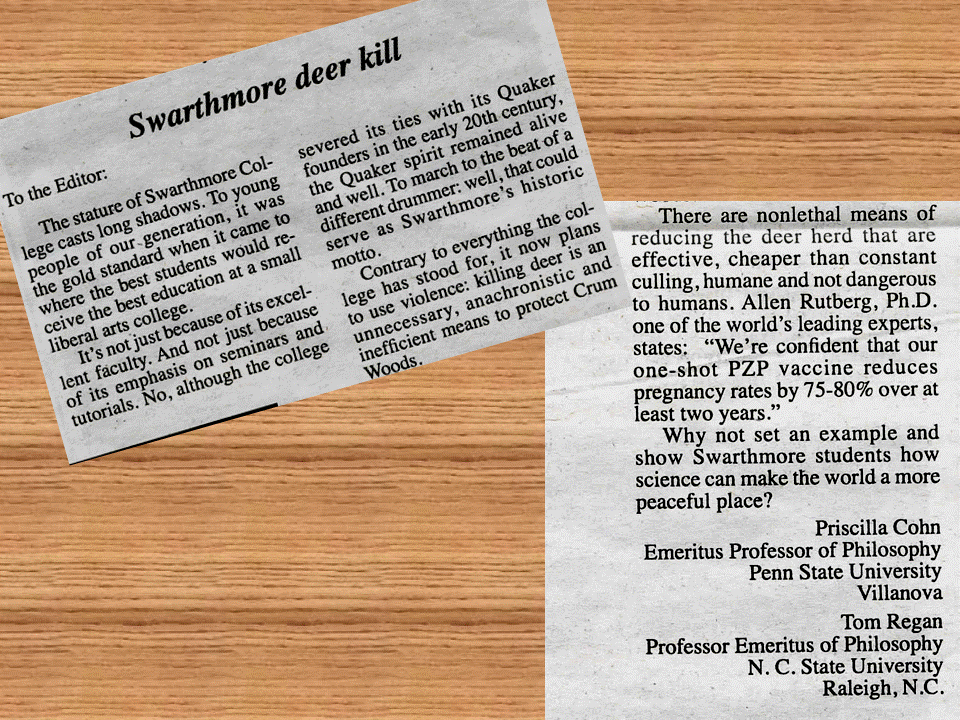
The assumption that free-living animals might wreck their environment and need us to step in as supervisors matches the claims of administrative officials ready to lower the boom on animals in woods, parks, and fragments of green space. In 2008, when deer were targeted near Swarthmore College in Pennsylvania, rights advocate Tom Regan accepted the premise that the local deer must be controlled, but argued that it should be done by pharmaceutical means. The contraceptive substance porcine zona pellucida (PZP), made from the membranes of pig ovaries, triggers the deer’s immune system, forcing the body to attack the deer’s own eggs.

Slide17

The Swarthmorean, 18 Dec. 2008

Regan’s position startled and disappointed me—for Regan’s book The Case for Animal Rights had urged: “With regard to wild animals, the general policy recommended by the rights view is: let them be!” But support for human-controlled reproduction in free-living communities had precedent in animal-rights legal work. In the 1990s, Gary Francione and Anna Charlton, on behalf of their Animal Law Project at Rutgers, explained their action on behalf of Pity Not Cruelty, Inc. to change deer-control policy in Montgomery County, Pennsylvania:

“We are assisting the plaintiffs in the Lower Merion challenge in the dissemination of information concerning non-lethal methods to decrease any deer/human conflicts, including the possible use of immunocontraception where the deer population can be verified to have increased considerably.”

This presents the deer’s very act of reproducing as a possible situation of true conflict. The stance ignores the obvious—balancing the deer population isn’t up to humans; it’s the role of native carnivores and omnivores.

Today, communities are demanding the systematic spaying of deer.

Slide20

A liberatory theory ought to call for the neutering of cats (TNR) or to prevent dogs from mating, they already lack the ability to reproduce and raise their young on their terms. Phasing out the breeding of animals as pets would, essentially, put wildcats and wolves off-limits to selective breeding to suit our whims. But contraception for free-living animals is animal control—nothing more, nothing less. Note the importance of distinguishing selectively bred animals from communities of animals who could actually experience autonomy, and shouldn’t be denied that opportunity.

I’ll let the next slide speak for itself.

Slide21

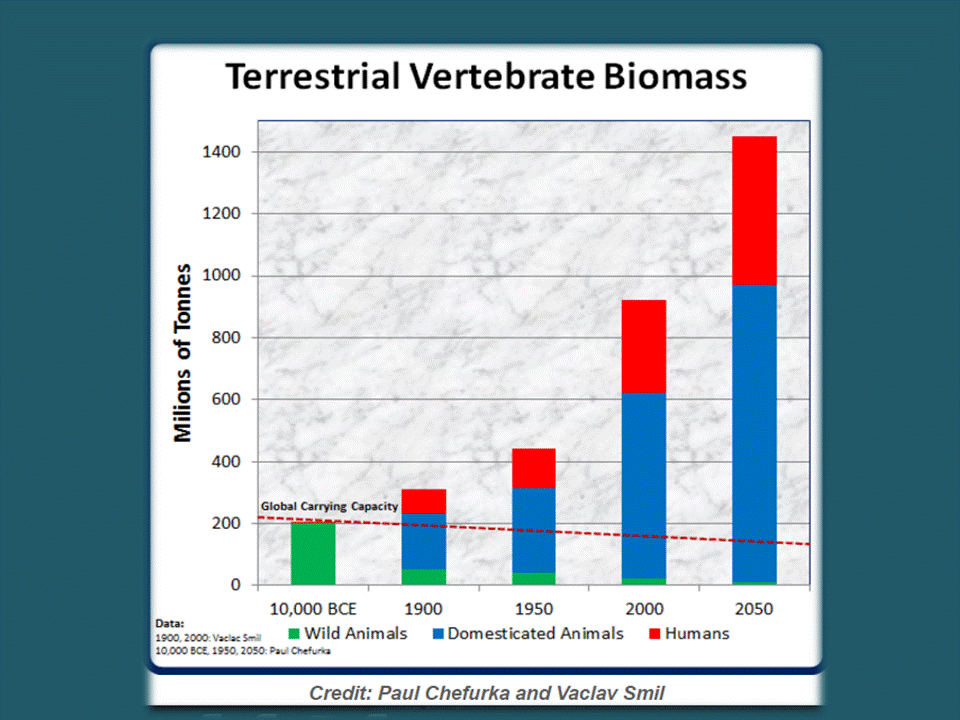
But for context, let’s talk about how much room we take up on this planet, thanks to some work made available by Californians for Population Stabilization.

Slide22Humanity’s mass (we’re the red bar segments in the next chart) has eclipsed the collective weight of all Earth’s free-living land mammals (green segments).
Slide24

Add to this the weight of our entourage of purpose-bred animals (blue segments).

Witness our expansion as we press the rest of Earth’s bio-community off the chart.

Can we so readily accept the claim of “too many of them”?

Shoppers gonna shop. Can we accept that some (really fancy) husbandry improvements support the liberation mission, sort of?

OK, let’s look at an e-mail I received from Whole Foods Market in London on 15 April 2016, just one week before Earth Day. Slide25It says…

“While organic dairy cows yield on average a third less than intensive production, the benefits of organic dairy are huge. In order for a dairy to achieve organic certification the herd must be pasture-grazed throughout the grazing season.”

The cows are on pastures (read: sprawl – and let’s explain it as such to our shopping friends), and they only “yield” a third of what densely confined cows produce. So, if all the cow’s milk shoppers switched to organic, they’d effectively demand three times as many cows? Look at these cows.

The next slide joins the two above advocacy positions: (a) constricting the populations of free-living animals, and (b) allocating more space to animal husbandry. Both positions, and certainly the two combined, support human claims to habitat and, in turn, the disappearing of the untamed.

Slide27

Both campaigns arguably advance ye olde humane-treatment principle “based on values that most people accept” but neither supports true animal welfare. The vegan response to these campaigns is non-participation. (That doesn’t mean doing nothing! We need to give our active support both to vegan-organic farming and predator coexistence initiatives.)

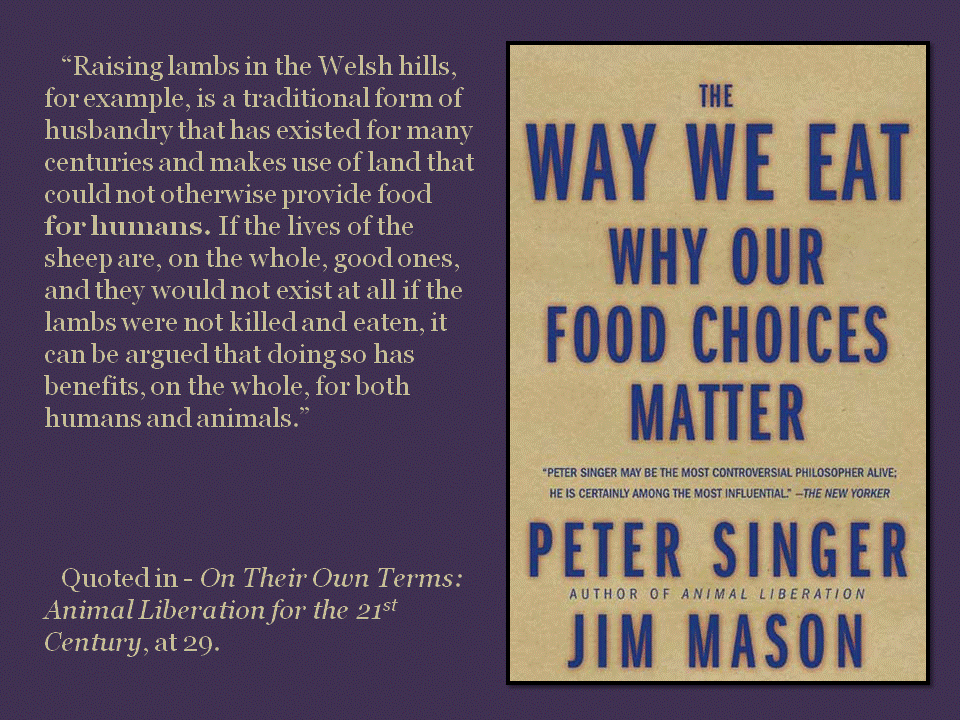
Slide31Peter Singer and Jim Mason, in The Way We Eat: Why Our Food Choices Matter, suggest animal husbandry could be a beneficial system for the animals involved. Hogwash. The hills were the habitat of wolves and wildcats before we came in with our animal husbandry.

As for an incremental step on the way to rights for animals, let’s be clear: no improvement in the conditions for purpose-bred animals cuts the mustard. The more connected to nature the farm is, the more reasons for the farm owner to set traps or call the “nuisance control” professionals.

Free-living animals lose where they’re overlapped by controlled ones, as the owners continually introduce problems into habitats.

Slide34

No authentic rights await purpose-bred animals; the concept is an absurdity we can accept only as long as we accept purpose-breeding.

Cultivating Active Respect

One rights scholar has said: “If we are going to make good on our claim to take animal interests seriously, then we have no choice but to accord animals one right: the right not to be treated as our property.” Will this resolve all the problems?

Slide36

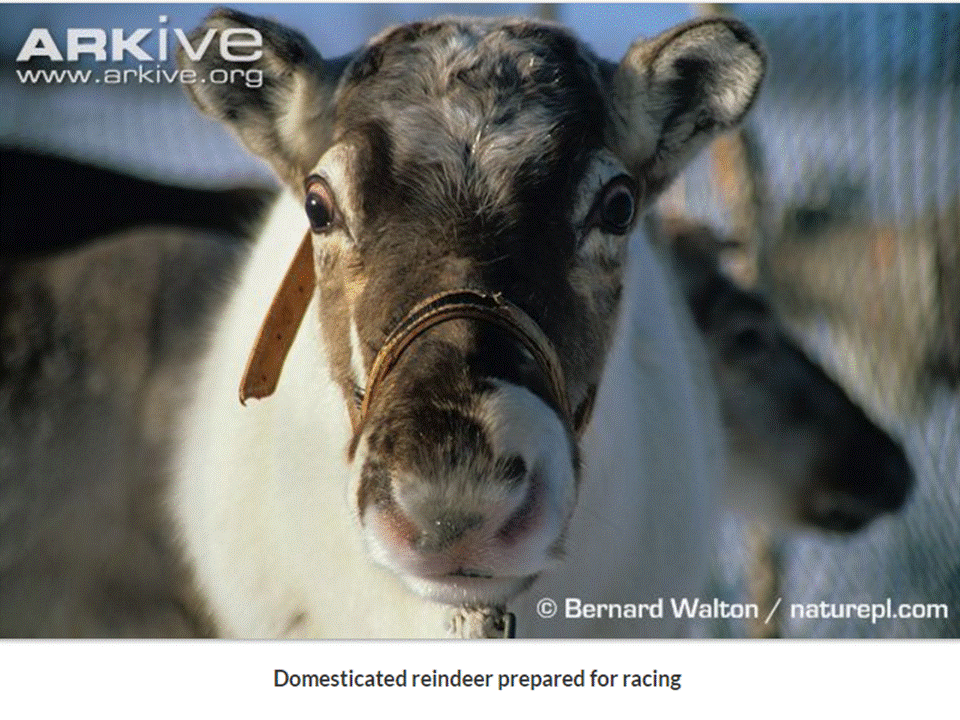
Reindeer were domesticated back in 14000 BC; dogs were bred from wolves about 13000 BC—long before modern conceptions of rights and property.

Because domination is a deeper, broader problem than property status, we’d best think of abolitionism—the call to stop treating animals as commodities—as a component of animal liberation. We’ve got to get over our practice of warring against other beings, displacing them, hijacking their reproduction and demolishing their spaces. Authentic animal-liberation theory conceives of affirmative action to facilitate animals’ flourishing on their own terms. This means cultivating active respect for animals’ connections with their own communities, for their interests in the climate, in the land, water, and air they require to experience freedom.

Slide37And while the interest in shifting other animals’ legal status from property to person is worthwhile, the outcome will be limited if we base our claims on their remarkable abilities to adapt to human environments. Or if we focus on pain control. Slide38
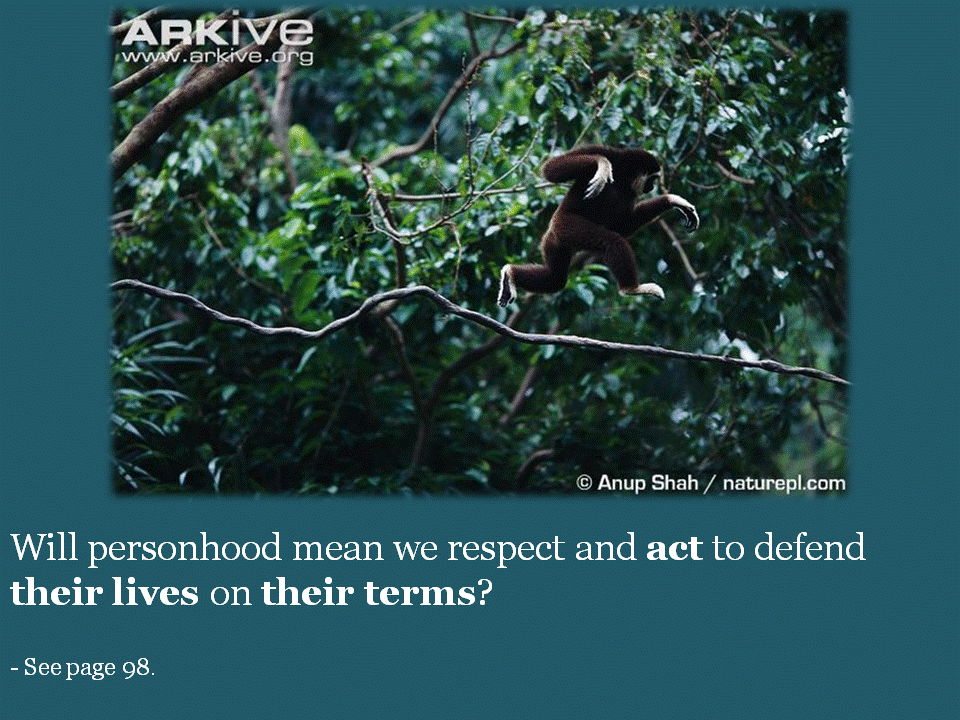
The argument for nonhuman personhood, in the 21st century, will defend the life experiences for which animals themselves evolved, free from our assessments or supervision.
CLE convenors

Thank you . . .

to Cleveland’s vegan community for encouraging this exploration of our movement and the writing of the book itself. Having a launch date helped to move the new work from a computer file to a book! Bill, thank you for choosing the graph slide and explaining its elements during the presentation. Thanks to all our animal writers, including those not mentioned and those critiqued here, for their contributions to the advocacy dialogue. This writing is not an attempt to compete or compare. It’s intended, in the vegan spirit of collective progress, to help refine our wayfinding, knowing that involves dynamic and sometimes knotty discussions.


Photos of the Earth Day Celebration and book launch in Cleveland Heights courtesy of the Cleveland Animal Rights Alliance. THANKS TO ARKIVE.ORG FOR OFFERING A HUB FOR PHOTOgraphers of animals in Habitat, and encouraging the sharing of these images. Encampments meme: Tiffany Warner on PINTEREST, Pinned from KnowYourMeme.Com

New Book on Animal Liberation Now Available

I’m pleased to report that On Their Own Terms: Animal Liberation for the 21st Century is now available. 

UPDATED LINK: Here is a summary and audio files.

Carolyn Bailey of AR Zone has called it “one of the most important books on animal activism for a long time” (cheers, Carolyn!) and I hope friends at Vegan Place will find it worth your valuable time.

Let me know what you think. Love & liberation,

Lee.

Coming Soon…New Book on Animal Liberation

Readers of VeganPlace and my fellow bloggers will, I hope, be excited to know that I’m making a debut as an “indie” by way of Kindle Direct Publishing. The new work, for which VeganPlace will become a discussion platform, is just days away from publication. This week, I’ll announce the Kindle link, price, and so forth. It might be free for the first five days, and in any case it will be under a tenner.

And COVER jpg fileI’d love for you to read it and review it. Writing a review will be the single most helpful thing you can do to support this work, beyond reading it. Keep in mind that this is a book by an indie vegan author, not an e-pub ninja; so don’t expect technical perfection on the first go. The e-publication phase has been much more difficult than I’d expected. The information technology-loving Cathy Burt has stepped up at the eleventh hour to work out a few glitches, although, given our time limitations, a paragon of production is not a reasonable goal. We’re learning as we go.

As for the substance, you might well ask what makes this new book worth your time. I believe the concept of animal liberation has never been more relevant, but…that concept is due for renovation. On Their Own Terms: Animal Liberation for the 21st Century updates the idea of animal liberation, as it explores the hits and misses of animal-rights and environmental advocacy, and presents a brief guide to the burgeoning vegan movement.

And why would I say a new animal-liberation philosophy is so important? Look at the way world leaders are now reacting to weather and climate dynamics. Finally they are reacting, but that’s basically to figure out how we can keep doing what we’ve been doing in supposedly “sustainable” ways. Until we redefine our role within Earth’s great biological community, the changes we find ourselves forced to accept will mean coping with one emergency after another.

Animal liberation should come to the fore during discussions of “sustainable” gatherings and products. Promoters of sustainable animal agribusiness or sustainable meals made with local vegetables and flesh of pigs, cows, or fish purchased from small farms or local waters don’t usually want to talk about animal liberation. It is important to meet these organizers where they are: to acknowledge their concern about a topic of great importance, and then to direct their attention to the question of whether their unspoken ethic of human dominion is sustainable.

On Their Own Terms: Animal Liberation for the 21st Century offers ways of uncovering our personal connections with the current climate and extinction crises. It explores the human potential to fit our own habitat, while allowing nonhuman communities to thrive in theirs.

Consider that a transformation of our human identity will spare us, and every other biological community on Earth, from enduring an endless string of gradually or abruptly worsening emergencies whose roots we fail to address. Consider, if you will, relinquishing the human assumption that the Earth is ours…


“I believe Lee Hall is one of the most interesting and insightful writers working in animal rights. This book gets all the thumbs-up.”

— Jonathan Hussain, rescuer and campaigner, Grass Valley, California

“In On Their Own Terms: Animal Liberation for the 21st Century, Lee Hall reclaims the concepts of animal liberation, animal rights and animal welfare, and compels us to reimagine what it means to be an animal activist.”

— Sangamithra Iyer, Satya Magazine

Our Privilege to Look

A link going around Facebook is asking:

Should animal advocates use graphic images of animals suffering or cute pictures of happy animals to get their message across? What simple techniques make people twice as likely to donate money or volunteer their time to help animals?

And come to  think about it, that’s mainly what one sees in animal advocacy: graphic images of animals suffering or cute pictures of happy animals.

Meanwhile, in real life, animals are doing much more than suffering and being cute. In their countless and varied communities, they lead lives of infinite richness.

Consider the “simple techniques” question, posed by someone in another area of social justice. By way of illustration, imagine someone in an immigration advocacy group asking:

Should refugee advocates use graphic images of refugees suffering or cute pictures of happy refugees to get their message across? What simple techniques make people twice as likely to donate money or volunteer their time to help refugees?

When I worked in migrant advocacy, I noticed a photo of the same emaciated child and mother on various fundraising websites. Refugees and asylum-seekers live and move in many roles. They might be homeless; they might be teaching international law. How do they feel when seeing refugees portrayed over and over as mouths to feed, while the fundraising campaigners who use the images have no idea what their lives are like or what their talents are?

Maybe the child and mother whose faces keep appearing, if they are alive somewhere today, are highly skilled people; in any case, these refugees are more than their victimhood.

I’ll get back to the “cute pictures of happy animals” in a later post. But real quick: For an advocacy group or sanctuary to depend on baby-faced animals to solicit funds parallels the conduct of zoos. Circuses, commercials and comedy hours often show chimpanzees smiling, though the smile on the chimpanzee’s face is a signal of fear. Pandas’ big eyes are there not to attract human caregivers; rather, as George B. Schaller writes:

The eye patches enlarge the panda’s small, dark eyes tenfold, making the stare more potent. In addition, a staring panda often holds its neck low, a position that not only presents the eye patches to an opponent but also outlines the black ears against the white neck, in effect presenting two pairs of threatening eyes. Conversely, to show lack of aggressive intent, a panda averts its head, covers the eye patches with its paws, or hides its face…

In other words, pictures that signal vulnerability, whether intended to raise funds or to move people to join a campaign, may inadvertently defy reality and respect for beings, or whole groups of beings, who are represented as helpless, perpetually needing rescue.

MasksThe “simple techniques” for drawing donors and supporters involve short-cutting: The animal advocate who uses shocking pictures and employs emotional words that require no thought (a high percentage of alerts include “cruel” or “horrific” or “barbaric”) can get by with limited understanding of ethical, environmental or political issues. That can be convenient when membership drives, a petition full of signatures, or fundraising take over as goals. It can also fail to respect the audience, and fail to accord genuine respect for the individual or population with interests at stake.

Even the gentlest, most painstaking and studious advocacy films interpret others’ lives through the camera’s lens. Often, the photographer or videographer was a passive witness to a harrowing event, infusing a disturbing element to the very process of obtaining the imagery.

Watching animals is normal for us. We were carefully and frequently taught as children to regard other animals as spectacles. So it takes a conscious awareness to question our privilege to look, and our prerogative to do what we like with the images.

image source

Is a Vegan Humanity Possible?

Life on Earth is getting stranger. When the vegans started out in 1944, they noticed that our population, even then, weighed heavily on the planet. In seventy years, we’ve gone from two to seven billion human beings, with the number of animals bred into existence to feed many of these people—the land animals alone!—numbering in the many tens of billions.

The easy thing to do is be pragmatic and figure other animals are losing their habitat forever as fast as we can grab it, that we are incorrigible domesticators, and that life is everywhere commodified, so the best we can do, given that other animals are always going to be in some sort of relationship with us, is to be as easy as possible on all the other animals we control.

And yet I feel sure a world with room for animal rights is a world that’s still possible. Our dominion will be overthrown at some point anyway. Should we exhaust our planet, the force of life will rearrange itself accordingly.

The question for us, then, is whether we want to swim with the tide—with conscious awareness. Whether we grasp that we—scared little primates with big weapons, as Harold Brown has called us—are not in charge of this planet; whether we acknowledge that our lives unfold within a bio-community; whether we value, and will strive to increase, our capacity to respect other communities on this Earth.

Animal law generally misses these questions. It’s become part of North American social and educational life, with the model often involving pressure for courts to recognize, as animal law professors tend to put it, other animals’ true value and special place in our homes. But to me the radical hope was expressed when law professor Catharine MacKinnon (in the 2004 essay “Of Mice and Men: A Feminist Fragment on Animal Rights”) called for a new way of understanding animal advocacy, observing that the primary model of animal rights to date “misses animals on their own terms.”

Vegans have risen to the occasion and refused to be consumers of animal commodities. This general opting-out is the broad base for dissolving the for-sale status of other animals, and (because being vegan isn’t just about what we don’t want) letting them thrive on their own terms in untamed spaces.

Consider the free-roaming horses. They, at least in the United States, are continually rounded up and auctioned off. Some have been trained as border guards, others for display in circus-like shows. Some have been sent to die. Many animal advocates are focused on closing horse-slaughtering plants. From the vegan perspective, confronting slaughter makes sense—but only as part of a broader, autonomy-seeking perspective.

Nor is the answer to impose birth control on free-roaming horses while cattle ranches expand.

There is a law—the Wild Free-Roaming Horses and Burros Act of 1971—that set out to let free-roaming horses and burros do just that: roam free. It hasn’t worked out. What horse advocates need, I believe, is to link to a vegan ethic: the permanent boycott of flesh and dairy products so animal agribusiness doesn’t push these horses and burros off the land.

An enormous segment of the human economy is based on taking habitat out from under other animals, yet each one of us has the power to change this structure. What’s more, we all know and constantly encounter other people with this same potential. People can and do respond to reasoned optimism.

May we stay mindful of the ideal and strive for it, so that wolves, coyotes, horses, bison, deer, elk and moose may freely roam their habitats. So that bears flourish, bees flourish, and horses live freely on Chincoteague, Assateague, the western ranges…Nova Scotia and the Nemaiah Valley. So that no one is calling for roundups, because the products of cattle ranching are no longer in demand. So that jaguars, pronghorn, and nectar bats, humans as well, have the right to move across the face of the earth. So that Earth’s CO₂ balance is restored, its wildlands are recovering, its air and its waters are clean and clear. So that pesticides are things of the past and the only lethal traps, snares, birdcages, guns, fishing poles and spurs left in the world are in antique stores.

Love and liberation,

Lee.