Climate and Vegetarian Summerfest 2016

On Thursday 7 July in Johnstown, Pennsylvania, I’ll be offering a talk named Climate Change: How the Public Conversation Is Shifting and How Vegetarian Voices Can Be Heard. (The North American Vegetarian Society presentation summary includes a description: “This session will provide updates on farming and climate, and also involve some easy, memorable, and valid points to raise—whether in ordinary conversations or at the policy level. Attorney Lee Hall holds a specialist’s degree in environmental law with a focus on climate change, and will facilitate discussion, including new findings and vital points not raised in most discussions of climate and diet.”)

Some VeganPlace readers might ask: Wait—vegetarian voices should be heard? Don’t vegetarians consume cow products, which are obviously connected to methane and general climate-wrecking?

No. Real vegetarians don’t eat dairy. The ovo-lacto take on vegetarianism has been ruled out by the North American Vegetarian Society for twenty years. The five-day menu at Summerfest is not ovo-lacto-; it’s pure vegetarian. Sometimes vegans rail against the shortfalls of vegetarians, but in my opinion the vegan movement needs to tip its hat to vegetarians taking their mission seriously. Respect to NAVS for encouraging its membership to strive for an authentic vegetarianism and to learn why animal agribusiness is not climate-friendly.

And now, yes, the public conversation about climate change has shifted. It has to. We’re not stronger than the climate system. It’s having the last word in every debate. No lifestyle, no matter how rich or famous, is exempt.

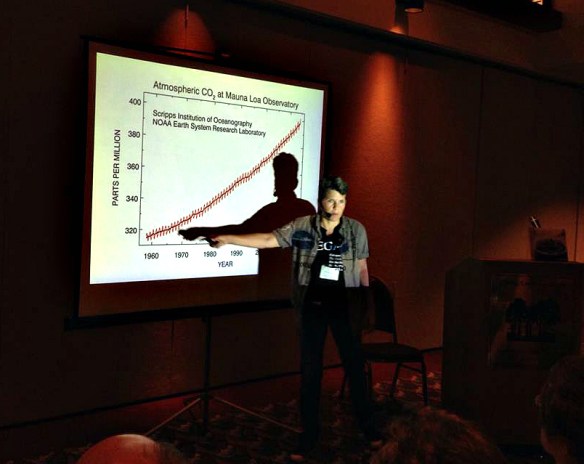
Nor is any place on Earth untouched; we now know that levels of Antarctic CO2 have reached 400 parts per million. For the first time in 4 million years.

The roadways on which we burn so much fossil-fuel energy seem to be bucking us off.

And yet a poll six months ago showed half of U.S. society thinking climate change isn’t a very serious problem.
2014-summerfest-patreon-cropNothing could be more serious. Everything depends on climate. Plants are losing the conditions that support them. By 2100, some tropical regions are predicted to have 200 fewer growing days a year. Let that sink in.

And then think about what is happening to untamed animal communities when native plants stop growing where they live.

We keep on releasing stored carbon dioxide (by burning oil and gas) and disrupting Earth’s capacity to store it (by cutting down trees). We’re releasing methane into the atmosphere from our landfills, through fracking, and from domesticated animals, mostly cows. We’re polluting the atmosphere with nitrous oxide through our use of manure too.

And getting our proteins though animals raises costs. If your shopping bag is loaded with flesh products, including the bodies of marine animals, your receipt total is going to come out pretty high, compared to that of the shopper with a bag full of horseradish hummus, red and green cabbage, red pepper and ciabatta, sweet potatoes, etc. When we use cows, pigs, goats, rabbits, birds and other animals to funnel our protein through, we are not advancing culture so much as advancing business. I will use the term animal agribusiness when talking about animal farming and its attendant feed industries, and reserve the word agriculture for the growers who produce food.

Free-range is really another form of sprawl

It’s been ten years since the United Nations published Livestock’s Long Shadow, explaining the enormity of damage done through animal agribusiness. But the U.N. never suggested we stop farming animals or consuming the products (which many of us could do overnight). Its key recommendation? Greater intensification. In other words, consolidate and contain animals into high-volume operations. In situations of intense confinement, animals (along with their emissions and waste) can be more strictly contained; and with animals not moving as much, less feed is consumed.

What we learn from environmental science does not lead us to support any of this:Slide44
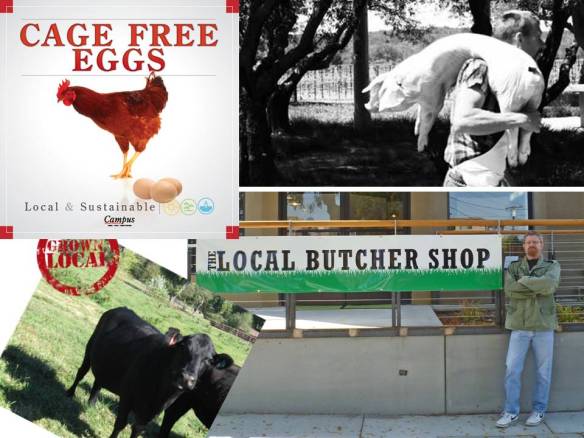
The above scenes are evidence of a spreading-out of the environmental problems we need to move beyond.

And the warmer the planet gets, the more intensively animals will be raised, for reasons such as temperature control. Overheated dairy cows aren’t efficient producers of milk. When the Union of Concerned Scientists, in their booklet Climate Change in Pennsylvania: Impacts and Solutions for the Keystone State, say that cows are going to need fans and water sprays to cool them as the hot days multiply (cows drink four times as much liquid as they produce in summertime), they too are indicating that factory-style farming is the way of the future. (Look at page 8 in this PDF.)

Nowadays it’s popular to say that “factory farming” is inhumane. Yet we have environmental scientists communicating some important realities about how “cage-free” systems just spread the emissions around and use up more feed to raise roaming animals. With animal agribusiness, you can’t win.

A better recommendation comes Vegan Environmental Party of Ontario when it calls on the government to divest from animal agribusiness by halting the subsidies.

Consider that we reserve about 20 million acres of land for alfalfa alone. (And it must be irrigated.) Virtually all of it is used as feed.

That is in addition to the imposition of the domesticated animals themselves on the land. We need not continue this overbearing way of living on our planet.

For reasons that are many and interconnected, we need to be creating animal-free meals. Seekers of pure vegetarian cuisine miss nothing and conserve so much.

Make reservations at Vedge in Philadelphia or Plant in Asheville if you want to go gourmet. Most cities now have such offerings. Want to learn to prepare food like a pro in your own kitchen? You can learn. Try a subscription to a home delivery service with recipes and instructions from a professional chef such as Trish Sebben-Krupka at VegTable.

“But I just eat fish!”

That’s another sector of animal agribusiness, and not a sustainable one. The people at Greenpeace say “sustainable seafood” is within reach. They want us to demand better labels on the bodies of marine animals in the grocery aisle so we can tell if codfish are being scraped off the Norwegian Arctic seafloor with massive trawlers. Why do they take this position when they could do better? If we can afford to get food from a grocery store, we can get pure vegetarian food and make it great. And for the climate’s sake, we should.

The personal and political 

Recently a study was published in the journal Climatic Change involving 60,000 “meat-eaters, fish-eaters, vegetarians, and vegans” in Britain. Remarkably, the study found dietary greenhouse gas emissions from the participating omnivores about twice as high as those from vegans. If we have the power to bring our emissions down so low, but we decline to use it, aren’t we committing malpractice as human beings?

By being vegan we can also alleviate social stress. The 2007-2010 Syrian drought, which forced rural people to move in droves to urban areas, culminating in one of the most severe conflicts of today, for example, was driven by climate factors.

What’s to come? We all know, if we read the papers, that 2016 has already shown record global temperatures, month after month after month. The New York Times offers regular reports on this, accompanied by  simplistic, incomplete advice. The Times acknowledges that the problem is complex and can feel overwhelming: “We get it.” 

But they don’t.

They mention “reducing meat” as one item in a list of things to do. They do point to animal agribusiness as the worst segment of agribusiness for the climate. The science would back the Times up on that one.  Slide36
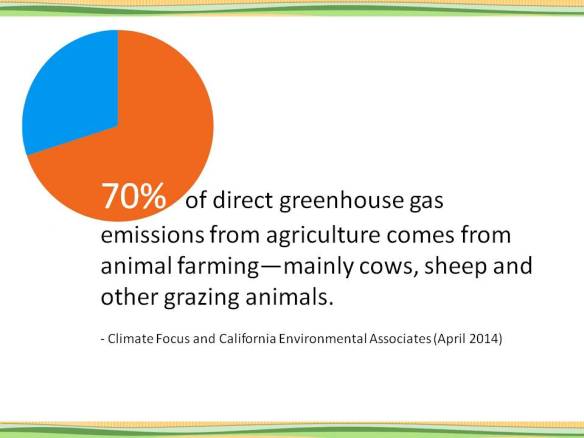
The Times tells us in particular that “some methods of cattle production” demand a lot of land. Now, wait. “Some”? All of it does, and all cows create manure and methane, whether out on the range or within walls.

The Times urges “switching from beef to pork and chicken” and suggests that chicken farming is the least harmful kind.

Let’s not even get into the harmful health ramifications of the “eat pork” advice. Pig manure is still manure and what the world needs now isn’t more of it. And you don’t help the climate even by buying local eggs and chicken or pig flesh. To do so means you’re really relying on a massive feed industry—a serious fuel guzzler. “Local” animal farming isn’t local—because animal feed is routinely shipped many miles for mixing and packaging, and shipped again in distribution.

The huge feed requirements arise in fish farming too. Farmed fish really are “chickens of the sea”; aquaculture is tied into the global grain and feed market and it’s expected to double in size by 2050. Why contribute to that?

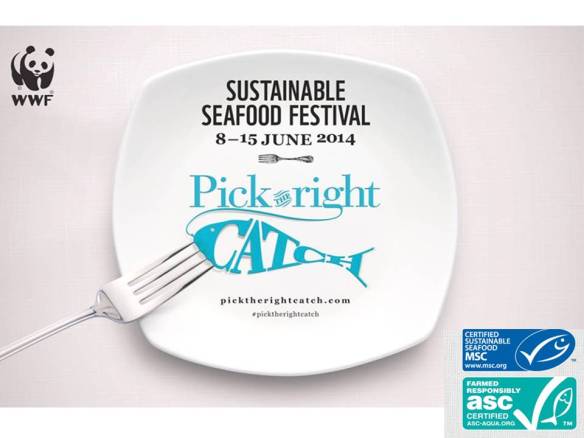
Instead, groups such as WWF should be funding vegan festivals.
Slide40


WWF’s so-called sustainable seafood standards are pressing small, family businesses, which once used by-products as feed, to enter the global feed market.

Before the pressure to adopt environmental standards like those of WWF’s Aquaculture Stewardship Council, catfish farmers used home-made feeds that included farm by-products. No more. Now the local farmers of the world have to vie for the labels that the affluent populations want to see in the grocery store.

Slide42Is it the height of irony that WWF would expose the “hidden soy” in animal products after pushing this same market?

People listen to the WWF and the New York Times when what they really need is no-nonsense information, and a key part of that information needs to come from those of us who’ve already divested from animal agribusiness in our own lives and can help others to do it.

This is not to say that being vegan is all we need to do. I’m starting to notice a lot of people picking out one kind of change that they like and claiming it as their part. I’ve heard people who bring their own bags back to the supermarket overstate the goodness of this good deed by claiming to be “saving the world, one bag at a time” (regardless of what products are in their re-used bags). Vegans need to be careful that we don’t fall into the trap of thinking we’re doing so much by being vegan that we ourselves needn’t make deep changes in our mindsets and actions.

I’ll also talk about the influence of religious doctrine and of education on people’s attitudes and understanding of climate change. I expect a lot of informed comments and feedback at Summerfest on Thursday the 7th. Join us in the Scholar’s Room if you can.

Meanwhile I’d like to conclude with a thought question. Should we use “the war on” language when we talk about climate? This language is meant to indicate a serious approach to climate change, which of course is well past due.

Slide50

But are we really in combat?

And should we be “arming” ourselves against the hordes of invaders coming in when climatic zones shift because of our own conduct?

Is warring against a natural system’s response to overload what we need to be doing? Is this the best mindset for the work we must do to put ourselves in good stead with our planet?

Let’s talk about this.

Orlando

Yes, I’m in. Let’s put an end to non-military availability of military-style weapons.

And what of the military use of military-style weapons?

And the use of weapons for terrorizing the other animals in our midst?

How about we put an end to heterosexism, domestic violence, rape culture, hatred against queers or anything perceived as queer? Could we stop requiring everyone to mark “female” or “male” boxes, in light of the way this binary has so long negated the relationships of, and otherwise obstructed, so many people in so many times and places, even resulting in medically prescribed physical harm? Female and male are not absolute categories, and the binary fails a humanity striving to be all we’re meant to be.

How about we make solid efforts to show respect for Latinx, for the LGBTQIA movement, for Muslim communities, for non-citizens?

Consider that we needn’t identify ourselves in terms of nationality, and thus needn’t be involved in a constant reconstitution of enemies which this social construct generates. That we could transcend bordered societies.

And how about we cut out bullying, and teaching bullying at home? How about we rid our everyday, continuing history of the classism that systematically denies creative self-expression to the majority of people?

How about we refuse to accept captivity and habituation of other animal communities as a human prerogative?

How about we respect everyone’s interest in living their way, unmolested, expressing themselves creatively as they were meant to do, and support them in doing it?

How about we stop investing in win-lose scenarios and essentially meaningless competitions and quests for social prestige at the expense of lives of genuine collaboration? Let’s try a little tenderness before we cook the Earth’s biosphere to a crisp, shall we?

Without human decency and mutual support, and empathy for each other and a sense of connection with all consciousness, how can we ever transcend the “I’ve got mine” mentality to save what we love, even love itself?

And right this moment: Listen. You don’t threaten, as Hillary did, to “ramp up” military strikes against a place, a community (even as The Donald seized the moment to emit yet another rant against human migration), because someone’s home-grown soul in Orlando, Florida was so unhinged as to turn a safe space for queer people into their death trap.

Listen. You don’t get to use an attack on queer people to threaten violence on some other community. You don’t exploit the hurting of people who have taken down gender-based social walls in order to fortify your nation-based ones. Enough blood has flowed.

The green stripe in the rainbow flag means nature. The use of military weapons on so-called foreign nations destroys safe spaces for someone’s children, for other conscious beings, and for the biosphere that’s home to all.  Disrespect that biosphere, and you disrespect an integral element of the pride movement.

Red stands for life, orange for healing. Yellow stands for sunlight. Blue is for harmony. Purple, for spirit.

The banner of nation-based bullying can’t hold a candle to this.

All the World’s a Stage: Thoughts on the Death of Harambe, the Cincinnati Zoo Gorilla

A gorilla named Harambe has been shot and killed.

And just as Blackfish—the film exposing everything wrong with using orcas for human observation and fun—reverberates beyond SeaWorld and challenges the existence of aquaria generally, so will Harambe force the public to rethink gorillas wherever we look at them. Harambe’s life, we now must note, was marked by isolation from this gorilla’s own parents, and by alienation, transit and objectification.

And like the great killer whales, a zoo gorilla, alive or dead, has lost a lifetime, missing everything that makes a free life possible…

Read more here . . .


Photo offered through Creative Commons for non-commercial use; original image by Frank Wouters on Flickr: link.

A New Animal Liberation: Why?

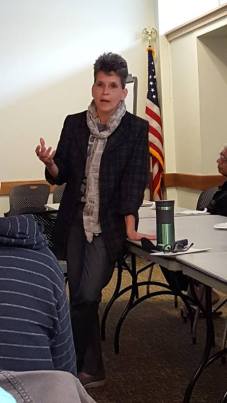
On Earth Day weekend 2016, the Cleveland Animal Rights Alliance invited me to the Cleveland Heights library to offer a presentation (public; free vegan pizza and homemade dishes) on Why We Need an Animal Liberation for the 21st Century.
So we focused on the subtitle and reasons to recharge the phrase animal liberation.

Discussions of rights so often veer into questions about who qualifies. We laud certain animals for demonstrating (often at great cost to the animals themselves) that they can decipher and respond to our cues, or adapt to our domestic environments, or act like us. Our assessments of what animals deserve can trap them again. As Catharine MacKinnon observed more than a decade ago, the model that “makes animals objects of rights in standard liberal moral terms—misses animals on their own terms.”

And lately I’ve beenKai and Candice leaning to liberation as our real objective: it evokes those living on nature’s terms, autonomous, free.
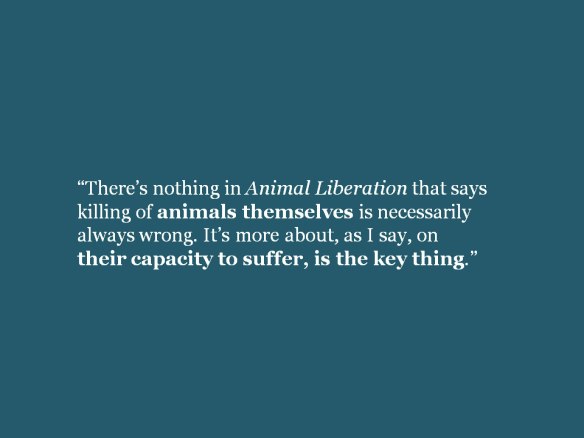
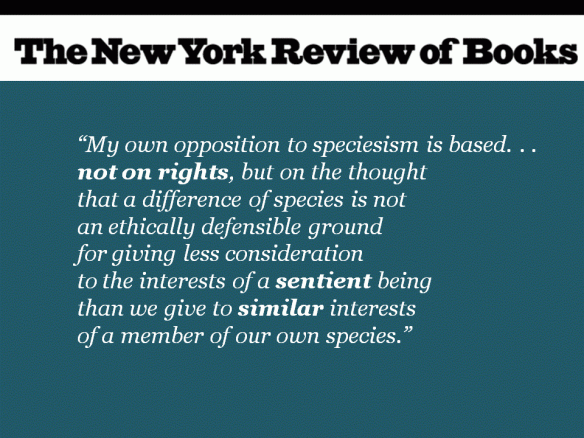
We can credit Peter Singer as a catalyst for a rising conversation, in the English-speaking world, of animals’ interests and human responsibility. Singer personally underscored this in the New York Review of Books three decades after having published Animal Liberation.

The thing is, the theme of Peter Singer’s 1975 book was not so much liberation as pain management.

Slide4

To Singer, Animal Liberation promotes a principle that most people already accept: we should minimize suffering. This became the keynote argument for the animal-rights advocacy that followed.

The next slide, quoting Singer at Taking Action for Animals (sponsored by the Humane Society of the United States, 2006), highlights a point of contention. While many advocates agreed with Singer’s opinion that pain sensitivity is what draws our ethical consideration, some wouldn’t wave off our role in their deaths this readily. Slide5

Many advocacy groups followed Singer, though, and never established precepts against killing. The Animal Legal Defense Fund wrote up a Bill of Rights for Animals that accepts killing though livestock must be stunned into unconsciousness prior to slaughter.

Humane slaughter is an oxymoron

Yes!

The idea that causing a conscious being’s death is allowable under the “liberation” banner is bizarre, yet taken for granted in a lot of advocacy. To this day, exposés don’t decry the killing so much as the way animals are killed.

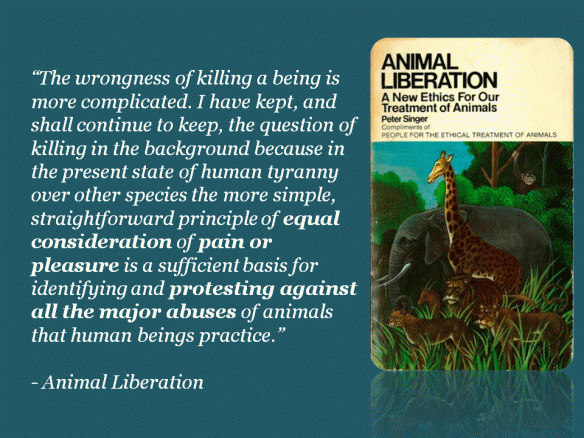
Peter Singer’s “equal consideration” for nonhuman interests will essentially regard animals as containers of pain and pleasure. To cut down on the most suffering, the activist is urged to oppose glaring abuses in animal husbandry. Here’s the point as originally stated in Singer’s Animal Liberation:Slide6

To a large extent, even rights advocacy (while taking great pains to differentiate itself from Singer’s brand of utilitarianism) reflects Singer’s model.

Slide8

– Peter Singer. nybooks.com/articles/2003/05/15/animal-liberation-at-30/

Singer, who wrote Animal Liberation during a key decade for human equality movements, says equal consideration ought to be extended to nonhuman animals. But according to Singer this consideration will only the cover interests we deem similar to those we seek to protect for ourselves.

This might seem logical on its face, but I’m not convinced it’s a fair (or even relevant) way to judge the interests of other animals who have no need for our assessments.

Nautical Dogs and Sterile Deer

Animal-advocacy theorists have presented hypothetical emergencies to justify our preference for putting humans first. Picture a lifeboat that can’t carry an entire group of humans and a dog to safety. Who gets to stay in the boat?

Tom Regan’s Case for Animal Rights came out in 1983. In Regan’s version, the dog loses. Regan assigns a human and dog equal moral significance: we all experience our lives. Yet Regan distinguishes the value of the lives lived by the humans and dog from the value of beings themselves. And then allows the sacrifice of any number of dogs to save the human. Slide10

This assertion was repeated quite recently by Gary L. Francione and Anna Charlton, who, in Eat Like You Care: An Examination of the Morality of Eating Animals (2013), say they “will not challenge these widely-shared moral intuitions” that “may tell us that in situations of genuine conflict between humans and animals, humans win. But our intuitions also tell us that in situations in which there is no conflict, we cannot inflict suffering on animals simply because we get enjoyment from doing so.”

Here’s the message the 21st century is sending to animal advocacy: There is hardly any uncontested space on this planet. There are more than seven billion of us, and everywhere, humans are “winning” while everyone else is disappearing.

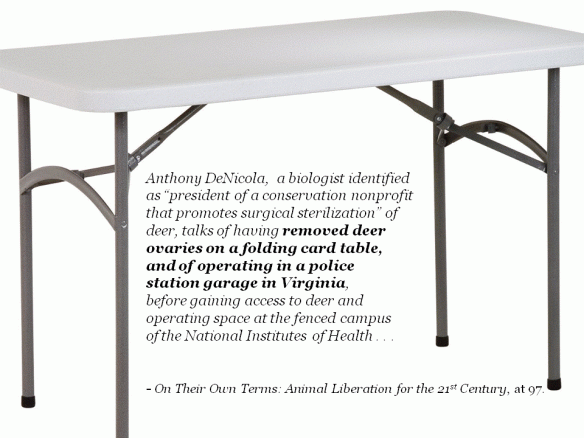
People now impose contraception on deer so we can CLE Leespread ourselves out without having to deal with the “conflict” of animals in our way. Or we oust untamed animals in the name of human rights. In India, a Tribal Rights Bill was introduced to redress discrimination by allocating land to several million indigenous forest-dwellers—while annihilating the region’s last few hundred tigers. Is erasure of tigers acceptable because the tigers would have had less possible sources of satisfaction than the indigenous people? Or does ethical decision-making require a thought process more complex than that?
Under new global climate patterns, lifeboat scenarios will happen a lot. Environmental crises are unfolding more quickly than could have been predicted when many animal-rights texts were written.

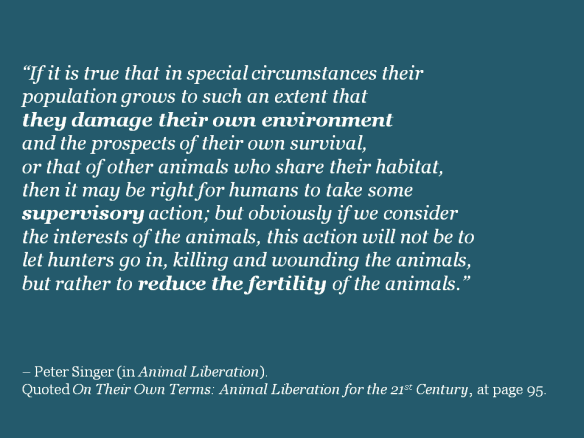
Chapter Nine of On Their Own Terms: Animal Liberation for the 21st Century reviews advocates’ agreement to control the fertility of free-living animals over the years. In 1975, Singer suggested that animals have an interest in our research and development of fertility control over free-living communities.Slide16

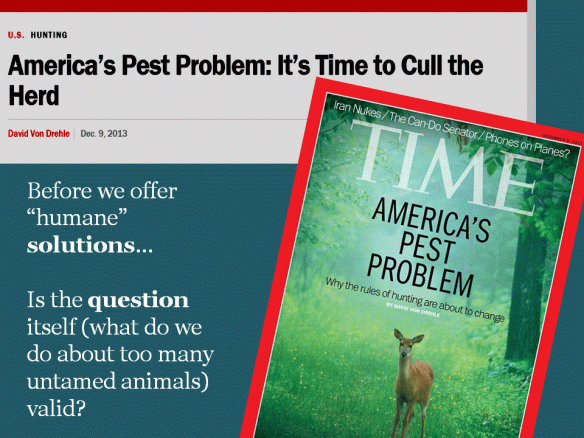
The assumption that free-living animals might wreck their environment and need us to step in as supervisors matches the claims of administrative officials ready to lower the boom on animals in woods, parks, and fragments of green space. In 2008, when deer were targeted near Swarthmore College in Pennsylvania, rights advocate Tom Regan accepted the premise that the local deer must be controlled, but argued that it should be done by pharmaceutical means. The contraceptive substance porcine zona pellucida (PZP), made from the membranes of pig ovaries, triggers the deer’s immune system, forcing the body to attack the deer’s own eggs.

Slide17

The Swarthmorean, 18 Dec. 2008

Regan’s position startled and disappointed me—for Regan’s book The Case for Animal Rights had urged: “With regard to wild animals, the general policy recommended by the rights view is: let them be!” But support for human-controlled reproduction in free-living communities had precedent in animal-rights legal work. In the 1990s, Gary Francione and Anna Charlton, on behalf of their Animal Law Project at Rutgers, explained their action on behalf of Pity Not Cruelty, Inc. to change deer-control policy in Montgomery County, Pennsylvania:

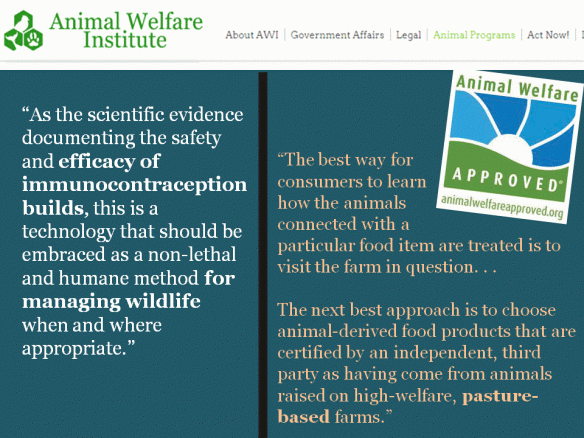
“We are assisting the plaintiffs in the Lower Merion challenge in the dissemination of information concerning non-lethal methods to decrease any deer/human conflicts, including the possible use of immunocontraception where the deer population can be verified to have increased considerably.”

This presents the deer’s very act of reproducing as a possible situation of true conflict. The stance ignores the obvious—balancing the deer population isn’t up to humans; it’s the role of native carnivores and omnivores.

Today, communities are demanding the systematic spaying of deer.

Slide20

A liberatory theory ought to call for the neutering of cats (TNR) or to prevent dogs from mating, they already lack the ability to reproduce and raise their young on their terms. Phasing out the breeding of animals as pets would, essentially, put wildcats and wolves off-limits to selective breeding to suit our whims. But contraception for free-living animals is animal control—nothing more, nothing less. Note the importance of distinguishing selectively bred animals from communities of animals who could actually experience autonomy, and shouldn’t be denied that opportunity.

I’ll let the next slide speak for itself.

Slide21

But for context, let’s talk about how much room we take up on this planet, thanks to some work made available by Californians for Population Stabilization.

Slide22Humanity’s mass (we’re the red bar segments in the next chart) has eclipsed the collective weight of all Earth’s free-living land mammals (green segments).

Slide24

Add to this the weight of our entourage of purpose-bred animals (blue segments).

Witness our expansion as we press the rest of Earth’s bio-community off the chart.

Can we so readily accept the claim of “too many of them”?

Shoppers gonna shop. Can we accept that some (really fancy) husbandry improvements support the liberation mission, sort of?

OK, let’s look at an e-mail I received from Whole Foods Market in London on 15 April 2016, just one week before Earth Day. Slide25It says…

“While organic dairy cows yield on average a third less than intensive production, the benefits of organic dairy are huge. In order for a dairy to achieve organic certification the herd must be pasture-grazed throughout the grazing season.”

The cows are on pastures (read: sprawl – and let’s explain it as such to our shopping friends), and they only “yield” a third of what densely confined cows produce. So, if all the cow’s milk shoppers switched to organic, they’d effectively demand three times as many cows? Look at these cows.

The next slide joins the two above advocacy positions: (a) constricting the populations of free-living animals, and (b) allocating more space to animal husbandry. Both positions, and certainly the two combined, support human claims to habitat and, in turn, the disappearing of the untamed.

Slide27

Both campaigns arguably advance ye olde humane-treatment principle “based on values that most people accept” but neither supports true animal welfare. The vegan response to these campaigns is non-participation. (That doesn’t mean doing nothing! We need to give our active support both to vegan-organic farming and predator coexistence initiatives.)

Slide31Peter Singer and Jim Mason, in The Way We Eat: Why Our Food Choices Matter, suggest animal husbandry could be a beneficial system for the animals involved. Hogwash. The hills were the habitat of wolves and wildcats before we came in with our animal husbandry.

As for an incremental step on the way to rights for animals, let’s be clear: no improvement in the conditions for purpose-bred animals cuts the mustard. The more connected to nature the farm is, the more reasons for the farm owner to set traps or call the “nuisance control” professionals.

Free-living animals lose where they’re overlapped by controlled ones, as the owners continually introduce problems into habitats.

Slide34

No authentic rights await purpose-bred animals; the concept is an absurdity we can accept only as long as we accept purpose-breeding.

Cultivating Active Respect

One rights scholar has said: “If we are going to make good on our claim to take animal interests seriously, then we have no choice but to accord animals one right: the right not to be treated as our property.” Will this resolve all the problems?

Slide36

Reindeer were domesticated back in 14000 BC; dogs were bred from wolves about 13000 BC—long before modern conceptions of rights and property.

Because domination is a deeper, broader problem than property status, we’d best think of abolitionism—the call to stop treating animals as commodities—as a component of animal liberation. We’ve got to get over our practice of warring against other beings, displacing them, hijacking their reproduction and demolishing their spaces. Authentic animal-liberation theory conceives of affirmative action to facilitate animals’ flourishing on their own terms. This means cultivating active respect for animals’ connections with their own communities, for their interests in the climate, in the land, water, and air they require to experience freedom.

Slide37And while the interest in shifting other animals’ legal status from property to person is worthwhile, the outcome will be limited if we base our claims on their remarkable abilities to adapt to human environments. Or if we focus on pain control. Slide38

The argument for nonhuman personhood, in the 21st century, will defend the life experiences for which animals themselves evolved, free from our assessments or supervision.
CLE convenors

Thank you . . .

to Cleveland’s vegan community for encouraging this exploration of our movement and the writing of the book itself. Having a launch date helped to move the new work from a computer file to a book! Bill, thank you for choosing the graph slide and explaining its elements during the presentation. Thanks to all our animal writers, including those not mentioned and those critiqued here, for their contributions to the advocacy dialogue. This writing is not an attempt to compete or compare. It’s intended, in the vegan spirit of collective progress, to help refine our wayfinding, knowing that involves dynamic and sometimes knotty discussions.


Photos of the Earth Day Celebration and book launch in Cleveland Heights courtesy of the Cleveland Animal Rights Alliance. THANKS TO ARKIVE.ORG FOR OFFERING A HUB FOR PHOTOgraphers of animals in Habitat, and encouraging the sharing of these images. Encampments meme: Tiffany Warner on PINTEREST, Pinned from KnowYourMeme.Com

In Print

My new work On Their Own Terms: Animal Liberation for the 21st Century is now in print as a paperback.

One aspect of the book I’d like to mention here is the decision to reclaim the “animal liberation” idea.

I was trained as a legal thinker. For years, no wonder, I liked the term “rights” as a signal of serious consideration and respect for the interests of non-human animals. To declare our support for “rights” meant we weren’t satisfied with an anti-cruelty tradition that accepted the habit of forcing other animals to conform to human purposes, as long as we abided by some set of “humane” standards.

But of course the nonhuman communities do not themselves construct rights; we do.

Perhaps the question of animal rights ought to be reversed, and examined with regard to ourselves: Should humans have the right to domesticate other animals?

Photo credit: Suzannah Troy

Photo credit: Suzannah Troy, New York City

To make them dependent on us?

Should we be so entitled? Why?

A questioning of that entitlement is key to an authentic call for liberation. The 1970s conception of “animal liberation”—which still influences major campaigns of high-profile charities—by-passed that question, and in some ways even assumed that animal control in nature is a good thing. The serious effects of “missing animals on their own terms” could do with a reversal, today.

To find the book where you are, please look:

The “Look Inside” function is enabled so you can browse some of the interior.

matt shaw says the book examines “crucial points that other vegan/animal rights/animal liberation writers have either overlooked or shied away from.”

It does. And I hope the ensuing thought and conversations will take these points further, into the policy sphere, and ultimately renew and strengthen public interest in the idea of animal liberation.

With love,

Lee.

The First Step

If we do acknowledge and encourage the predator-prey relationship as a sound process, what does that mean for ourselves—the human primates? How far should we suffer the large predators to roam? How much risk can we accept? We’ll take these hard questions as they arise. The first step is to acknowledge risk as part of a healthful life experience.

We have forged an elaborate and very often beautiful human history. If we hope to safeguard our future, we’ll need to let go of our identity as masters and regain that surge of emotion—of awe….

More at magazines-500-350x294CounterPunch, whose editors kindly highlighted this excerpt of On Their Own Terms: Animal Liberation for the 21st Century.

Putting Out Michael Pollan’s Fire

By guest blogger Robert Grillo

Last night I watched “Fire,” the first episode of Michael Pollan’s Netflix mini-series Cooked based on his book by the same name. The show weaves together Pollan’s life as an author/personality in California with the story of a group of Aboriginal people in Australia portrayed as hunter-gatherers as well as a “pit master” from the American South. The central theme explores fire as an evolutionary and cultural symbol that allegedly predisposes us to eating animals. And the sweep from one cultural extreme to another is supposed to make some profound statement about the cultural universality of hunting, raising, killing, preparing and eating animals as a kind of rite of evolutionary passage and a remedy for our modern day aversion to cooking. In his search to find the primordial roots of eating flesh, Pollan’s new-age journey finds himself sitting around a fire pit, upon which a whole, gutted pig is searing, and drinking beer with his 50-something friends in a kind of male-bonding ritual. Here Pollan seems to go out of his way to impress upon us that he is as real and down-to-earth about food as he is worldly and philosophical.

“Fire” is stoked with all of the rhetoric and progressive foodie tropes that Pollan made infamous in The Omnivore’s Dilemma, including “thanking the animals for their sacrifice,” “knowing where your food comes from makes you an ethical eater,” “raise and kill them with kindness,” and, above all, honoring “the natural order” in which farmed animals are essential, not only as a human food source, but also as a source of fertilizer and ecosystem “balance.”

“Fire” cleverly interjects two subtle yet powerful anti-vegetarian messages to further bolster its case for eating animals. The first is the story of the former “animal rescuer” turned pig farmer who claims to have found a higher calling by raising pigs to feed her community. She would rather see her local town’s people eat pigs that were responsibly raised on her farm rather than from a factory farm. It’s a common logic that sounds plausible on the surface to many of us, until we recognize the false dilemma implicit in the statement, the false either-or scenario that excludes the very real possibility of feeding them with plant foods instead. She names her pigs and tells us that her impregnated mother sow reminds her affectionately of her grandmother. All the while she is fattening up and preparing her offspring for slaughter. In her final scene, she is bidding her pigs farewell as they are loaded on to the truck bound for their deaths, padding the truck with blankets to ensure that at least their transport to the slaughterhouse is cozy. Stories like this one seek to reassure us that farmers are good people who care, even if they do ultimately betray the juvenile animals who learned to trust them. And more importantly, they seek to obscure the fundamental distinction between farms and sanctuaries. They obscure the fact that farms admittedly value animals to the extent that they provide an economic resource and dispose of them when they outlive their usefulness. On the other hand, sanctuaries see each animal as an individual having intrinsic rather than economic value, worthy of living out their lives as comfortably as possible, much like the animals in our lives we regard as “pets.”

In another scene, Pollan insists that a young vegetarian guest at his dinner party sample the pig. Predictably, she is overcome with ecstasy upon tasting it, and Pollan and his male friends gloat in their “gotcha,” ego-stroking moment. But this decisive moment renders all of Pollan’s elaborate ethical posturing leading up to this point essentially meaningless; it is ultimately taste, and not ethics, that renders even vegetarians complicit to eating animals. This act of vegetarian surrender fulfills the meat-eater’s fantasy in which they imagine vegetarians sabotaged by their “natural” desire to eat flesh and the meat-eater’s triumph over the vegetarian’s betrayal of her values in the name of her taste buds. It says as much about the objectification of animals as it does about the male desire to control women.

Photo for Robert Grillo guest pieceBut perhaps the most strikingly dishonest narrative ploy in “Fire” is the attempt to blur the important moral distinction between hunting and eating animals for reasons of survival as portrayed by the Aboriginal hunter-gatherers with Pollan’s celebratory pig roast in which eating animals, far from being necessary, becomes a glorified centerpiece intended to woo guests. Indeed, the eating of animals is fetishized here as straight up palate porn. Pollan indulges his animal-eating viewers by unapologetically wallowing in the pleasure he derives from the pig’s flesh, but also the satisfaction he gets from connecting to his “food roots,” his hunter-gatherer ancestry.

Throughout “Fire,” Pollan makes sweeping nutritional and environmental claims without citing any credible evidence, as if to suggest that his notoriety as a food writer somehow makes him a authority on nutrition, environmental science and animal behavior. One of the many highly debatable claims he makes is that farmed animals are beneficial and even necessary for healthy ecosystems. “There is something quite elegant ecologically about having plants and animals together,” he tells us. But, as environmental author and activist Will Anderson writes, “…we can accomplish magnitudes of recovery more if conservation biologists introduce native species in tandem with the end of animal agriculture. As it dies, ecosystems will thrive. Conservation biologists will need generations before plant and animal communities regain at least some relationships that are essential to the ecosystems. Grazing cattle will be replaced by the original inhabitants, the bison, antelope, deer, tallgrass and shortgrass, prairie chickens, and ground squirrels. Highlands and lowlands, forests and plains, all should be rid of the pox that livestock represent. Livestock were never needed as replacements to benefit ecosystems.”

In the end, Pollan’s dilemma is not really a dilemma at all. He advocates, without remorse, the eating of animals raised in preciously rare circumstances and available only to an affluent niche, readily admitting that he can’t justify most of the animal products he ends up consuming due to the difficulty of tracing them. His vague conclusion is that we at least express intent to do better, without any serious attempt to act on that intent or hold ourselves accountable in any meaningful way. In the end, Pollan’s “Fire” amounts to a half-baked, half-hearted recipe for a more evolved, ethical way of eating, but his lack of moral courage ultimately extinguishes the flames of that fire.


Robert Grillo is the director of Free from Harm which he founded in 2009. As an activist, author and speaker, Grillo focuses awareness on the animal’s experience and point of view, drawing on insights from sociology, psychology, popular culture, ethics and social justice to bridge the gap between humans and other animals.  As a marketing communications professional for over 20 years, Grillo has worked on large food industry accounts where he gained a behind the scenes perspective on food industry branding. He is currently working on a new book about how popular culture uses a variety of fictions that appeal to our beliefs about farmed animals and animal products, heavily influencing our food choices. The book is based on his keynote presentation, Fictions, Facts and Food Choices.


Floor Show: Looking Back on the Newkirk Biopic “I Am An Animal”

How time flies. I Am an Animal: The Story of Ingrid Newkirk and PETA (Stick Figure Productions for HBO®, a division of Time Warner) is now eight years old. Its website labels it “unavailable” (though it can still be found).

Yet a biopic of Ingrid Newkirk, president of People for the Ethical Treatment of Animals (PETA) since its founding in 1980, remains significant in the story of animal advocacy. And this film speaks to an ever-relevant topic: the effects of emotionally charged rhetoric and images of animal abuse. As I’ve noted at the Species and Class blog, many animal charities employ graphic video footage of industrial animal handling. I’ve also briefly noted this in the newly published On Their Own Terms: Animal Liberation for the 21st Centuryciting this biopic. Here, then, is a brief exploration of the biopic and what it might tell us about popular advocacy.

I Am an Animal begins by recounting Newkirk’s role in the documentation of animal handling in a Maryland primate laboratory, focusing on filth and untreated wounds, and the subsequent prosecution, which got attention “like no other anti-cruelty group had done.” Newkirk, who was a Maryland law enforcement officer and a director of animal cruelty investigations in Washington, D.C., had found a calling. PETA was born.

Early in the film Newkirk invokes the day when everyone will think animals are not ours to eat, wear or experiment on, borrowing a slogan then associated with the British Union of the Abolition of Vivisection (BUAV), whose simple magazines and straightforward messages PETA closely mimicked in the early eighties. By the nineties, PETA’s magazine had gone glossy, and high-profile media stunts became the group’s hallmark.

A well-known slogan usually associated with PETA originated with the British Union for the Abolition of Vivisection. Here it is on a post card sent to me by the first vegan I ever (knowingly) met, Robin Lane.

A well-known slogan usually associated with PETA originated with the British Union for the Abolition of Vivisection.

I PROVOKE, THEREFORE I AM

According to filmmaker Matthew Galkin’s Press Notes: “PETA is aggressive and its marketing tactics are obscene and offensive to a lot of people. Yet Ingrid has grown PETA into the largest animal rights group in the world.”

As for the “obscene and offensive” Newkirk explains: “Everybody is obsessed with sex and obsessed with violence”; so PETA’s choice “is no attention or some attention.” Galkin introduces the audience to PETA’s Milk Gone Wild, a rejected Super Bowl anti-milk video. Remember that one? PETA promoted it by exclaiming: You won’t BELIEVE what we’ve packed into this video! You’ll see the HOTTEST girls baring it all – AND MORE!!! No rules, no parents, no limits, and of course no cows. The sexism has continued for years in PETA’s public campaign designs: the need to be “edgy” supposedly dictates sexual objectification and even jokes about gendered violence.

Another of Galkin’s scenes has Newkirk reviewing a staffer’s proposal for PETA’s Animal Liberation (“Are Animals the New Slaves?”) display, juxtaposing pictures of a hoisted steer and a lynching. When a media-relations employee asks if the slavery exhibition should avoid the use of Holocaust images, Newkirk says it would be fine to use them as well, especially if they happened to find a “super-duper one.” In this film we learn a lot about how it became accepted, and then routine, for campaigners to replicate the traumas of subjects – human or not – who can’t consent to being displayed as victims. Today, this routine is confronted by writers such as Claire Heuchan at Media Diversifiedobserving that “Black experience is regularly placed on a par with animals as a provocation.”

JUST A THING

Newkirk’s home – perhaps to the surprise of viewers who associate advocacy with rescue – isn’t shared with any other animals. Newkirk says people “should work to help them” and not “accumulate them” – neglecting the reality of homeless domesticated animals as our refugees, our asylum seekers.

Newkirk’s “work to help them” includes killing, as the film then shows. In North Carolina, Newkirk approaches an underfed dog. “You look like like a sorry soul!” Newkirk quizzes the owner quickly, several times interrupting the answers, then sets down a bowl of food and tells the owner, a soft-spoken person with dreadlocks, that the dog has a serious case of worms. After offering the owner free veterinary care – “We have to sign him over for that. Let me get my clipboard” – Newkirk takes the dog.

In the van, Newkirk comments, “He’s just a thing. He’s one more thing that they have, I think. Sort of a passing nice idea, you’ve got yourself a pet. But the reality of care is – not understood.” Yet the ultimate proof that you’re a “thing” is that somebody can destroy you. And this is exactly what Newkirk proceeds to do. At PETA’s headquarters, where the dog is found to have an abnormal red blood cell count in addition to worms, Newkirk directs an employee to kill the dog. No one tries to communicate with the dog’s owner in more than the authoritative language of the expert assuming control. PETA’s dual message is clear: Some people shouldn’t have animals. Advocates perform a lethal kind of sanitation role.

THE KILLING FLOOR

Then we watch the filmmaker filming another filmmaker. Chris, a young PETA employee, is tapped to videotape a ConAgra site where turkeys are slaughtered for the Butterball brand. On the killing floor – where, from dawn to dusk, a four-person team works the shackles to process some 50,000 bird into bodies every day – Chris breaks down and can’t run the hidden camera. Galkin’s crew films the two-month period in which Chris descends into despair.

Though Chris’s constant technical failures suggest a gut resistance to an active role in violence, Newkirk is not impressed. “We can’t afford to just lollygag around with some young person who can’t get their act together .” By failing to produce what Newkirk wants, “he’s screwing the birds over.”

A more experienced infiltrator is deployed to catch the company’s violations of the Arkansas anti-cruelty statues and the Poultry Inspection Act. A press conference is planned. Whereas Newkirk says footage of abuse has the potential to change the world, the group doesn’t challenge the agricultural use of birds or animals generally; the articulated idea is to score a victory with a big company, and on the grounds that workers in the investigated plant have inflicted “gratuitous” harm. Butterball assures PETA that if there is any abuse found, they’ll fire the employees responsible.

PETA’s street campaigners then convey PETA’s mixed message: “Like a free DVD?” “Boycott Butterball; we found them molesting birds at a processing plant in Ozark.” “Go vegetarian this holiday, but at the least don’t support Butterball.” So, what does animal advocacy want?

WHAT’S IT ALL ABOUT?

When Newkirk hugs a designer who promises to use no wool in a coming season, fashion mogul Marc Bouwer qualifies the vow as meaning products of the Australian Wool Industry – a particular business group PETA has targeted. “We definitely won’t use wool from Australia, that’s for sure!”

Again, what does animal advocacy want?

Newkirk’s PETA, for all its brashness, can’t give a clear response. The PETA website suggests that a “perfect world” of freedom for horses isn’t possible, so just don’t use whips and spurs, for “gentle methods can be employed to teach a horse to allow a rider on his or her back.”

Newkirk states that PETA’s “main goal is to stop suffering, as much suffering as we possibly can” but isn’t too interested in animals living in their free, uncontrolled states. When a staffer shows Newkirk footage of a person hitting tigers, Newkirk first says, “Do we have more of this?” and then stops short. “I am deeply worried,” Newkirk says, “because we keep doing these investigations into exotics, and it’s all worthwhile…but the one thing that everybody needs to get involved in is empathy with the animals they eat and don’t think twice about”; and attention is redirected to assembly-line turkey processors. Then, evidently lumping all undomesticated animals into a cute class, Newkirk says, “All animals feel – not just the cute ones with the big eyes, not the fluffy bears, and the smiley dolphins, but all the animals.”

But animal liberation isn’t a movement to make conscious beings feel better in captivity. It involves opting out of animal agribusiness, not ensuring workers follow the Poultry Inspection Act; it means advocating for the interests of free-living animals and defending the habitat they require to experience their lives. And it means careful attention to root causes of social inequality, not generalizing about, and policing, the financially poor.

Amidst today’s social-movement dialogue, with its attention to intersectional critiques of objectification, and on today’s Earth, with human domination driving mass extinctions, nearly every aspect of Newkirk’s focus is gravely obsolete. Would someone like to explain, then, why its base of financial support is ever increasing?

New Book on Animal Liberation Now Available

I’m pleased to report that On Their Own Terms: Animal Liberation for the 21st Century is now available. 

UPDATED LINK: Here is a summary and audio files.

Carolyn Bailey of AR Zone has called it “one of the most important books on animal activism for a long time” (cheers, Carolyn!) and I hope friends at Vegan Place will find it worth your valuable time.

Let me know what you think. Love & liberation,

Lee.

Coming Soon…New Book on Animal Liberation

Readers of VeganPlace and my fellow bloggers will, I hope, be excited to know that I’m making a debut as an “indie” by way of Kindle Direct Publishing. The new work, for which VeganPlace will become a discussion platform, is just days away from publication. This week, I’ll announce the Kindle link, price, and so forth. It might be free for the first five days, and in any case it will be under a tenner.

And COVER jpg fileI’d love for you to read it and review it. Writing a review will be the single most helpful thing you can do to support this work, beyond reading it. Keep in mind that this is a book by an indie vegan author, not an e-pub ninja; so don’t expect technical perfection on the first go. The e-publication phase has been much more difficult than I’d expected. The information technology-loving Cathy Burt has stepped up at the eleventh hour to work out a few glitches, although, given our time limitations, a paragon of production is not a reasonable goal. We’re learning as we go.

As for the substance, you might well ask what makes this new book worth your time. I believe the concept of animal liberation has never been more relevant, but…that concept is due for renovation. On Their Own Terms: Animal Liberation for the 21st Century updates the idea of animal liberation, as it explores the hits and misses of animal-rights and environmental advocacy, and presents a brief guide to the burgeoning vegan movement.

And why would I say a new animal-liberation philosophy is so important? Look at the way world leaders are now reacting to weather and climate dynamics. Finally they are reacting, but that’s basically to figure out how we can keep doing what we’ve been doing in supposedly “sustainable” ways. Until we redefine our role within Earth’s great biological community, the changes we find ourselves forced to accept will mean coping with one emergency after another.

Animal liberation should come to the fore during discussions of “sustainable” gatherings and products. Promoters of sustainable animal agribusiness or sustainable meals made with local vegetables and flesh of pigs, cows, or fish purchased from small farms or local waters don’t usually want to talk about animal liberation. It is important to meet these organizers where they are: to acknowledge their concern about a topic of great importance, and then to direct their attention to the question of whether their unspoken ethic of human dominion is sustainable.

On Their Own Terms: Animal Liberation for the 21st Century offers ways of uncovering our personal connections with the current climate and extinction crises. It explores the human potential to fit our own habitat, while allowing nonhuman communities to thrive in theirs.

Consider that a transformation of our human identity will spare us, and every other biological community on Earth, from enduring an endless string of gradually or abruptly worsening emergencies whose roots we fail to address. Consider, if you will, relinquishing the human assumption that the Earth is ours…


“I believe Lee Hall is one of the most interesting and insightful writers working in animal rights. This book gets all the thumbs-up.”

— Jonathan Hussain, rescuer and campaigner, Grass Valley, California

“In On Their Own Terms: Animal Liberation for the 21st Century, Lee Hall reclaims the concepts of animal liberation, animal rights and animal welfare, and compels us to reimagine what it means to be an animal activist.”

— Sangamithra Iyer, Satya Magazine