Statement of Support for the Vegan Justice League

“We may not pay to kill animals, but our taxes still do. It’s time to end animal agribusiness subsidies. We need to lobby.”

— Vegan Justice League

The Vegan Justice League intends to effect change in the U.S. Farm Bill, which encourages farmers to produce meat and dairy. Taxpayer-funded subsidies, the League observes, let animal agribusinesses produce a surplus well above market demand.

Of course, a vegan would say all animal products are “surplus”; and, as a vegan, that’s what I say. That’s what the League thinks, too.

Why focus a campaign simply on the subsidies in animal agribusiness? Because the subsidies essentially force us to undo our work. Vegans are funding the damned farms. Or the farms that would be damned if only vegans had a level playing field. 

Plant- and nut-derived dairy replacements and flesh-food analogues, together with the vegan culinary scene, are the financial success story of the decade. U.S. residents want artisan cashew-based cheese. We’re replacing barbequed flesh with vegetable kebabs. Thanks to the vegan movement, the population now knows:

Dairy’s not necessary.

Meat’s no treat.

Still, animals are bred, managed, and killed in droves every second. The industry evades normal supply-and-demand dynamics by way of bailouts and subsidies under the guise of insurance extended to animal husbandry corporations.

The Vegan Justice League intends to deploy billboards and professional lobbyists, and to call politicians out for accepting funds from animal agribusiness—focusing on ag-heavy North Carolina, Texas, and Washington state.

Authentic Sustainability

Behind the much-vaunted term “sustainability” is a growing awareness that we’re depleting the Earth’s water and forestland. This is not just about us and what we’ll have left to use. Other animals in natural bio-communities must have viable habitats to survive and thrive. That vital space is lost to deforestation for feed and grazing, and it’s eroded exponentially on a heated Earth.

Animal agribusiness can make no authentic sustainability claims. It’s nothing more and nothing less than a worldwide traffic in introduced species—yet it gets a pass because we presumably need to consume animals. That presumption no longer stands. 

As for the argument that farmers need to make a living, that is an argument for redirecting their business to growing food—not feed. Staying stuck in an unsustainable model is not the way businesses and their people will thrive.

Shifting from animal flesh to a plant-powered humanity stops massive ecological harm, and offers a way to stop deforesting, and to make space for re-wilding proposals.

A recent study carried out at Oxford University reports on one of the most thorough examinations ever undertaken on the impact of agribusiness on the environment. It involved nearly 40,000 farms, and 119 countries. And it showed that by becoming vegan, we could shrink our individual carbon footprints by as much as 73%, and reduce land use by 75%, saving an area equivalent to the size of the U.S., the E.U. and China combined.

Understood in this context, veganism is not extreme. It is a rational commitment to stop greenhouse gas emissions and biodiversity loss now.

Moreover, while leaders of struggling people hope for food aid for millions, animal agribusiness is a massive funnel of feed crops to billions of cows, chickens, and aquatic animals who are bred to be eaten. Consumption of flesh, fish, dairy and eggs takes a massive toll on the environment, the climate, and a finite Earth on which everyone in the world depends.

It is also a frivolous use of our talents to exert systematic dominance over other conscious beings.

Veganism appropriately responds to urgent human safety, social justice, and environmental ethics questions. Veganism understands that our most powerful stance is:

  • The permanent boycott of flesh and dairy products.
  • Conscientious objection to industries that displace, capture, breed, buy, sell, control and exploit beings who, as we do, have an experience of life.

We hold the ethical, environmental, and health-conscious high ground. Yet we are undermined every day by the misdirection of our own dollars.

We do have the power to change our relationship with the rest of our bio-community. Active objection to the investment of our tax money in animal agribusiness is one element of our power.


Banner credit: Architect of the Capitol. Images within text: Allie Smith and Alexander Mils, via Unsplash.

Berkeley Heights Vegan Fest

Outreach on the vegan response to all beings’ health and climate happens SATURDAY 21 SEPTEMBER – because the Berkeley Heights, New Jersey Environmental Commission is connecting the dots.

The group hosts this year’s Vegan Fest at Lower Columbia Park. The event starts at 10am. Bold Arts will offer creative dancing for kids, while educational sessions focus on health and the environment. I’ll be a climate panelist (11am-12pm).

Sustainable Berkeley Heights is also a host and organizer of the Vegan Fest, which happens in Lower Columbia Park, 411 Plainfield Avenue, New Jersey, behind Columbia Middle School.

Come back on Sunday 22 September for the vegan cook-off.

Eating Flesh: How Do We Frame The Question?

A debate is running about what humans will eat when we stop eating meat.

Why? Our most sustainable protein on Earth is the bean. Beans, lentils, and peas grow in harsh climates with little water, in financially poor regions. They self-fertilize, capturing nitrogen from the air and fixing it in the soil, so they don’t need the synthetic fertilizers that are running off the land and killing the ocean.

Yet some vegans, of all people, are promoting “clean meat” that is actual flesh, made in the lab from real animal cells. No doubt most readers will have heard some self-identified vegans touting this new future of food.

Do they have a point? This is a matter of question framing. And I think we need to lay out what the questions are.

Read on…


Banner photo credit: Niklas Rhöse, via Unsplash.

This Flood Is Your Flood

To my fellow human being:

If you are still eating cows (flesh or dairy) and other farm animals, it’s incumbent upon you to understand why they are drowning in the midwestern United States…and baking to death in Australia.

It’s up to you to understand your part in it, and end at least your part in it.

It’s your responsibility to look behind the curtain, and deal with these unnatural disasters connected with the unnatural sprawl that produces those unnatural groceries you so easily toss into your shopping cart.

It’s never too late to learn. And you won’t be alone on the journey.

This is what I want the average New Yorker on the street to hear on Sunday 14 April.

On the day of the Veggie Pride Parade, I’ll have a mic for a few minutes, and dang! Do I know how precious a few minutes of someone’s attention can be!

In 1983, Robin Lane, a vegan, left a pamphlet on my seat (and all the other seats) in a concert hall. The leaflet took just a few minutes to read. It changed the world for me. That night I made the commitment to become vegan. The day before, I’d never even heard the word.

Leaflets are sacred.

I appreciate the call to be an audible leaflet for just a few minutes.

To my fellow vegan:

I share your anguish as we witness what animal agribusiness is doing to the animals in it. What the massive plundering of fossil fuels, former forests, and natural sierras and plains has wrought. The ecocide. The coming apart of the climate.

And each day we get up and go out into the world. Kind of, but not quite, like that person who said they’d plant a tree today even if the world would end tomorrow.

Sparing the tree that’s already there, we know, is better.

Love & liberation,

Lee.


Banner image: Public domain (FEMA). Please note: advertisements on this site are not endorsed by VeganPlace. Eventually, with subscriber support, VeganPlace will be ready to make the shift to a paid presence on WordPress so readers don’t have to see the tacky advertisements.

Summerfest Schedule Now Posted

Are you coming to the North American Vegetarian Summerfest this year? If so, please find me so we can get some time in person! I’ll be in the hallway near the main Living Learning lobby a lot. Watermelon shows up there frequently and, from time to time, so does  Miyoko Schinner’s artisan nut cheese. 
As for presentations, I’ll be offering:
  • The Environmental Impact of Eating Sea Life. Current status of Earth’s aquatic habitats and communities. Is the “sustainable seafood” concept helping or making things harder for sea life to survive and thrive?
  • Why Vegan? Vegan for Your Health, for Environmental Healing, for Fair Food Sources, for Animal Liberation. (Maureen and Vance: You are quoted in this one.)

Photo credit: Jason Pompilius

  • Climate Change: Is It More a Fossil Fuel Problem, or a Diet Issue? Comparing these emissions sources. Of course there is a lot of overlap between animal agribusiness and fossil fuels. This session will offer information on the science basics, plus a few less discussed aspects of the dichotomy. It will conclude with a call for a movement of Dietary Divestment for the Climate.
This is an event I can recommend. It draws more than 700 attendees from all over the continent. It offers a positive, refreshing atmosphere with endless conversation (I mean that in a good way!) and several days of really fabulous food that will inspire you and tune up your support network for the coming year.

If You Can’t Stand the Heat, Get ANIMAL PRODUCTS Out of the Kitchen

That’s the topic of a presentation I’ll offer on 9 September 2017.

Hurricane Harvey’s unfolding tragedy is connected to climate change—which is, in turn, connected to animal agribusiness in a very big way. Equipped with the facts, let’s encourage people to stop eating like there’s no tomorrow or they could be right.

Is veganism really about climate, though?

Yes, squarely. Without a well-functioning atmosphere, advocating for habitat preservation and animal liberation is spitting into the wind. Climate crisis is an urgent subject for everyone to discuss, but this “inconvenient truth” has never been adequately addressed by policy devoid of a vegan perspective.

This presentation will take place at the 3rd annual Vegstock Festival, which is now seeking . . .

Activists · Artists · Authors · Doctors · Dietitians · Musicians Cooks · Chefs · Farmers · Foodies · Gardeners · Growers · Healers · Thinkers · Speakers · Students & Teachers for the Vegstock Vegan Festival. And folks to spread the word.


Presented by Wildflower Vegan Cafe, the vegan restaurant in Millville, NJ and the Millville Development Corporation. Time and place: 10am-4pm Saturday, September 9 2017. 501 North High Street, Glasstown Arts District, Millville NJ 08332.

“If You Can’t Stand the Heat, Get Animal Products Out of the Kitchen” is made possible by dedicated patrons of the Art of Animal Liberation.

“But Vegans Kill More Animals!”

Justin Van Kleeck is a microsanctuary pioneer—a farm animal rescuer working on a small scaljustin-van-kleecke, often rescuing animals from small-scale farming operations too, and resisting the calls of industry to tout “humane” or “local” agribusiness as a step in the right direction.

While Justin urges consistency—no amount of homespun pictures or creative PR can ever make animal exploitation “humane”—some will then challenge the commitment to crops as food.

There’s a clever argument, and maybe you’ve heard it, that vegans cause the deaths of more animals by being vegan. Growing crops for human food, the argument goes, involves tractors and threshers that kill field mice, voles, and so forth.

Have you ever noticed how this argument misses all the feed crops used in animal farming? Note, for exSlide37ample, that 99% of your local chicken farmers drive to feed stores to keep their birds growing and producing. The feed store is reliant on the fossil-fuel industry. So the “local” and “sustainable” concept in animal farming, when we dig deeper, is questionable.

Your local animal farm would also be a consumer of the massive feed industry that uses heavy equipment on the land without regard for the countless small animals seeking food and shelter amidst the fields.

As discussed before on Vegan Place, facile excuses to avoid personal change abound. When people face the reality that becoming vegan is possible, there seems to be a shut-off valve, signifying: “Change myself? No! Let me seize an excuse that I haven’t really thought through and hope you haven’t thought through either. Vegans do more harm—so there! Yeah, that’s the ticket!”

Justin, when confronted with the “vegans kill more animals than your local animal farmers” claim, says:

We vegans start from the premise that exploitation and killing of other beings for our own ends is unacceptable, and we seek solutions…beneficial for all involved. Husbandry starts from the premise that other animals are here for us to use and consume, and all we have to do is be nice. So vegans seek harmonious coexistence without holding a knife to anyone’s throat.

Veganic models of agriculture and permaculture are available. Along with being more sustainable they are also workable in a variety of settings. Veganic urban gardens and food networks EXIST, but animal husbandry does not make sense for all communities. Remember: “If it isn’t accessible by the poor, it is neither radical nor revolutionary.”

In our conversations, Justin has noted that we, our whole generation, are products of an industrial revolution now. Why hold vegans alone responsible for what mechanized farming does to the land and to animals seeking habitat? Vegans didn’t plan to produce food this way.

Feeding crops to animals kills more animals. Animal farms breed large numbers of animals into existence for human consumption.

And when field animals get caught up in the collateral damage in the production of food crops (eaten by vegans and non-vegans), it’s because we’re all dealing with constraints imposed on us by modern agribusiness.

But we can go vegan to stop direct exploitation and killing within our food system, and try to change that system completely. Let’s insist on fewer excuses, and real engagement.


I am grateful to Justin for expanding my knowledge on vegan and sanctuary ethics greatly, and also for being a patron of my animal-liberation work. Photo of Justin: source. Banner photo by Philipp Kuchler (own work), via Wikimedia Commons.

If Beanstalks Had Feelings

Vegan? Becoming a vegan? One day, someone is going to ask you that burning question: “Oh, so you think plants don’t have feelings?”

What About PlantsDepending on your mood, available time, and experience with this classic outburst, your answer might be (1) terse, (2) practical, or (3) biological:

(1) Whatever. You roll your eyes and return to what you were doing before this unoriginal remark was uttered.

(2) OK, but animal farming harms more plants. Obvious, is it not? Animal husbandry requires several times the volume of crops as would be grown if we just grew food for people to eat. Willy could spare untold leafy billions from torture by growing food, not feed.

(3) Plants can’t run. You could also remind Willy that nature gave animals nervous systems to prompt them to self-protectively move away from sources of pain. If beanstalks had feelings, evolution would have equipped them with moveable feet, fins, or wings.

My preference is 1.

Plant Sensitivities, Revisited

So now that we’ve got the retorts laid out, let’s think seriously about plants. They are indeed responsive to their surroundings. And in this time of climate change, plants’ sensitivity to stress is coming to the attention of environmental science. Plants naturally breathe in carbon dioxide. But they can only take so much.

Excessive carbon dioxide in our atmosphere results from several human activities—including the burning of fossil fuels, deforestation, and animal agribusiness.[1]

We also tend to drive predators out of any biological community we enter. That leads to an abundance of herbivores, standing around the foliage, chomping away without a care. Their bliss is illusory; the absence of wolves and other predator animals is unhealthy. And the put-upon plants can’t absorb the greenhouse gases they could handle in a balanced environment.

A study at the Yale School of Forestry and Environmental Studies showed plants around spiders (predators) took in carbon 1.4 times faster than when with only grasshoppers (herbivores). Grasshoppers coping with predators ate less grass, and grasses stored more carbon in their roots when dealing with these herbivores and carnivores together. Where only herbivores were present, plants tended to breathe out, rather than store, carbon.[2]

Compare the way sea otter scarcity correlates with rising emissions. The missing otters’ prey, sea urchins, are free to feed heavily on the kelp forests which would otherwise hold in carbon. With predators gone, CO2 emissions have, in some cases, risen tenfold!

What Are the Implications for Vegan Activism?

We need to get out there and challenge the persecution of predator animals. I’ll gladly help in the writing of educational materials with any vegan group interested in forming, say, a coyote co-existence initiative. coexistence initiative

By being vegan, we’ve already built a solid platform for this advocacy. Predators are so often wiped out because they impede human hunting and animal farming (which a vegan humanity would stop).

And of course, trees and foliage can’t take in carbon dioxide if they’re gone because the forest was cleared of indigenous flora and fauna so corporations could usurp the land to farm domesticated animals.

All told, plants and their sensitivities have diverse and interesting ramifications, and we need to pay attention. In the mystical yet grounded words of my friend Jack McMillan:  “Plants—and, yes, rocks, and water, and all . . . are part of the exceedingly complex web of life and the sacred constellation of consciousness.”


NOTES

[1] United Nations Environmental Programme (UNEP), “Assessing the Environmental Impacts of Consumption and Production” (2010) examines fossil fuel consumption, land use, and the impacts of population growth, and states: “A substantial reduction of impacts would only be possible with a substantial worldwide diet change, away from animal products.”

[2] The scientific experts who study climate change for the United Nations haven’t been taking these multiplier effects into account in their models. 

Thanks goes out to Jack McMillan for inspiring this post. Coyote coexistence art by Lee Thompson.

A Performance Review of Humanity

On Earth Overshoot Day, which inches earlier each year, we exhaust more resources than Earth annually regenerates. #Pledgefortheplanet, we tweet! But what of the root-level change needed to address “over-exploitation” of Earth and its living communities?

Throughout our range across the Earth’s surface, we deem ourselves nature’s managers. Managers usually have to account for themselves in performance reviews. What if Earth Overshoot Day prompted a performance review of humanity?

Let’s try it.


Essay by Bill Drelles, Lee Hall, and matt shaw. Banner photo by Mónica Vereau.

Climate and Vegetarian Summerfest 2016

On Thursday 7 July in Johnstown, Pennsylvania, I’ll be offering a talk named Climate Change: How the Public Conversation Is Shifting and How Vegetarian Voices Can Be Heard. (The North American Vegetarian Society presentation summary includes a description: “This session will provide updates on farming and climate, and also involve some easy, memorable, and valid points to raise—whether in ordinary conversations or at the policy level. Attorney Lee Hall holds a specialist’s degree in environmental law with a focus on climate change, and will facilitate discussion, including new findings and vital points not raised in most discussions of climate and diet.”)

Some VeganPlace readers might ask: Wait—vegetarian voices should be heard? Don’t vegetarians consume cow products, which are obviously connected to methane and general climate-wrecking?

No. Real vegetarians don’t eat dairy. The ovo-lacto take on vegetarianism has been ruled out by the North American Vegetarian Society for twenty years. The five-day menu at Summerfest is not ovo-lacto-; it’s pure vegetarian. Sometimes vegans rail against the shortfalls of vegetarians, but in my opinion the vegan movement needs to tip its hat to vegetarians taking their mission seriously. Respect to NAVS for encouraging its membership to strive for an authentic vegetarianism and to learn why animal agribusiness is not climate-friendly.

And now, yes, the public conversation about climate change has shifted. It has to. We’re not stronger than the climate system. It’s having the last word in every debate. No lifestyle, no matter how rich or famous, is exempt.

Nor is any place on Earth untouched; we now know that levels of Antarctic CO2 have reached 400 parts per million. For the first time in 4 million years.

The roadways on which we burn so much fossil-fuel energy seem to be bucking us off.

And yet a poll six months ago showed half of U.S. society thinking climate change isn’t a very serious problem.
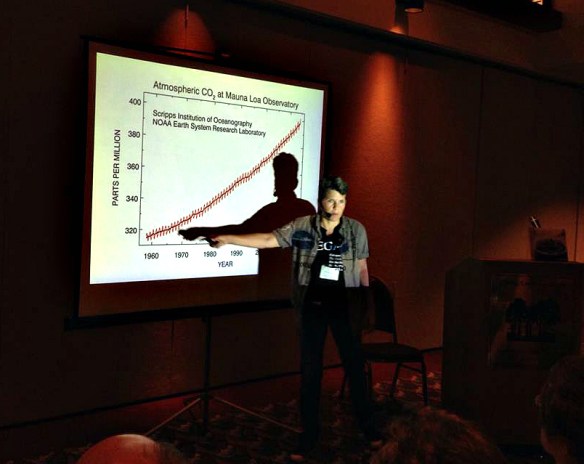
2014-summerfest-patreon-cropNothing could be more serious. Everything depends on climate. Plants are losing the conditions that support them. By 2100, some tropical regions are predicted to have 200 fewer growing days a year. Let that sink in.

And then think about what is happening to untamed animal communities when native plants stop growing where they live.

We keep on releasing stored carbon dioxide (by burning oil and gas) and disrupting Earth’s capacity to store it (by cutting down trees). We’re releasing methane into the atmosphere from our landfills, through fracking, and from domesticated animals, mostly cows. We’re polluting the atmosphere with nitrous oxide through our use of manure too.

And getting our proteins though animals raises costs. If your shopping bag is loaded with flesh products, including the bodies of marine animals, your receipt total is going to come out pretty high, compared to that of the shopper with a bag full of horseradish hummus, red and green cabbage, red pepper and ciabatta, sweet potatoes, etc. When we use cows, pigs, goats, rabbits, birds and other animals to funnel our protein through, we are not advancing culture so much as advancing business. I will use the term animal agribusiness when talking about animal farming and its attendant feed industries, and reserve the word agriculture for the growers who produce food.

Free-range is really another form of sprawl

It’s been ten years since the United Nations published Livestock’s Long Shadow, explaining the enormity of damage done through animal agribusiness. But the U.N. never suggested we stop farming animals or consuming the products (which many of us could do overnight). Its key recommendation? Greater intensification. In other words, consolidate and contain animals into high-volume operations. In situations of intense confinement, animals (along with their emissions and waste) can be more strictly contained; and with animals not moving as much, less feed is consumed.

What we learn from environmental science does not lead us to support any of this:Slide44
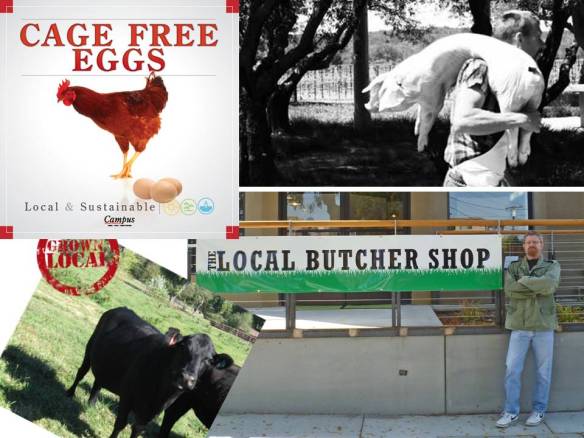
The above scenes are evidence of a spreading-out of the environmental problems we need to move beyond.

And the warmer the planet gets, the more intensively animals will be raised, for reasons such as temperature control. Overheated dairy cows aren’t efficient producers of milk. When the Union of Concerned Scientists, in their booklet Climate Change in Pennsylvania: Impacts and Solutions for the Keystone State, say that cows are going to need fans and water sprays to cool them as the hot days multiply (cows drink four times as much liquid as they produce in summertime), they too are indicating that factory-style farming is the way of the future. (Look at page 8 in this PDF.)

Nowadays it’s popular to say that “factory farming” is inhumane. Yet we have environmental scientists communicating some important realities about how “cage-free” systems just spread the emissions around and use up more feed to raise roaming animals. With animal agribusiness, you can’t win.

A better recommendation comes Vegan Environmental Party of Ontario when it calls on the government to divest from animal agribusiness by halting the subsidies.

Consider that we reserve about 20 million acres of land for alfalfa alone. (And it must be irrigated.) Virtually all of it is used as feed.

That is in addition to the imposition of the domesticated animals themselves on the land. We need not continue this overbearing way of living on our planet.

For reasons that are many and interconnected, we need to be creating animal-free meals. Seekers of pure vegetarian cuisine miss nothing and conserve so much.

Make reservations at Vedge in Philadelphia or Plant in Asheville if you want to go gourmet. Most cities now have such offerings. Want to learn to prepare food like a pro in your own kitchen? You can learn. Try a subscription to a home delivery service with recipes and instructions from a professional chef such as Trish Sebben-Krupka at VegTable.

“But I just eat fish!”

That’s another sector of animal agribusiness, and not a sustainable one. The people at Greenpeace say “sustainable seafood” is within reach. They want us to demand better labels on the bodies of marine animals in the grocery aisle so we can tell if codfish are being scraped off the Norwegian Arctic seafloor with massive trawlers. Why do they take this position when they could do better? If we can afford to get food from a grocery store, we can get pure vegetarian food and make it great. And for the climate’s sake, we should.

The personal and political 

Recently a study was published in the journal Climatic Change involving 60,000 “meat-eaters, fish-eaters, vegetarians, and vegans” in Britain. Remarkably, the study found dietary greenhouse gas emissions from the participating omnivores about twice as high as those from vegans. If we have the power to bring our emissions down so low, but we decline to use it, aren’t we committing malpractice as human beings?

By being vegan we can also alleviate social stress. The 2007-2010 Syrian drought, which forced rural people to move in droves to urban areas, culminating in one of the most severe conflicts of today, for example, was driven by climate factors.

What’s to come? We all know, if we read the papers, that 2016 has already shown record global temperatures, month after month after month. The New York Times offers regular reports on this, accompanied by  simplistic, incomplete advice. The Times acknowledges that the problem is complex and can feel overwhelming: “We get it.” 

But they don’t.

They mention “reducing meat” as one item in a list of things to do. They do point to animal agribusiness as the worst segment of agribusiness for the climate. The science would back the Times up on that one.  Slide36
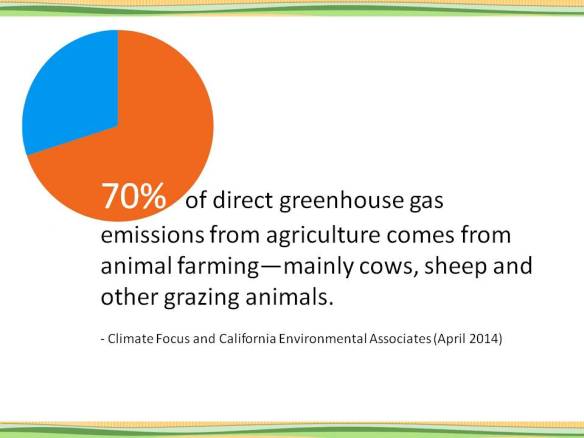
The Times tells us in particular that “some methods of cattle production” demand a lot of land. Now, wait. “Some”? All of it does, and all cows create manure and methane, whether out on the range or within walls.

The Times urges “switching from beef to pork and chicken” and suggests that chicken farming is the least harmful kind.

Let’s not even get into the harmful health ramifications of the “eat pork” advice. Pig manure is still manure and what the world needs now isn’t more of it. And you don’t help the climate even by buying local eggs and chicken or pig flesh. To do so means you’re really relying on a massive feed industry—a serious fuel guzzler. “Local” animal farming isn’t local—because animal feed is routinely shipped many miles for mixing and packaging, and shipped again in distribution.

The huge feed requirements arise in fish farming too. Farmed fish really are “chickens of the sea”; aquaculture is tied into the global grain and feed market and it’s expected to double in size by 2050. Why contribute to that?

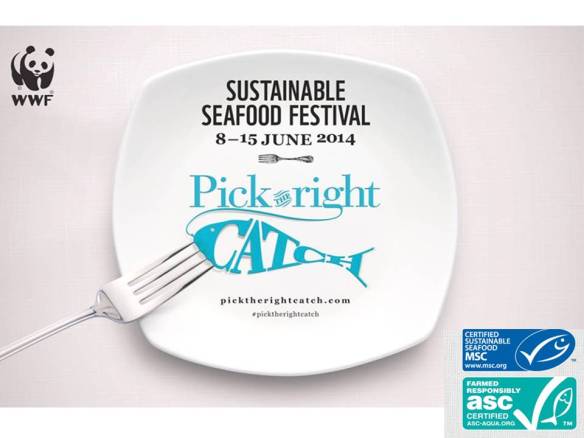
Instead, groups such as WWF should be funding vegan festivals.
Slide40


WWF’s so-called sustainable seafood standards are pressing small, family businesses, which once used by-products as feed, to enter the global feed market.

Before the pressure to adopt environmental standards like those of WWF’s Aquaculture Stewardship Council, catfish farmers used home-made feeds that included farm by-products. No more. Now the local farmers of the world have to vie for the labels that the affluent populations want to see in the grocery store.

Slide42Is it the height of irony that WWF would expose the “hidden soy” in animal products after pushing this same market?

People listen to the WWF and the New York Times when what they really need is no-nonsense information, and a key part of that information needs to come from those of us who’ve already divested from animal agribusiness in our own lives and can help others to do it.

This is not to say that being vegan is all we need to do. I’m starting to notice a lot of people picking out one kind of change that they like and claiming it as their part. I’ve heard people who bring their own bags back to the supermarket overstate the goodness of this good deed by claiming to be “saving the world, one bag at a time” (regardless of what products are in their re-used bags). Vegans need to be careful that we don’t fall into the trap of thinking we’re doing so much by being vegan that we ourselves needn’t make deep changes in our mindsets and actions.

I’ll also talk about the influence of religious doctrine and of education on people’s attitudes and understanding of climate change. I expect a lot of informed comments and feedback at Summerfest on Thursday the 7th. Join us in the Scholar’s Room if you can.

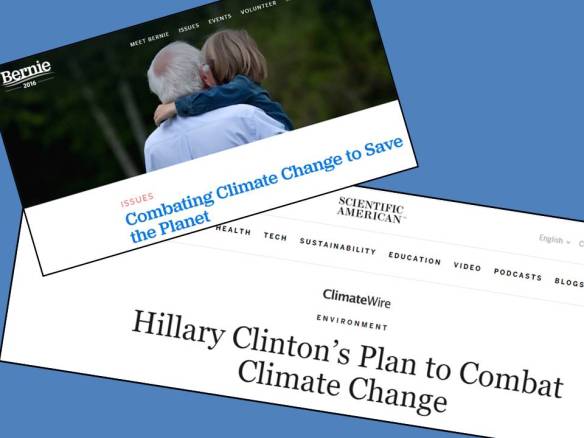
Meanwhile I’d like to conclude with a thought question. Should we use “the war on” language when we talk about climate? This language is meant to indicate a serious approach to climate change, which of course is well past due.
Slide50

But are we really in combat?

And should we be “arming” ourselves against the hordes of invaders coming in when climatic zones shift because of our own conduct?

Is warring against a natural system’s response to overload what we need to be doing? Is this the best mindset for the work we must do to put ourselves in good stead with our planet?

Let’s talk about this.