Animal Liberation Follies

Professional advocacy now congratulates itself for its hands-on manipulation of animal fertility. It’s a false anti-cruelty position that strives to replace guns, arrows and traps with high-tech animal removal. What gives anyone the right to impose birth control on untamed animals? What gives career advocates that right?

Read more at Dissident Voice  today.

Basic Respect

An Abolitionist View of Pets

By guest blogger Chris Kelly

For decades we’ve heard slogans such as “Animals are not ours to use…” We hear proclamations of anti-fur, labs, meat, zoos, etc. We rarely hear those individuals and advocacy groups proclaim opposition to pets…

Not just to puppy mills and abuse, but to the Frankensteinish manipulation of animals for the most frivolous of human-benefit reasons. I believe the large AR organizations have very specific reasons for avoiding this subject, and it has to do with donations – pet ownership is the “third rail” when it comes to fundraising. Forget animal humane-use/husbandry organizations (operating under the general term of welfare), as they are deeply entrenched in the pet status quo, some large ones even connected with breed activities.

People spend an incalculable amount of time and money fostering and rescuing pets in an attempt to alleviate suffering. Celebrities spend lifetimes begging people to neuter pets, we build bigger shelters, and we throw money at the horrors created by the pet mentality.

It’s easy to understand why many of us have large nonhuman animal families in our homes – we need to do something, if only by opening our arms and homes.

I think the vegan community needs to shine a light on the basic wrongness of the pet mentality. We need to acknowledge human responsibility to care for the animals we made dependent, while providing a path for phasing out pets. Webster defines respect (noun) as follows:  “a feeling or understanding that someone or something is important, serious, etc., and should be treated in an appropriate way.”  Pet keeping means total control over other beings, from conception to death – no room for respect there.

And, users are very adept at justifying their own practices citing regulations governing other users (example: Church of Lukumi Babalu v. City of Hialeah, 508 U.S. 520 (1993), allowing religious animal sacrifice after comparing it with allowed slaughter practices, pest control, and pound deaths). I doubt we will ever see any changes in line with abolitionist principles in labs, meat, and other user areas until pet fanciers realize their own complicity in the suffering which is domestication, starting in their own back yards. Perhaps we need to start a nonprofit focused on changing “animal lovers” into animal respecters.


ChrisChris Kelly has worked with numerous shelters and sanctuaries, including in the processes of writing by-laws and hiring, and as a media spokesperson. Chris has served on animal-rights discussion panels and managed online discussion groups, and organized protests. Vegan for 31 years, Chris self-identifies as an abolitionist. 


Victory for Ringling Bros. Elephants? Not so fast.

The Ringling Bros. and Barnum & Bailey Circus just announced plans to phase out elephant acts from its performances by 2018. The Associated Press broke the news.

Don’t miss the bottom paragraph. The people in charge of the largest group of elephants in North America say the 43 will be “retired” near Orlando’s tourist attractions, so the elephants, in addition to being available for elephant researchers, are slated ultimately for public display. Swapping the circus for a zoo is no bargain.

I hope the elephants are indeed let out of these degrading shows. I have been moved to protest — alone, when I could find no companions — by the sight of elephants paraded through downtown Baltimore, right past the law school. And while I’m sure it’ll come as a relief to the elephants to be spared the street parades, the amplifiers and the acrobatics under the stage lights, that relief does not address the fundamental fairness issue. On whose terms will the elephants live — ours or theirs? Other questions are all details springing from the root injustice, which involves a group of officious primates maintaining supremacy over their lives, bodies, histories, and all of their daily affairs.

Last month, I read the news that Ringling Bros. introduced its “Xtreme Camel Act” with Mongolian camel stunt riders. That tells us, loud and clear, how little this business comprehends or cares about the harm it does.

How Pro-Pitbull Crusades Harm Workers — and Dogs

Industry groups such as the American Pit Bull Foundation are out to vaunt the public image of these dogs, and “promote responsible breed ownership through providing owner and public education.” Why should animal advocates buttress their exploitive, deadly position?

Full article at CounterPunch today.

Fifteen Buzzwords Vegan Educators Can Stop Using Today

Semantics, says the Online Etymology Dictionary, is the science of meaning in language. To be understood, we need words to mean what the receiver thinks they mean. Semantics matter.

What about creating new phrases? When we choose coined terms, we’re usually communicating to insiders—others who’ve read the same literature. These terms often come from specific non-profit groups or individualsEureka - from espaciotiempo.org.ar claiming to advance a groundbreaking theory.

The use of a coined term even in a small group of insiders can cause misunderstandings, for it might suggest agreement with the whole kit and caboodle set out by the phrase’s inventor.

You might ask: Isn’t vegan a coined term? And so it is. But in its 70 years of use, it has become plain language. The word was offered by a community rather than an individual, and it functions as an essential signal to a unique and liberating pathway. It draws on a principle known and expressed for many generations, and channels it into a social movement’s terms.

Beyond that, the animal-rights idea takes no special jargon to explain. The idea that animal husbandry involves inflicting unnecessary harm is not a novel theory; it appears in Henry Salt’s 1892 book Animals’ Rights Considered in Relation to Social Progress. International Vegetarian Union historian John Davis says that although Salt died five years before the founding of The Vegan Society, the last 55 years of Salt’s life were lived (as we now say) vegan.

Much term-coining and buzzword creation that’s come along since vegan has muddied clear waters, as our competitive culture promotes the act of personal marking—branding, to use today’s infelicitous term—on something that could just be straightforwardly recalled.

Here are 15 words and phrases we could drop and be better off for it:

1. Welfarist. For anyone who missed the “abolition-versus-welfare” back-and-forth, a quick synopsis. The animal-rights ideal would mean everyone opts out of using other animals. Instead of making that clear, charities continue to use heart-wrenching images and vow to fix the most “barbaric” abuses. Pity doesn’t challenge the status quo. A donation to reduce spectacular suffering can affirm the donor’s superior status in the system, changing nothing. PETA asks restaurant chains to prefer chicken suppliers that use gas slaughter technique. If any businesses enter into such preference agreements, PETA will publicize their promises to consider better animal welfare. Because it’s been connected to this kind of industrial whitewashing, welfare is used by some critics as a negative word; people who promote minor changes in animal enterprises are derided as welfarists. But does the word welfare have anything to do with the way businesses adjust their handling of the animals they own, use, and ultimately kill?

In contrast, an authentic caregiver promotes animal welfare. Trap-neuter-return work—catching abandoned domesticated cats and their offspring, neutering them, and supplying continued care—is praiseworthy welfare work. Welfare, to the ordinary ear, means well-being. So, right now, we should stop using welfarist as a negative code-word. (I should add that rescuing or “helping” animals does not, by itself, advance animal rights. But rescue and genuine caregiving are needed when we humans have caused an emergency in other animals’ lives, or imposed dependency upon them.)

2. “Stop factory farming!” Can we object to all animal farming at once? Even the small, family-run farm violates other beings’ most basic personal interests, beginning with the purpose-breeding of them because we can. And such farms still use resources that could feed hungry humans. Mathematician Adam Merberg published rough calculations suggesting a well-known free-range farm uses more calories in feed than it produces in food; and with the needless waste they generate, these property developments degrade water, soil and air. The very existence of any pastureland signifies predator removal. There is no benign animal agribusiness. Not for the planet, ourselves, the animals we’ve domesticated or those we haven’t.

3. Euthanasia. The term means a good death. It does not mean killing refugees to make space or save resources. Starting today, let’s all rule out the term euthanasia to mean the cold-blooded killing of a bear who chased a camper, or the death of a dog in a so-called shelter.

4. Companion animals. It’s not fair to selectively breed other animals to suit our desires, then call them companions as though they chose to hang out with us. I know: this is a tough one. Most people reading Vegan Place care for and love individual animals in our homes. So it can be hard for us to challenge the practice of keeping household animals. It might feel unloving. But step back and consider how they got here. These animals’ domestication is based on neoteny—the purposeful retention, in an adult cat or dog, of juvenile characteristics that prompt an animal to need and solicit care.

Most vegans already agree that nursing on another species is weird, and indeed that selectively breeding animals so we can take their milk is weird. Isn’t it also weird to want wolves and wildcats selectively bred so we can make them forever dependent?

And fashioning toys out of powerful wolves and wildcats—separating them from their families, buying and selling them, subjecting them to praise or punishment at whim, making ourselves their indispensable overseers—can hardly be justified on the grounds that pets benefit from the arrangement. Did it really benefit wolves to become Schnauzers? The land that is now the United States was once home to hundreds of thousands of wolves. Today, it has a few thousand wolves and 80 million domesticated dogs.

rackIf we’re honest with ourselves, we’ll admit that we have, over time, forced free souls into submission. And when we think of it that way, companionship is an unfair term.

5. “Why love one but eat the other?” I’d think genuine advocacy seeks to cultivate an attitude of respect, not love in a system of inequality. If so, the best thing we can do as teachers is to inspire communities to respect other animals’ natural freedom and power—all that is taken away when we transform the Earth’s other conscious life into shapes that please us. The vegan issue isn’t about why we only eat one, but why we purpose-breed either.

6. Farm animal rights movement. There is no such thing. To animal agribusiness, the effective response is conscientious objection. Those who feel they are missing an ethical duty by not showing undercover videos or lobbying for animal-husbandry adjustments might consider farmer Harold Brown’s counsel: Let the animal farmers themselves improve conditions (they will, for PR reasons) as the vegan movement grows without them. Leave them without assistance, threats, cajoling or praise. It’s not the advocate’s role to police an abusive system.

7. Farmed animals. Why, instead of farm animals, has it become fashionable to say farmed animals? As in: animals who just happen to be farmed? It’s not as though we could just stop using them on farms, and the problem is solved. These animals have been selectively bred as farm animals: to be as easily confined and herded as we can make them. We need to do more than rescue them from farm use; we need to challenge the purpose-breeding at the root of the wrong.

8. Vegan cats. One of these words is not like the other… Veganism is an ethic that can be safely, harmlessly, naturally embraced by human primates. Forget about forcing cats to eat plants, and start getting vocal about the making of pets in the first place. See #4.

9. Single-issue campaigns. Should we dismiss the defending of any targeted group because it’s “single-issue”? What wrong done to a community or even to one person is beneath concern? All lives matter.

10. Wildlife. Aren’t we talking about animal communities? The word wildlife can mean plants as well as animals. Moreover, wild means uncultivated—a concept that falls short of representing the complexities of the non-human lives, systems, and interactions.

11. Humane, non-lethal alternatives.  Don’t do it. Don’t ask managers to put free-living animals on birth control rather than shoot them. Earlier on this blog I shared my column examining the way forcing contraception on animals became confused with advocacy; here is that link again. Read it and weep for the deer of Valley Forge National Historical Park and at several other National Parks in the eastern United States, where plans are being carried out to kill kill kill for as many years as park managers say so—until they get approval for some disappear-deer drug. The Natural Resources Director at Valley Forge claimed to have implemented this plan as a compromise with animal-rights activists.

12. Ethical vegan (also: abolitionist vegan). There is no unethical or pro-exploitation kind of veganism. Nor must we establish subcategories, subcultures, or exclusive clubs for only certain vegans. Vegan is vegan.

13. Meatless. Meat means an article of food or an essential part of something. It’s the term animal agribusiness which covers all the interconnected exploitation of an industry at once—and doesn’t suggest that vegans lack anything.

14. Veg. Nobody knows what that means. 

15. Vegan options. How about vegan offerings? In contrast to the if-we’re-lucky connotation of options, vegan offerings has a ring of confident generosity. Let’s imagine, discuss, and create a culture that makes animal farms history, one where vegan living is embraced as the way to sustain our world.


Thanks to Meg Graney and Kate Sparkman Sharadin for helpful online comments that got me in the mood to write this up. Source of banner detail: Shop With Meaning. Source of Eureka! drawing: EspacioTiempo (PDF). Source of St. Bernard breeding rack photo: Stornum Kennels.

Who Owns the Bees?

Honey, vegans have noticed, is a food made by bees for bees. When I first became vegan (back when we had to walk ten miles uphill, both ways, to get vegan ice cream only to find it wasn’t invented yet), I heard honey was left to the discretion of the individual vegan. Years later I’d be corrected on that point by a document from the really early days of the vegan movement, unequivocally declaring honey is not ours for the taking.

But what about products pollinated by bees? As bees have co-evolved with plants, so have we co-evolved with bees, who pollinate our tomatoes, berries, peppers, squashes and nuts. Can we have these foods without the deliberate exploitation of bees? It seems only vegan-organic growers can claim to produce food for human communities free from the commercial pollinator industry, which takes half its profits from almond production.
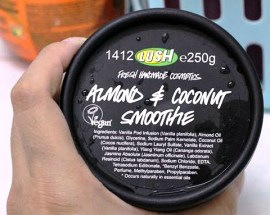
Skin cream from Lush.

An almond-based skin cream. Looks like there’s palm oil in there too, but I’ll leave that for a future blog entry…

Store-bought almond milk, almond-based skin-care products, and almonds themselves are vegan; but with such a large human population craving these nutrient-packed nuts, it would be no mean feat to find an almond-based item produced apart from commercial bee pollination. In the United States alone, pollination by honeybees and other insects facilitates $40 billion in commerce annually, according to the North American Pollinator Protection Campaign.

But in recent decades, in the shadows of our burgeoning population and the advent of mass-scale agribusiness, flat fields have stretched over habitable landscapes, wiping out hedges and flowering shrubs. Large, social bees such as honey bees and bumble bees have faced “colony collapse disorder”—entire bee colonies dying suddenly. Dairy and other animal farmers are becoming concerned about their stores of feed, including alfalfa. And note that farm animals are being fed seven times the grain that people eat directly, at least in the United States. All told, the overwhelming factor straining bees is animal agribusiness.

Varied reports of collapses have appeared out of about half of the United States, from the Mediterranean region, and from Britain, and from China and Australia as well. When we lose what insects do for us, we notice them.   Scientists are now urgently recommending conservation efforts for all kinds of insects, given their ecological role as pollinators and evolutionary significance in the web of life.

Beekeeping: Part of the Problem?

The Public Broadcasting System’s Nature webpage “How can you help the bees?” recommends leaving wild spaces in gardens and avoiding pesticides, and it counsels readers to “put pressure on politicians to reinstate laws that used to prevent importing bees into the country and transporting them across state borders.” Yet PBS displays concern for them only insofar as one species—the species in which we happen to identify ourselves as members—wants to keep taking advantage of bees’ work.

In 2007, PBS reported that genetic testing had shown a link between the collapses of bee colonies and a virus. The study was led by the U.S. and Pennsylvania agriculture departments and two universities: Penn State and Columbia. That virus was discovered in 2004, the same year U.S. beekeepers started importing packaged bees from Australia.

Thus it’s a bit odd that PBS urges viewers to take up home beekeeping. Beekeeping threatens other animals as well. Gorillas have had to deal with hundreds of bee farmers in Rwanda, Congo and Uganda who use the forestland of the Virunga Mountains to produce beeswax for candles and the cosmetic industry.

Meanwhile, a new area of vivisection has arisen, with the aforementioned U.S. government and Penn State researchers setting out to “stress bees in certain ways and evaluate the effect on their health” in order to determine whether the virus itself wipes out colonies or if instead the disorder is triggered by other pathogens and stresses. Israeli researchers have posited that virus-resistant bees can be bred, and initiated yet more experiments, injecting bees with viruses.

Overbearing keepers

The earliest pollinators were insects such as beetles, but bees became specialists—more efficient than beetles, butterflies, pollen wasps, or any other pollinating insect. Bees’ ancestors are the wasps—predators of insects. Some wasps, commonly known as beewolves, prey on bees themselves in order to supply food to their carnivorous larvae. Thus, to some beekeepers, predator control means targeting wasps.

Unlike bumble bees, who typically form small colonies of 50 to a few hundred members, honey bees might form groups of 30,000 or more, so they’re exploited as high-volume producers. Yet bumble bees can fly in cold temperatures and keep moving after dusk, and they’ve been used for those abilities. Plus, they can pollinate tomatoes by holding a flower while buzzing with their wings to vibrate and loosen the pollen. And as they survive indoors, they’ve been used extensively in greenhouses.

Worldwide, humans use bee colonies in the millions to obtain honey, pollen, royal jelly, novelties such as propolis lollipops, mead or honey wine, beeswax candles and cosmetics. To obtain these products, beekeepers regularly disturb the hives, crushing some bees in the process. Beekeepers will replace the bees’ honey with high-fructose corn syrup or cheap, refined sugar. Many beekeepers will clip the queen’s wings or use excluder cages to keep queens from moving hives; many will also kill queens when their egg production wanes. Some keepers smoke bees out of the hive to get to the honey, or torch whole colonies before winter.

In a natural environment the queen bee would locate the hive. The bees would gather nectar and pollen to feed their own communities. Do the bees themselves care that they have lost control over their lives? Probably. Bees have brains. And a large body of evidence (often noted as beginning with observations of Austrian zoologist Karl von Frisch) shows that bees exchange information, make group decisions, form abstract concepts and create intricate forms of nest architecture. They have life experiences, steering clear of dangers, and seeking out what appeals to them and sustains them.

Dubious Cures 

Honey can contain bacterial spores which reportedly cause botulism in human infants. And propolis, a gluey product of beehives, has caused allergic dermatitis in beekeepers and people who use it in cosmetics and medicines. Nevertheless, apitherapy, or the health-related use of honey and pollen, propolis, royal jelly and bee venom, is promoted by some as an arthritis cure. The American Apitherapy Society, in New York, admits bee venom treatments haven’t been adequately evaluated in the United States, and that no doctors use them; yet the group promotes the 1935 “classic” Bee Venom Therapy: Bee Venom, Its Nature, and Its Effect on Arthritic and Rheumatoid Conditions by Bodog F. Beck, M.D. In a foreword to a reprint of Beck’s book, Charles Mraz writes: 

One of the first duties I assumed when I met Dr. Beck was to take charge of his beehive on the window sill of his office. He had a five-frame hive, covered with a wire screen. The bees had an entrance through the window so they could fly outside and gather a surprising amount of honey from Central Park during the spring and summer months. He had a small metal door on the screen which could be opened easily and the bees removed with long forceps and the bee applied to the patient’s affected areas. This created a perpetual supply of a “self-activated, self-contained, sterile hypodermic needle.”

The usual treatment involved bees applied every other day, thrice weekly, over arthritic areas and the spine. Clients experienced large, hot, itchy swellings, pain and nausea. “During this reactive stage,” recounts Mraz, “the patient often felt worse and would become greatly discouraged about the treatment.” Mraz insists, though, that they would often later become well.

An association called the North American Apiotherapy Society began researching and promoting the use of bee venom, which has also been tested on mice as a failed medicine for multiple sclerosis. In the 1990s, Vespa Laboratories and the (U.S.) National Multiple Sclerosis Society gave a research grant to Fred D. Lublin, M.D. and colleagues at Allegheny University of the Health Sciences in Philadelphia to inject mice with doses replicating between four to 160 bee stings, then wait for symptoms such as limb paralysis. They reported no clinical benefit at any dosage level, but said the numbers of mice were too small, and went on to conduct additional studies. 
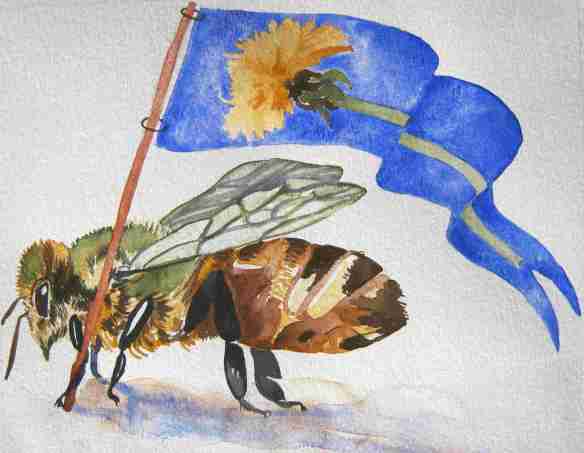
J. Muir: Bees for Peace

Bees for Peace, by J. Muir

Supportive gardening

There’s a good deal of emerging science on bees these days, but few expressions of how bees matter to themselves. Yet there’s something to be said for stepping outside our own skin some of the time. Our view that everyone else in the bio-community is around at our beck and call is a major underlying factor in Earth’s current biodiversity crisis. Probably the major underlying factor. Are we, at some point in our lives, able to see ourselves as cohabitants with other living communities, rather than the planet’s biggest user? It seems to me this is what vegan striving is about, all the time.

Anyone with some garden space can help bees to flourish on their terms. Bumble bees make nests in grass or holes in the ground, such as abandoned mouse nests, so it’s a good idea to leave a spot of unkempt garden space. Early spring flowers are particularly important to new bumble bee colonies, and bees especially appreciate blue, purple, and yellow flowers, planted in clusters. Gooseberry is an early bloomer, and the graceful camas lilies are perfect for bees in the Pacific Northwest and British Columbia. Avoid ornamental types, as they can be short of nectar or pollen; native plants are best adapted to the life cycles of local animals including bees, and also provide key connections to remaining wildlands. Eastern waterleaf, a groundcover, is an example in the central or northeastern United States, where these herbs naturally bloom from May to August.  Large, lavender beardtongue blooms over the North American prairie in May and June. Deciduous azaleas are native across North America and so are rhododendrons.

Purple prairie clover is indigenous to the North American Great Plains. White clover is native to Europe and Asia, but has become naturalized in much of North America, and if you’ve got it in the summer, it will be a smorgasbord for bees and moreover it’s an edible plant, eaten raw, cooked, baked, or used in teas for its nutritional value. From British Columbia across the prairies and into western Ontario and the adjacent states, the anise hyssop (liquorice mint) blooms all summer, and the flowers also work for teas and traditional tea breads.

In the northeastern U.S., late October and early November is the time to collect milkweed seeds for planting in the spring; and native bee balm will attract bees, butterflies and hummingbirds in early summer. The fragrant, dusky-green leaves may also be used in teas. Joe-pye weed, a perennial native from Maine to Michigan, south to central Florida and Texas, is beloved by moths and butterflies and bees.

And isn’t it the greatest feeling to walk or jog alongside patches of blooming goldenrod in late summer and see the bees buzzing around them? Asters too, hangouts for bees and butterflies alike, are native to the northern United States as well as Canada from British Columbia to Newfoundland. Aster alpinus is the kind native to North America. In Britain, Aster tripolium, or sea asters, are indigenous. And when autumn arrives in the Northern hemisphere (Europe and North America included), sedum is the bees’ knees, and its leaves are edible too.

The growers at the Vegan Organic Network advise us all to do some gardening, even a little, even inside. Like learning to prepare meals, it’s a basic life skill and a way of cultivating vital social networks. What will you grow this year? Would anyone care to add some pictures or pro-bee gardening information?
Artist J. Muir paints with vegan, cruelty-free, earth-based watercolors from Colors of Nature
Source of Lush skin cream photo: http://soloverly.blogspot.com/

A Note on World Vegan Day 2013

It’s today! Plenty of delicious vegan dinners are about to begin; at 7 o’clock tonight I’ll be at SuTao in Malvern, Pennsylvania, joining a celebration buffet with the house full of vegans, aspiring vegans, and potential vegans of the Delaware Valley.

Isn’t it great how the vegan word is getting out? Next year, the vegan movement turns 70. In the span of a human lifetime, much has been accomplished.

During November especially, I like to appreciate the people who started things off.

They were a small, focused group. Originally they’d called themselves the non-dairy vegetarians. They weren’t breaking away from the vegetarian movement that (drawing on a much longer history spanning Mediterranean, Middle Eastern, Asian, and African regions) arose in Britain and the United States in the nineteenth century; they were the ones, rather, taking its mission most seriously.

For the original principle and thSunflower at old shede definition of vegetarianism was indeed vegan.

John Davis, historian for the International Vegetarian Union, writes of the first vegetarian society in England: “In the early 1850s the magazine representing the Society had quite clearly defined it as: ‘Vegetarian: one who lives on the products of the vegetable kingdom.’” In the early 1900s, the Vegetarian Society’s Vegetarian Messenger, citing ethics and human health, reaffirmed its support for a diet free of eggs and dairy.

In the 1940s, the vegans emerged to underscore the “non-dairy” aspect of the vegetarian platform. Nor was free-range farming a step in the right direction in the vegan paradigm; in fact, it was the free-range farms of England that the founding members had found unacceptable. In the Vegan Society’s first newsletter, Donald Watson wrote: “We can see quite plainly that our present civilization is built on the exploitation of animals, just as past civilizations were built on the exploitation of slaves…”

Defining veganism in 1951, Vegan Society VP Leslie Cross wrote that the concept “possesses historical continuity” with the anti-slavery movement, and further explained:

…veganism is not so much welfare as liberation, for the creatures and for the mind and heart of man; not so much an effort to make the present relationship bearable, as an uncompromising recognition that because it is in the main one of master and slave, it has to be abolished before something better and finer can be built.

And so began a movement, explicitly connecting vegetarianism with a liberation call, based on a stated conviction that humanity has no right to exploit other creatures for our own ends. The vegan’s diet—which can be absolutely exquisite as chefs will reaffirm tonight at SuTao and many other restaurants and kitchens worldwide—would come entirely from “fruits, nuts, vegetables, grains and other wholesome, non-animal products” and exclude “flesh, fish, fowl, eggs, honey and animal milk and its derivatives.” Encompassing the diet is the principle. The early vegans took the war-resister’s principle of conscientious objection and expanded it to encompass all conscious life.

Essentially, some two dozen people set out to activate a paradigm shift in the human identity. Donald Watson, who pointed to the Essenes as one example of a group that had conscientiously avoided animal exploitation, was doubtless also inspired by the uncompromising opposition to vivisection demonstrated by Frances Power Cobbe, founder of the British Union for the Abolition of Vivisection. Also present at the time of the Vegan Society’s formation were opponents of “cruel sport”; the vegans merged the separate anti-exploitation movements together into comprehensive animal-rights advocacy with personal commitment as its basis, and an emphasis on continuous public outreach to raise awareness of, and challenge, humanity’s ordinary uses of animals, whether for human food, work, “sportsmanlike” pursuits, product testing, or any other reason.

“If the vegan ideal of non-exploitation were generally adopted it would be the greatest peaceful revolution ever known,” said Donald Watson, “abolishing vast industries and establishing new ones” in the better interest of human and non-human animals alike. This is a simple ideal, but it is far from easy, for in order to emancipate other animals, vegans “renounce absolutely their traditional and conceited attitude that they had the right to use them to serve their needs.”

No revolutionary idea appears, of course, without attracting people who’d like to blend it into something else. The humane charities’ Big Tent prefers not to see veganism as a movement, instead referring to it as a “tool” for opposing the “horrors of factory farms and industrial slaughterhouses”—although veganism came not to challenge factory farms, but to challenge animal farms.

Admittedly, the vast scale of animal use and the ubiquity of animal products can be overwhelming. Anxiety, driven by the thought that assaults on animals won’t end in our lifetimes, might lead us to ask whether pressing for industry reforms is the best we can do. Reforms or no reforms, suffering isn’t reduced when animals are unnecessarily bred or brought into an exploitive system.

The call for animal-husbandry reform, “compassionate standards” for agribusiness, etc. is an appeal to politicians and the owners of animal enterprises to do something helpful for a principle. Ordinary people who sit down to our dinners, not these authorities, have the real power. Veganism is both direct action and a genuinely humane agriculture.

Why November?

There’s something noteworthy about the designation of this day and month itself. When people at the Vegan Society resolved to set a special time to celebrate the movement, they first considered September. The 2nd of September was the birthday of Donald Watson, who put together and sent out the first copy of Vegan News—and many copies to follow. But Donald said the day shouldn’t be focused on any particular person; so rather than Donald’s birthday, the members agreed to pick November—anniversary of the first issue of the Vegan News. 

I thought of this recently, when Natasha Lennard in Salon discussed a political commentary made on television by Russell Brand. Brand called for political change at a deeper level than our prevailing voting system can reach. Lennard agreed, but rightly pointed out that people were, maybe a little absurdly, making Brand into an idol for saying it. Weary of Brand’s “famous-person” stature, Lennard explained: “I love much of what the boisterous comedian says, but this Great Man narrative lets sexism slide and has to go.” Lennard then asked:

Would he be willing to destroy himself — as celebrity, as leader, as `Russell Brand`?

Evident in the vegan scene today are efforts by some self-styled leaders to develop specific approaches to ending animal exploitation or spreading vegan ideas. We do, I’d say, have to deal with the Great Man narrative in the vegan movement. (That narrative is not the same thing as outright misogyny, which Lennard also discusses—but the narrative is both a facilitator and a result of the gender-infused hierarchy within which all of us are obliged to live and work.)

Anyone turned off by famous-person figures in the vegan sphere can take heart, knowing that the vegan principle has a long history, in no need of reinvention, in no need, even, of leading spokespersons. There’s no reason to throw the bathwater out with the babies. The idea that we need to follow any person’s “abolitionist animal-rights” or “ethical vegan” approach is redundant: those concepts are the core of veganism and have defined it from the start. This is not about advancing a personality. This is about advancing a social movement. Every vegan is this movement’s representative.

Next thing for today: Not only did Donald Watson eschew the famous-person mantle, but Donald actually did not take credit (sorry, Wikipedia) for coining the word vegan.

How did they get the word vegan?

The term vegan was adopted in 1944 by Vegan Society founding members Donald Watson and Elsie Shrigley. Dorothy (Morgan) Watson thought up the term and offered it to Donald—at a dance they both attended. (I thank Patricia Tricker and George D. Rodger of the Vegan Society in Birmingham, England for this intriguing piece of information.) The word came from the first three and last two letters of vegetarian—because veganism starts with vegetarianism and carries it through to its logical conclusion.

To be a vegan is to adopt a revolutionary worldview. We have found that that egg, flesh, and dairy production and consumption can be hazardous to the planet and our bodies; and that animal husbandry, whether pasture-based or assembly-line, involves exploitive treatment of other conscious beings. We don’t want to play a role in that; nor do we wish to be at war with free-living animals.  As vegans, we strive to live harmoniously with the planet and all its inhabitants.

Some of those inhabitants, of course, are other humans. And in the year ahead, in addition to noticing the word “vegan” all over and maybe getting a slideshow or two done on this blog that others can use, I hope to be engaged in discussion of the meaning of veganism as a movement, and also the way it encompasses kindness, solidarity, and respect. People who become vegan don’t all embark on this journey from the same starting point, and are not always going to agree with each other as we proceed along the path; but we can strive with integrity to work through things. It’s really important that we figure out how to disagree without hurting, and to agree without competing. I welcome further dialogue here on all of the above thoughts.

Love and liberation,

Lee.

Is a Vegan Humanity Possible?

Life on Earth is getting stranger. When the vegans started out in 1944, they noticed that our population, even then, weighed heavily on the planet. In seventy years, we’ve gone from two to seven billion human beings, with the number of animals bred into existence to feed many of these people—the land animals alone!—numbering in the many tens of billions.

The easy thing to do is be pragmatic and figure other animals are losing their habitat forever as fast as we can grab it, that we are incorrigible domesticators, and that life is everywhere commodified, so the best we can do, given that other animals are always going to be in some sort of relationship with us, is to be as easy as possible on all the other animals we control.

And yet I feel sure a world with room for animal rights is a world that’s still possible. Our dominion will be overthrown at some point anyway. Should we exhaust our planet, the force of life will rearrange itself accordingly.

The question for us, then, is whether we want to swim with the tide—with conscious awareness. Whether we grasp that we—scared little primates with big weapons, as Harold Brown has called us—are not in charge of this planet; whether we acknowledge that our lives unfold within a bio-community; whether we value, and will strive to increase, our capacity to respect other communities on this Earth.

Animal law generally misses these questions. It’s become part of North American social and educational life, with the model often involving pressure for courts to recognize, as animal law professors tend to put it, other animals’ true value and special place in our homes. But to me the radical hope was expressed when law professor Catharine MacKinnon (in the 2004 essay “Of Mice and Men: A Feminist Fragment on Animal Rights”) called for a new way of understanding animal advocacy, observing that the primary model of animal rights to date “misses animals on their own terms.”

Vegans have risen to the occasion and refused to be consumers of animal commodities. This general opting-out is the broad base for dissolving the for-sale status of other animals, and (because being vegan isn’t just about what we don’t want) letting them thrive on their own terms in untamed spaces.

Consider the free-roaming horses. They, at least in the United States, are continually rounded up and auctioned off. Some have been trained as border guards, others for display in circus-like shows. Some have been sent to die. Many animal advocates are focused on closing horse-slaughtering plants. From the vegan perspective, confronting slaughter makes sense—but only as part of a broader, autonomy-seeking perspective.

Nor is the answer to impose birth control on free-roaming horses while cattle ranches expand.

There is a law—the Wild Free-Roaming Horses and Burros Act of 1971—that set out to let free-roaming horses and burros do just that: roam free. It hasn’t worked out. What horse advocates need, I believe, is to link to a vegan ethic: the permanent boycott of flesh and dairy products so animal agribusiness doesn’t push these horses and burros off the land.

An enormous segment of the human economy is based on taking habitat out from under other animals, yet each one of us has the power to change this structure. What’s more, we all know and constantly encounter other people with this same potential. People can and do respond to reasoned optimism.

May we stay mindful of the ideal and strive for it, so that wolves, coyotes, horses, bison, deer, elk and moose may freely roam their habitats. So that bears flourish, bees flourish, and horses live freely on Chincoteague, Assateague, the western ranges…Nova Scotia and the Nemaiah Valley. So that no one is calling for roundups, because the products of cattle ranching are no longer in demand. So that jaguars, pronghorn, and nectar bats, humans as well, have the right to move across the face of the earth. So that Earth’s CO₂ balance is restored, its wildlands are recovering, its air and its waters are clean and clear. So that pesticides are things of the past and the only lethal traps, snares, birdcages, guns, fishing poles and spurs left in the world are in antique stores.

Love and liberation,

Lee.