I know most of you are not in Bucks County, Pennsylvania, but just in case…
I’m contributing to this conference, to be held 27 September 2025 at Bucks County Community College. Here’s my session summary:
Vegan for Earth’s Climate and Habitats. Explore how to converse about climate and ALL of Earth’s living communities — and why veganism makes all the difference in the world. 10 – 10.45 am by Zoom, for attendees.
There will be other presentations on various themes. The exhibitor lineup includes the community college itself, as well as Horseracing Wrongs, Rowdy Girl Sanctuary, the Bucks County Society for the Prevention of Cruelty to Animals, plus cat and rabbit rescue groups. They’re being highlighted on the Facebook page for the event. (That’s a public page so you don’t need to have a Facebook account to look in on the posts and responses.)
While millions of people seek food aid, we feed billions of farm animals.
Fish, dairy, meat and egg products take a huge toll on the planetary systems that sustain our lives.
Let’s be clear. We’re talking about all of animal agribusiness, not just factory farming.
The local, family-run farm betrays animals who trust their keepers. It exploits resources that could sustain hungry and thirsty humans. Its waste is largely unregulated simply because small farms (which are many, in the aggregate) slip through the cracks of federal environmental law. The development of local animal farms is a form of sprawl, no less than roadside malls and mini-marts. And animal farming involves the selective breeding, the purpose-breeding, of members of other living communities.
There is no fair animal farming business.
Nor is animal ag conducive to social fairness among human beings. Animal ag on every scale contains gruesome work. While we don’t want to see how the sausage is made, someone has to make it for so long we demand it. Those in the supply chain work long hours; some are migrants, housed in dorms to be ever-available.
Save for a handful of animal refuges, all animal farms sentence their nonhuman residents to death at some point. And that means some humans experience the repetitive and ghastly trauma of the killing floors. A more privileged class need never witness the sausage being made.
Veganism responds to urgent food security and social justice needs. If it can’t solve world hunger, at least it can drastically reduce it. And in a time of global climate breakdown, high-protein, drought-resistant pulses such as lentils are making a comeback.
As a principle, veganism holds that humans are one community among many, not the very point of Earth’s existence. Vegans relinquish the human assumption that the Earth (or any other planet) is ours. Consider how this enriches the human experience. It calls for a truce with, and maybe even a sense of contribution to, life on Earth that could not be experienced otherwise.
And here I’m getting into Jeffrey Moussaieff Masson’s urge to “go to the root of the trouble.” Jeffrey says:
I believe the single most dangerous idea of the human community is pseudospeciation—the belief that we are superior. This leads to depersonalization of “other” cultural groups within humanity, as it mimics our notion of dominion over all nonhuman life on the planet. If sustained any longer, it will surely undo us and much of the living world. How long can we cling to our illusory feeling of control that has already fashioned hominids into the most destructive presence the Earth has known? Yet there is hope; we do have the mental power to decide on the side of respect rather than exploitation. The point is to strive. The path ahead might not always look the same to you, to Lee, or to me as we contemplate this shared journey.
After noting the pain involved in acknowledging domestication as exploitation, Jeffrey says:
I would go even further: I would claim that humanity’s original sin lies in the domestication of animals.
I’ve been thinking about what I do as a vegan by being car-free. Just as I resisted cheese for the calf and the cow, I’m now resisting gasoline for climate-distressed sandpipers and sea lions.
Read the full entry in our Studio for the Art of Animal Liberation.
Let’s talk about it, at 6pm EDT on Thursday, the 11th of April. Come on down to the American Vegan Society’s Philadelphia digs in person, or settle in with a nice cup of tea and attend via Zoom! Either way, registration’s open.
I know this is terribly late at night for friends over the sea, but I understand it’ll be recorded and in any case I’ll be adding to this blog entry so you have some more of the gist. Check back often! Meanwhile, don’t forget to register at the link above if you can make it.
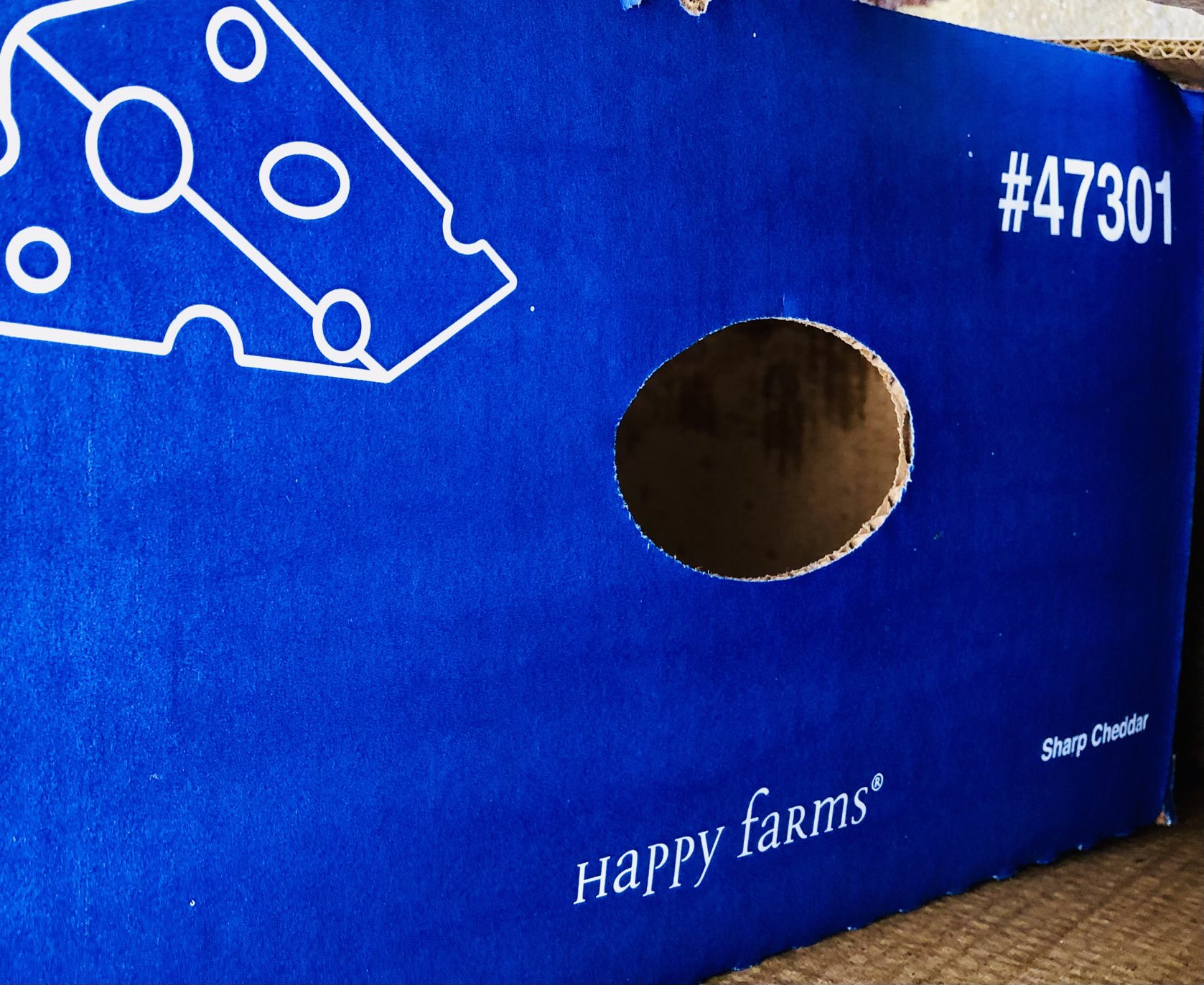
What’s so happy about purpose-bred animals confined for life, forced to endure serial pregnancies so human primates can cart their babies away and make snacks out of their maternal milk?
Someone went to work one day, and the task was to design this for the box printer. Precious human hours slid into the lies like sands through a minute timer.
That’s all for now. Thank you for keeping our hope for a better and honestly much happier culture alive.
It’s Solstice Day, and I want to say something uplifting, but oh, dear friends, I can’t absorb this nonsense any more. And I don’t believe any of us ought to. This is not fair. This is not love.
FRIDAY, 22 JULY 2022, 8-11 PM (EDT: the New York/Toronto time zone).
Let’s converse about the diet-climate connection and go deeper still. Why do we assign ourselves the right to displace habitat with systems that are not only massive emitters, but also massively aggressive to the natural web of life?
Human domination of the planet is the big issue we need to address. It’s also the most entrenched problem humanity has ever had to face.
But we cannot go on living as we are. We need to rethink our identity as a species on a living planet.
Please come to the Second Annual Vegan Climate Summit if you can. It would be great to see you there.
Event co-ordinator Kyle Luzynski of Project Animal Freedom is a patron of the Art of Animal Liberation. Project Animal Freedom has a very gutsy goal: cultivating a fully vegan Midwestern U.S. by 2056 through a strategic, chapter-based system.
Without getting too number-focused, how can we explain, in vivid and memorable language, the real and measurable impacts a vegan makes for climate and animals (humans and others)?
Just as important: How do we share this information before it’s too late?
Lee Hall holds an environmental law degree with a focus on climate change from Vermont Law School. A 39-year vegan, Lee wrote the “Nonhuman Rights and Human Sustainability” entry in the Encyclopedia of the UN Sustainable Development Goals.
EVENT DETAILS: 17 June 2022, 6:00 pm at the American Vegan Center, 17 North Second Street, Old City, Philadelphia. Open and free; KINDLY REGISTER HERE.
North America, 2022—More than a fourth of North American bumble bee communities face extinction risk. The American bumblebee (Bombus pensylvanicus) population has declined by nearly 90% and may soon be listed as endangered. The bees’ nemesis is land development. Competition from trafficked honeybees worsens the situation.
Understanding climate disruptions on bees, say researchers, is also vital. The International Union for the Conservation of Nature says one necessary step is to create a global database of bee records. Fine, but let’s do what we can now, before it’s too late to apply anything we might learn in the future.
Beekeeping is not the answer…
Avoiding the products of animal agribusiness is. Animal ag consumes massive amounts of feed crops—and is thus responsible for most bee use. Dairy companies use alfalfa feed crops, pollinated by bees. Those bees, like the beekeepers’ honeybees, are commercially trafficked to the United States.
Devote a simple patch of garden space to the cause. Choose bee-friendly, indigenous flowering plants, like liquorice mint, joe-pye weed, sedum, bee balm, beardtongue and native asters. Buy them from dedicated native plant sellers.
The growers at the Vegan Organic Network advise us all to do some gardening. Even a little. It’s a life skill, and a matter of animal liberation.
Bill Gates: “Now I’ve said I can actually see a path. But you’re right that saying to people, “You can’t have cows anymore”—talk about a politically unpopular approach to things.
James Temple (interviewer): Do you think plant-based and lab-grown meats could be the full solution to the protein problem globally, even in poor nations? Or do you think it’s going to be some fraction because of the things you’re talking about, the cultural love of a hamburger and the way livestock is so central to economies around the world?
Bill Gates: For Africa and other poor countries, we’ll have to use animal genetics to dramatically raise the amount of beef per emissions for them. Weirdly, the US livestock, because they’re so productive, the emissions per pound of beef are dramatically less than emissions per pound in Africa. And as part of the [Bill and Melinda Gates] Foundation’s work, we’re taking the benefit of the African livestock, which means they can survive in heat, and crossing in the monstrous productivity both on the meat side and the milk side of the elite US beef lines.
Yes, Gates said to the interviewer: “For Africa and other poor countries [sic], we’ll have to use animal genetics to dramatically raise the amount of beef per emissions…”
But Bill Gates! There is a richness in the culinary arts of simpler cultures.
There is so much for us to learn about the traditions of cooking with lentils, peas and beans—which need very little water and energy to produce, which can survive droughts, and are the most environmentally responsible proteins on Earth. Instead we find ways to fix other cultures’ problems (often introducing or reinforcing their dependence on the global corporate grain market).
Sometimes, when looking at these big “solution” plans, I wonder if we’d be better to consider the need to heal ourselves rather than the need to fix others.
Dang, Gates has such a massive platform. Some technology (WordPress included) seems so helpful, but the above quotes show the other side of what the money and status can bring. I’ve never met Bill Gates, but this sounds like a person who values complexity, and things that make a splash in the stock market, and therefore misses some clear answers to life’s most important challenges.
Why pick the side of manipulating animals even further?
Each of us can make a very big emissions difference—generally halving our overall emissions!—with a dietary commitment. And that difference isn’t about spending more money on changing infrastructure or re-engineering the genetics of cattle. Without genetically forcing more “monstrous productivity” on the animals.
Opting out of animal agribusiness is as simple and as cost-effective as a commitment can be. And it can happen more quickly than the big solutions. In fact, it’s always been accepted. People have always had a cultural love for fruits and vegetables, from potato pancakes to falafel to pasta marinara.
Let’s also be sure to notice what’s happening around us now, right where we are, in addition to what will happen in ten years or 12 or 20 or 30 years globally. Climate disruption is right now causing loss of bird communities in our area, shifting planting zones in our area, flooding homes in our area, and posing risks to the most vulnerable of us.
There are two forms of divestment that matter in addressing our climate disruption.
One is divestment from fossil fuels. Many people already know this.
The other is dietary divestment. Many people still need to receive the information on food impact, but when they do, the shift can happen quite quickly.
A $40 billion foundation and a crowd of genomics experts cannot tell us how to start.
_____________________________
The banner image is a work of the U.S. federal government, found in the public domain.



 Vegan Place
