I woke up today to Google’s gumbo banner and the shrimps and the crab and the chicken stood out. All are living, feeling beings with eyes. Their eyes witness their doom from inside the scene of their deaths. Two of them are in midair, the first one looking at two fellow shrimp who’ve already been tossed into the simmering pot…
Why write about racial fairness? Because all oppression is connected, no matter who is being oppressed in the course of category-forming and othering (white-or-minority; male-or-female; human-or-not). The issue is oppression, and why we human primates can’t seem to stop it.
So this article in the weekend edition of CounterPunch is about how the Philadelphia region’s transit system (in its current state) perpetuates an unjust social hierarchy, and how people in the suburbs are implicated.
They say it’s just not possible to take the bus out here. You’re really car-dependent.
Behold our inherent vulnerability in a social system focused on the primacy of private cars over public transit.
Car-dependent.
And still, somehow, the bigger your car, the tougher you are. Are you? Take the bus, buttercup. Sit down with folk who make your lifestyle possible every day…
For me, it’s a time to gather with local friends who affirmatively appreciate being vegan. This year, I’ll be the one to host a very small gathering of friends with a vegan feast from SuTao, our best local vegan spot.
The last time I accepted an invitation to a non-100% vegan holiday gathering was more than twenty years ago. I know what I’m missing and I couldn’t bear it. That’s me. Most vegans do have ties to relatives and things are complicated. That said, no vegan I know has ever been grateful to sit at a table focused on a big greasy stuffed dead animal.
Over the last decade, I have heard an increasing measure of honesty around this time of year, at least about the human misery in this holiday’s chain of title. The truth is seeping in about the Native Americans who mourn their lost ancestors on the U.S. Thanksgiving holiday. Heaven forbid anybody bring that up at the table! Never even heard about it for most of my life.
At the 1637 Pequot massacre, Europeans killed hundreds of indigenous adults and kids, burnt their village down, banned the word Pequot, and began giving thanks annually for having so quickly obliterated a community that had evolved over ten thousand years. It didn’t take the Puritans long to domesticate their violent memories into the official holiday called Thanksgiving. The place, now Mystic, Connecticut, is today packed with tourist draws, including an exhibit of trapped beluga whales.
My surroundings are similar in Chester County, just west of Phildelphia, where towns commemorate genocide. In the town of Wayne, a mural on the Post Office interior wall depicts General Anthony Wayne triumphantly standing over the body of an indigenous person. This sordid tribute to domination is highlighted by ceiling lights.
Also appearing in the mural, like props on a stage, are an eagle appearing to glorify the conquest, and a bridled horse, ready to be used in more of the same.
In nearby Valley Forge National Historical Park, too, there’s a statue of this same general. That’s the Park where the U.S. government annually baits and shoots deer, driving them off to ever-narrowing strips of greenery along the surburban roadways. Did I mention that the National Park Service puts out an education package about the Trail of Tears?
I live on a multi-unit property where the buildings have names that glorify the European settlement period: Kings, Patriots, Militia, Flintlock, Settlers, Puritan, Pilgrims, Colonial, etc. In that period, millions of acres were seized and granted to states for the land-grant colleges which, as Harold Brown tells us, etched animal husbandry into the development of the country. The descendants of displaced indigenous people have never received compensation. Their sacred ceremonial sites were pillaged, and the artifacts locked in museum displays.
Indigenous languages and ecological knowledge are nearly extinct. Everyone is harmed by the loss. In this time of climate crisis, much of what’s going or gone could be life-sustaining. We need thought, conversation, planning and action to restore what’s salvageable, to try to repair wrongs. We need to come together to create a mental shift in humanity.
Why is our task so hard? Because our cultural nomenclature is based on the dominator mentality and its much-vaunted exploits. Local leaders changed the name of the town Louella, Pennsylvania to Wayne, in tribute to the local “Indian fighter” general. You’d think they could have contemplated calling the place Sorry Does Not Cover It, Pennsylvania. Not yet.
So, the endless distractions just keep on not-ending. Preparations for traditional gatherings can be distractions when those traditions are just what we need to transcend. We need to reclaim our time, and focus on our potential…
To crowdsource
A refusal
To war any more on the bio-community
A refusal
To war against, or wall off, so-called other people.
This is a commitment worth celebrating.
Let me finish by quoting one of this blog’s readers, Lynn Kennedy, who works with Indigenous people in Canada in the area of mental wellness and substance use:
The effects of colonization continue to impact current generations. Across North America, more and more people are being awakened to the injustices being done to Indigenous peoples and people of colour and are speaking out against the injustices being wrought on these peoples. I hope this extends to the continued barbaric injustices to farmed animals, and the impact on our natural world and our collective futures.
With that hope, here is a recipe for Cashew Nut Roast that Robin Lane gave me when I was a new vegan. It’s a nutty roast I really love to make. It can stand for turning the unthinking celebration of false memories into a healthful insistence on telling the truth.
Cashew Nut Roast
Serves 4 to 6
Ingredients (organic when you can):
½ pound cashew pieces 4 ounces of brown rice 6 ounces of rye toast crumbs—including caraway seeds, or a dash of celery seed. 1 medium onion, chopped 2 cloves garlic, minced 2 large, ripe tomatoes 4 tablespoons olive oil Up to ¼ cup vegetable broth (depends on the consistency you prefer) 2 teaspoons brewer’s yeast ½ teaspoon dried basil ½ teaspoon dried thyme A squeeze of lemon and a pinch of ground pepper
Preparation:
Cook rice until tender; grind cashews. (This can easily be done by hand by carefully running a rolling pin or jar over bagged nuts.)
Chop onion and garlic finely and heat in oil until they are slightly brown; chop and add one of the tomatoes; simmer until soft and add the broth.
Combine all of the above ingredients and press into two 9-by-5-by-2½-inch loaf pans or glass round pie baking dishes. Slice second tomato and use to decorate top, then bake for 30 minutes or a bit longer at 350 degrees F / 175 C.
Cut the Cashew Nut Roast into slices to serve as a main dish, or as a side dish as an alternative to bready stuffing.
May every reader feel the support of vegan friends this season.
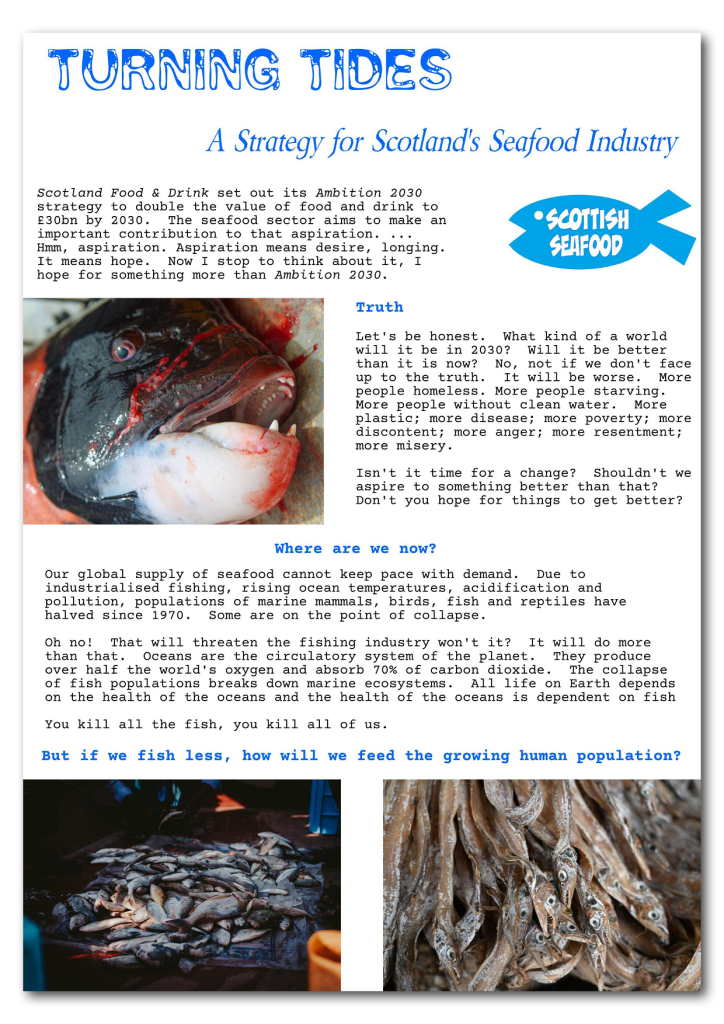
Those trying to sell you aquatic animal products will tell you what persuades you to pay them. And yes, people need work. But don’t they need work that sustains our planetary life support system?
Thank you for your own vital work, Violet’s Vegan Comics.
June is Pride Month — dedicated to, and celebrated by, LGBTIQ+ and allies worldwide.
I believe animal advocacy, at its best, works to challenge and transcend domination wherever it is found, and I think that belief explains why so many vegans from the movement’s earliest days have conscientiously objected to war.
It’s why so many of us sense that heterosexist oppression stems from the same place as human supremacy.
This month 51 years ago, at Stonewall Inn, an interracial group including nonbinary and transgender people rose up against vindictive policing. They rose up against bigotry, hate, and hurt. Their pain and their courage combined to open up new pathways to self-actualization for the rest of us. Pathways to respect. To love. To many more acts of protest, and to unforgettable times of joy and celebration.
And yet the torture and death of George Floyd reminds us, again, that — as far as we have come — the struggle for human freedom is still grotesquely immature. It tells us respect still takes a back seat. And it is a setback for every living being on the face of this Earth.
Pride month 2020 is a time of sorrow because of yet another murder in a pattern of authority-wielding murders, another profound loss to the collective conscious soul. Why? Why can’t we just be decent?
The Art of Animal Liberation must be committed to human dignity and respect for nonhuman life as a dual striving. The loss of George Floyd makes the reason all the more intense, and the need to speak up for the #BlackLivesMatter movement all the more urgent.
My CounterPunch bio identifies me as working for animal liberation. It feels right to have that bio follow a piece about the selective way “looting” is discussed in connection with #BlackLivesMatter protests. It feels right to spread the word that we’re all on this planet together, and no one is free as long as bullets, cages, and chokeholds rule our culture. Authoritarianism has got to go. Humanity must change now. There is no more “I won’t see the change in my lifetime, but…” because now we’re bracing for the storms of a distorted climate. It was always time for respect to ascend, and the very existence of a future, for us, should not be taken for granted.
Summer season’s greetings to all! I’m counting down the days to the North American Vegetarian Society’s annual Summerfest, happening Wednesday-Sunday 5-9 July at the University of Pittsburgh – Johnstown campus. This is the closest thing to a “vacation” I do all year. And it’s soul-refreshing to be around vegans who have become supportive and dear friends over the years.
The full timetable with all of the session descriptions is now available. Below are my three sessions. Should thoughts come to your mind on these topics. . . Please do share what comes to you.
The first one I’m ethically compelled to present: the diet-climate link. The second will be something I’ve never presented before, on an issue most of us face daily. The third brings to Summerfest something we don’t consider nearly enough in the vegan community: Veganism Defined. The brief, beautiful piece from 1951 is prescient, urgently relevant. Its call to stop thwarting evolution couldn’t be more vital, in light of stuff like the Trump administration’s removal of Endangered Species Act protection from the Yellowstone grizzlies, allowing people to stalk and kill them.
Yours for Liberation,
Lee.
If You Can’t Stand the Heat, Get (Animal Products) Out of the Kitchen
THURSDAY 6 JULY, 10.00 AM
Campus Room
Why do experts disagree on the proportion of climate impact from animal farming? Are any governments or international bodies taking action on meat and dairy, given its climate impact? Do our personal dietary commitments having any significant impact? As an environmental law specialist, I’ll offer an up-to-date analysis, and talk about what our community can do.
I’m Vegan. My Job Is Not. How Do I Reconcile This?
FRIDAY 7 JULY, 10.00 AM
Campus Room
In a perfect world we could all have vegan careers. In this world, so few of us do. How do we cope with the day-to-day reality? Are there any silver linings in this reality (or any drawbacks to working in vegan environments)? Can a vegan employment sector be stimulated? This will be a brief presentation followed by interactive discussion.
Vegan Dot Connecting – Why It’s So Much More Than a Diet
SATURDAY 8 JULY, 2.00 PM
University Room
Defining “vegan” through the Vegetarian World Forum in Spring 1951, the Vegan Society in England declared that through the vegan commitment “A great and historic wrong, whose effect upon the course of evolution must have been stupendous, would be righted.” I’ll facilitate a discussion of the broad and deep view of what veganism stands for.
An eco-friendly tip for those attending Summerfest: Amtrak’s “Pennsylvanian” route goes to Johnstown, PA, and there’s a free, student-driven van service to and from the University of Pittsburgh campus. Please travel by train when you can.
A young crocodile who utters a distress call will bring immediate help from completely unrelated adult crocodiles, even if it means risking their lives…Obviously this altruism does not extend to us. Saltwater crocodiles kill approximately one person every year in Australia. The same is true, more or less, in North America, where between 2000 and 2010, the American alligator killed thirteen people. In sub-Saharan Africa, however, it is believed that the Nile crocodile kills hundreds (possibly thousands) of people each year.
We are not prey for most supreme predators, but we are for crocodiles it would seem. They happily consume us.
Read the full post and wish Jeffrey Moussaieff Masson a happy birthday here! (Birthday is the 28th; post timed to catch it in the New Zealand time zone.)
Here’s an intriguing retrospective with many fascinating thoughts well worth exploring in detail, from time to time, at Vegan Place. I was delighted to post this piece to the Internet in June 2009, and now re-post it here in celebration of World Vegan Month 2013.
Appreciation to George D Rodger, both for conducting this interview in the first place, and for subsequently permitting me to publish it so that others might read and enjoy it. If you wish to copy this page, please cite the source (this site), show the courtesy of leaving this note intact; and know that while George has offered it to the public sphere, it would be appreciated if you would note its source as George D Rodger, chair of the Vegan Society. It can be freely quoted, but it is important that Donald’s words not be altered. As George Rodger explains, Donald Watson used the…
We live on an extinction-wracked planet. How did we put ourselves in charge of such destruction, and how do we get out of this role? We must take decisive action to respect the space and nutrients needed by other beings, beings whose own experiences of the world matter. But where is this message to be found? For all our scientific knowledge, humans see ourselves as impossibly special, above biological connections with other life, members of a deceptively insular category. When discussing other animals, we avoid the word “genocide”—which meanskilling a tribe. By thinking of extinction as genocide we pull these erasures from the abstract, and press our minds to reckon with them.
We need to discuss conscious beings without always resorting to the duality of “human and animal”; and how real, anyway, are the species boundaries? Dolphins have tiny, leg-like limb buds during their earliest…




 Vegan Place