On the 12th of October 2006, Satya magazine held an open gathering at the Jivamukti Yoga Studio Café, New York City. On the same date, I took notes and wrote this synopsis. This version is slightly condensed for clarity. It constitutes my observations only, and is not meant to be a comprehensive recording of the meeting.
Why, you might ask, would we revisit a 2006 discussion today? In retrospect, it shines a light on a major fork in the road of advocacy. Career advocates needed to choose a direction, and the dominant group endorsed the “practical” approach instead of radical opposition to capitalism’s claim on animal bodies.
So I’m leaving it to the reader to decide whether, and to what extent, this meeting had meaning. This is not tale-telling; nor is it an exposé. Everyone who attended had the knowledge that the Humane Meat Discussion would be the focus of public commentary. The discussion was promoted and hosted by journalists, and this synopsis itself was circulated after the event. Each person and each charity named in this synopsis shared their perspective voluntarily and publicly.
The staff of Satya magazine hosted the Humane Meat Discussion. Publisher Catherine (Cat) Clyne introduced the Satya staff and some contributors and groups present at the session.
Clyne said:
We all have one thing in common: we all care—deeply—about animals.
Gene Bauston [now Gene Baur] of Farm Sanctuary commented as the question-and-comment session began. Bauston said that the attendees could be divided into two main classes: There are those of us, Bauston said, who have “hands-on” experience, and those who approach advocacy from an academic—let’s say a theoretical—perspective. Bauston’s choice of words was apparently establishing Bauston as within the “hands-on” class.
It is common, of course, to hear animal-rights advocates and vegans being dismissed as idealist, ivory-tower, and so forth. Animal husbandry concessions are invariably justified by the claim that they are realistic, pragmatic, or derived from good business sense.
This dichotomy reflects (and does not challenge) the status quo: Veganism, although gaining ground, is indeed an ideal. Animal products are indeed a business.
By the latter half of the 1970s, we saw a point of view, most strongly associated with Peter Singer, that both breeding and killing (quintessential acts of domination) could co-exist with compassion. N. L. (employee of Friends of Animals) suggested that if activists had kept doing vegan advocacy rather than swap it for a strategy of concessions, animal rights would appear more realistic today.
An attendee named Chris was visibly upset due to the co-opting of the specific word “compassion” by animal agribusiness. Chris likened the use of the word “compassion” by an enterprise enslaving and killing animals to “a knife in my heart.”
Dan Piraro (a vegan cartoon artist) agreed that words are important but said activists ought to get used to them being distorted, because that just happens. For example, the “Clear Skies Initiative” takes an environmentalist idea, clear skies, and turns it into a plan that might be better termed “clearing the skies of birds.” In any case, Piraro insisted, things aren’t going to change, so activists should do anything they can. Piraro would like to see a vegan society, but: “It will never happen—certainly it will never happen in my lifetime. Think about those guys on death row.” Piraro said they’d appreciate better conditions.
Let’s take a closer look at Piraro’s claim. Nonhuman animals won’t be on death row insofar as they aren’t desired as consumer products. That’s the very point of vegan advocacy. Moreover, serious human-rights advocates do not accept the idea that people on death row should be killed humanely nor do the advocates negotiate rules on how to kill them.
One participant said it is not sensible to insist on veganism if it won’t work for people with babies and children. Cat Clyne suggested that it’s debatable whether breast milk is vegan but suggested reading The Way We Eat by Peter Singer and Jim Mason. [A clarification for the confused reader: Human breast milk is vegan.]
Others pointed out that Dr. Benjamin Spock had given veganism the clearance for babies and children, and so had the professional dieticians of the American Dietetic Association.
Someone said we’re all speciesist so let’s not say we’re not; after all we are not blocking the trucks now. Then the participant added: “And I am not out there doing it for humans either.”
Friends of Animals [the group I worked for at the time] provided a sheet for participants to pick up from the information table, listing facts about Whole Foods Market’s latest major promotion. We noted that the grocery chain designed a foundation “to assist and inspire ranchers and meat producers around the world to achieve a higher standard of animal welfare excellence while maintaining economic viability.” We noted that Whole Foods Market stock hit a record high the day the company announced the hiring of agribusiness expert Anne Malleau to direct the Animal Compassion Foundation.

Advertised with posters depicting the silhouettes of a cow, pig, and chicken, and designated First Global Five Percent Day, the final Tuesday in January 2005 represented the investment of $550,000 out of the company’s global receipts into the new foundation.
Several Friends of Animals employees, and a few supporters, leafletted on Global Five Percent Day at five Whole Foods locations, asking shoppers to reconsider the idea of funding a concept involving research on animals in agribusiness and the unveiling of yet another line of animal products.
On 20 January 2005, Friends of Animals published an open letter to Whole Foods Market CEO John Mackey, taking issue with the grocery chain’s Animal Compassion Foundation, observing that “we have the ability to decide whether to keep bringing other animals into existence simply to be sold as food, while using up land and water resources that could be left to animals who really could have free and full lives.”
Next, Whole Foods Market posted and circulated a statement in the form of a letter from Animal Rights International (ARI) to John Mackey, dated 24 January 2005, with the release titled Animal Rights Groups Express Support for Animal Compassion Foundation.
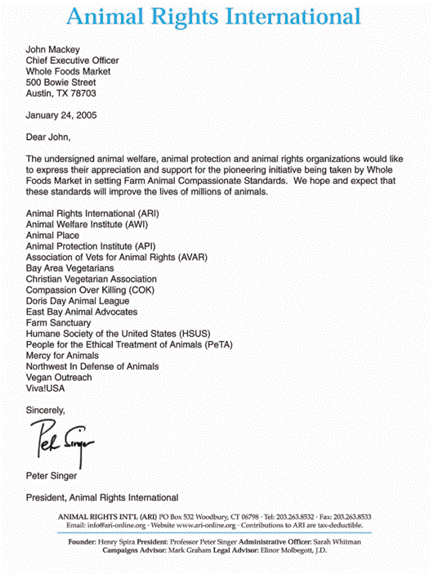
The endorsement was signed by 17 animal-protection groups, following Peter Singer, ARI president. Co-signers included the Animal Welfare Institute, Animal Place, the Animal Protection Institute, the Association of Veterinarians for Animal Rights, Bay Area Vegetarians, the Christian Vegetarian Association, Compassion Over Killing, East Bay Animal Advocates, Farm Sanctuary, Mercy for Animals, Northwest In Defense of Animals, and Vegan Outreach, as well as groups that had served Whole Foods Market as consultants more than a year in advance. Attending meetings with Whole Foods and ARI in December 2003 were animal welfare scientists Ian Duncan of the University of Guelph and Renee Bergeron of the University of Laval, and representatives from the Humane Society of the United States, People for the Ethical Treatment of Animals, Vegetarian International Voice for Animals! (Viva! USA), and the Animal Welfare Institute.
Gene Bauston of Farm Sanctuary acknowledged that, as of the date Satya held its open discussion in late 2006, there were still no actual “compassion standards” in place.
Nevertheless, as I stated in the Satya discussion, the corporation was touting its social responsibility promotions, including its Global Five Percent Day, with an enormous billboard in the expensive Kensington district of London, at the construction site of its new branch. Just across from Hyde Park, the selected site was Barkers of Kensington, west London’s oldest department store, bought out by Whole Foods Market CEO John Mackey for England’s first named branch of the grocery chain.
Mackey had already acquired London’s “niche retailer” Fresh & Wild. The Fresh & Wild chain was not animal-free before the takeover, but at least it hadn’t been using a false sense of kindness to animals to sell its products. “Sausages made from humanely treated animals,” the Guardian Observer announced in early 2006, summing up the hype surrounding John Mackey’s entrance into Britain.
Those of us from Friends of Animals reminded the Satya meeting attenders that support for family farms and pasture-based businesses would promote the idea of taking yet more space on Earth for agribusiness, leaving less space to exist at all for free-living animals.
Bauston countered:
If we really believe that free-range farming is bad because it uses more space, the next step in that argument would support concentrating animal commerce in factory farms!
We replied:
No, it would not.
The next step in the argument is vegan advocacy.
Farmer-activist Harold Brown stood up and talked about what it’s like to speak to agriculture students. Brown would say: “I’m against all animal agriculture. Now, let’s talk.” Students didn’t shrink from such forthright communication.
Brown said there’d be no point in lecturing about “animal welfare”—which is actually husbandry. Husbandry is already in the textbooks; it needs no promotion. The more we insist on taking other animals seriously, the more industry will respond with husbandry adjustments in an effort to pacify activists and the public. But it’s not our job to compromise our views and meekly request reforms, said Brown. We can’t dismantle animal use by compromising with it.
Brown recounted having recently read an article that said one thing industry cannot fight is the moral argument. So, Brown continued, advocates must regain or develop clarity of thought and purpose. Brown said:
We have the truths. The Orwellian Big Lie is that we need the market to drive ethical attitudes.
Of the letter signed by 17 groups supporting Whole Foods’ Animal Compassion Foundation, Gene Bauston countered, none of those groups actually endorsed the concept of humane animal products.
James LaVeck, filmmaker with Tribe of Heart, then read from the letter itself.
Dear John, The undersigned …would like to express their appreciation and support for the pioneering initiative being taken by Whole Foods Market in setting Farm Animal Compassionate Standards …
LaVeck asked if anyone could argue that it was anything other than an endorsement.
Lauren Ornelas got up to recount what it was like to promote the concept of the compassion foundation with Mackey in the first place, and how hard it was to be at the table and be sure that “animal rights groups” could be trusted to behave themselves. Ornelas also claimed to have persuaded Mackey to go vegan.
Disturbed by this, I got up to say this invocation of “vegan” was both a misuse of language and a distortion of vegan activism. Is Mackey vegan? No one is vegan who eats goat cheese and eggs. Moreover, as an international marketer of animal secretions and flesh, Mackey cannot possibly claim to be striving to opt out of animal agribusiness, which is what a vegan does.
Ornelas then said:
Well, Mackey was vegan.
Let’s take a closer look at that claim. Prior to unveiling the Animal Compassion Foundation, Mackey publicly said:
Technically, I am not a pure vegan because I eat eggs from my own chickens.
But there are no pure and impure vegan categories. Veganism doesn’t make allowances for eggs produced through backyard hen-keeping. With eggs featured in so many groups’ free-range farming promotions (including campaigns of many of the groups listed on the support letter to Mackey), I stated, Mackey’s words had special significance in co-optation dynamics.
Eddie Lama of Oasis Sanctuary had this to say about purportedly seeking animal rights by campaigning for husbandry adjustments:
If I want to grow figs, I do not plant an apple tree. If I want to eat pears, I do not plant a chestnut tree.
The grand focus of the animal-rights perspective is being lost, warned Lama, who compared scenes from FaunaVision [Lama’s video presentations, involving the fates of nonhuman beings in agribusiness] to how the vegan might view many of the aisles of Whole Foods.
Lama went on:
I’m so hurt. When I’m in Whole Foods Market, and I see the miles of bodies, all dolled up. Then they have these posters advertising their supposed humanely treated animals. They show the pictures of them, their former selves, grazing in the field.
Those animals, on their way to a terrible end, I see so many. I would buy them to save them.
Let husbandry changes come where they will, urged Lama, but don’t waste time entrenching animal use.
Bauston then said we have to understand reality and stop living outside of the real world. Bauston referred to the importance of pushing Proposition 204 in Arizona. [That proposal entailed a seven-year phase-in of a new minimum size for pig and calf containment. Farm Sanctuary’s website described itself as “committed to passing a measure on the ballot that would simply allow animals such as these enough room to turn around and extend their limbs.” The Farm Sanctuary page also condoned animal agribusiness for children: “Prop 204 is only about massive factory farming operations, not 4-H kids. Not only does Prop 204 specifically exempt county fairs and exhibitions, but 4-H kids do not confine pregnant pigs in gestation crates.” Such campaigns play well to conservative ideas of traditional business and family values, yet completely ignore veganism. The campaigners in fact argued that their goal was no threat to animal agribusiness: “There is no evidence to support this claim whatsoever, and in counties which have already banned both gestation crates and veal crates, there are still pork and veal industries.”]
One meeting participant replied to Gene Bauston:
You mentioned that we all need to get into the real world. There is no real world, other than what we make of it. You, telling us to get into the real world, remind me of someone from the 60s with a crew cut saying Cut your hair and grow up!
Bauston said:
I didn’t mean it to come out that way. What I mean is that you have to understand business.
Cat Clyne ended the meeting with a prepared concluding statement, which cited Australian rescuer Patty Mark’s insistence that 30 years of animal husbandry reform has done very little to help animals.
Juxtaposed against this, Clyne also invoked Peter Singer, who had recently urged activists to start thinking about other tactics that will lead not necessarily to a vegan world but to a world without factory farming.
By reframing animal advocacy as a counterpoint to high-tech, industrial farming, Singer demoted what vegans have long promoted: animal liberation.
Veganism is not an attempt to derive our power from the corporate world. It has always called on people to abolish exploitive industries through conscientious objection and replace them with animal-free initiatives.
—Lee Hall, October 2006
Post script, June 2015: A decade after PETA became involved in rolling out Whole Foods Market’s “compassionate” marketing scheme to sell very expensive animal products, PETA filed a legal challenge against Whole Foods, questioning whether the grocery chain is adhering to “animal welfare” standards.
The answer, of course, is no (regardless of the outcome of the litigation).



 Vegan Place
