Dear friends, we started purpose-breeding reindeer as early as 14000 BC. Likely the earliest human project of, yes, reining in our fellow living communities.
When people sing to their kids about the reindeer who’ll “go down in history” they don’t say that reindeer, you know, could have had their own history, but we interrupted it to tell them that guiding our sleigh would be their job.
Reindeer could have played reindeer games of their own making, on nature’s terms, had they grown up as free beings on this Earth. And I promise you that no reindeer ever shouted out with glee about any special job Rudolph was forced to perform. Maybe that’s something to talk about today. Because truth is a precious gift.
Whether or not you celebrate today as a religious holiday, may peace, hope, and resolve be yours this Christmas day. And may all who strive for authentic peace on Earth be keeping spirits bright in the year ahead, with mutual aid and moral support.
Here is the article. Don’t miss the link to the free-running Takh horses of Mongolia.
I’d guess you’re feeling the way I feel about the approach of the Kentucky Derby. We can only hope ethics-minded, socially responsible people would question the holiday mood it purports to bring. To nudge that hope along, I’ve done this pro bono work for CounterPunch.To support continued work like this, consider subscribing to the Studio for the Art of Animal Liberation.
Love and liberation,
Lee.
Photo by Kybluegrass of the sculpture of Barbaro, one of the horses who has died in the Kentucky Derby (CC BY-SA 3.0)
Cats returned to the outdoors may seem free, but they don’t really live in a natural bio-community on their terms. Most suburban “strays” are ultimately picked up by animal control officers and killed.
On the other hand, as long as they stay in a home, they are dependent. Sprite seemed to find this acceptable. Sprite adjusted so well to our indoor life that I couldn’t bear to follow through with the “R” phase of TNR. It would feel unfair.
If I’d decided to keep Sprite inside, Elf would also stay. The two cats loved each other. Separating them wouldn’t do.
So they’d have a roof overhead for life. And I got used to having Elf as a dissatisfied lodger. We’d never touch each other, and I’d live with that.
Subscribe (any amount) to the Studio to read the rest of this story, to see my future works in progress, and to keep this blog free of commercials and inappropriate political messaging. Thanks so very much to the Patrons of the Art of Animal Liberation.
Benjamin Franklin purportedly said the eagle design for the Great Seal of the settlers’ new country looked more like a turkey. And a turkey would have been a better choice, said Ben. In a rather smart-alecky letter in 1784, Ben Franklin wrote:
For in truth, the turkey is in comparison a much more respectable bird, and withal a true original native of America. Eagles have been found in all countries, but the turkey was peculiar to ours…
Franklin ought to have said turkeys populated the Americas (because Ocellated turkeys are native to Central America). Franklin might well have noted that people of European ancestry weren’t true orginal natives either. They seemed to show up “in all countries” as well!
Franklin continued:
…the first of the species seen in Europe being brought to France by the Jesuits from Canada, and served up at the wedding table of Charles the ninth.
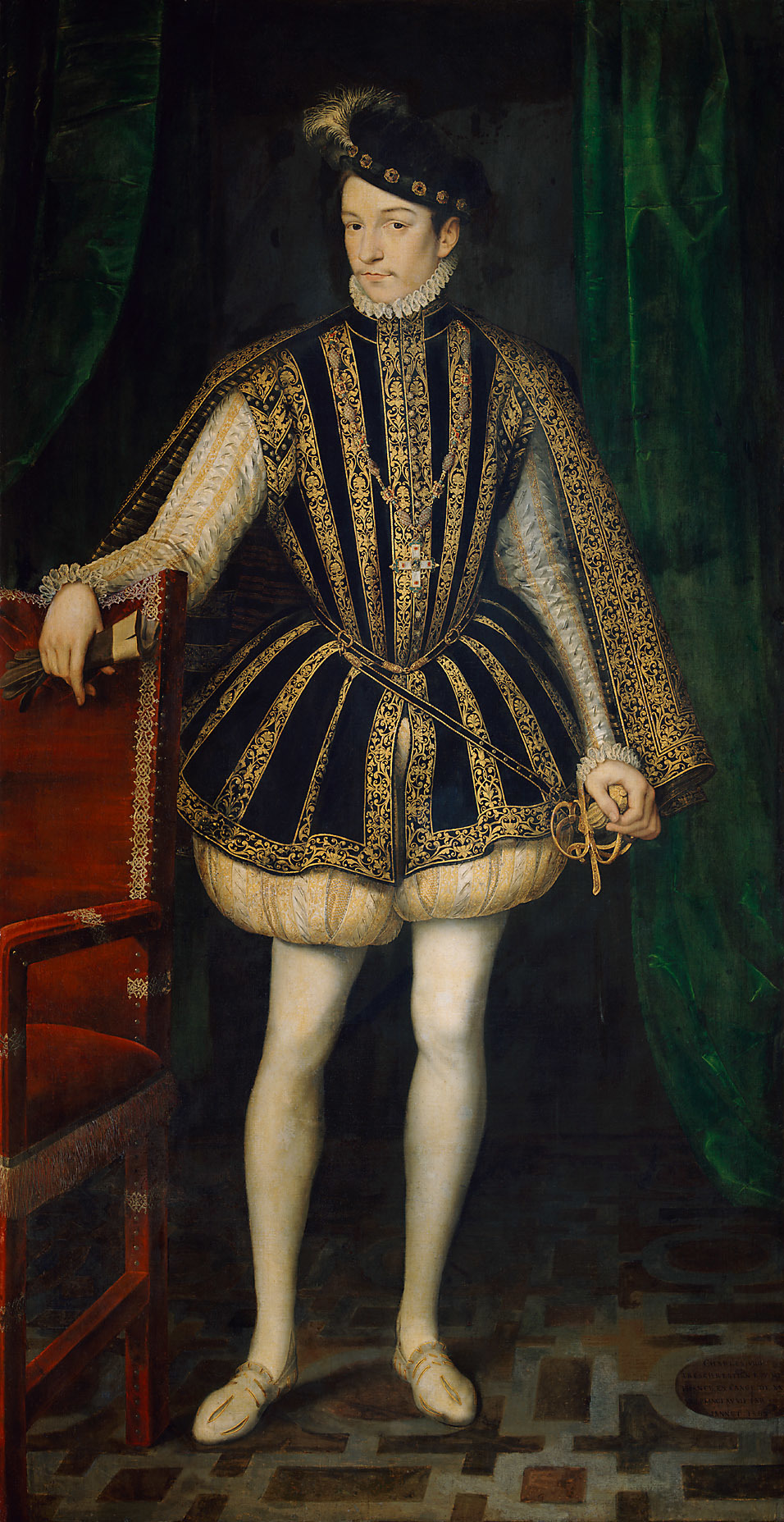
Charles IX of France
So Franklin knew about the turkeys of Canada, from whence priests snatched the birds and shipped them off to be consumed by Charles IX (pictured), the 16th-century mass slaughterer of Protestant Christians who, reportedly haunted by these killings, succumbed to tuberculosis, aged 23.
Franklin went on with the turkey story:
….He is besides (though a little vain and silly tis true, but not the worse emblem for that) a bird of courage, and would not hesitate to attack a grenadier of the British guards who should presume to invade his farm yard with a red coat on.
So Ben Franklin thought the turkeys would deem the British military — and not the turkey-keeping farmer — as the opressor … actually insulting turkeys, not admiring them.
Indeed, Franklin thought actual turkeys made good experimental subjects for electrocution and cooking, thereby laying the foundation for the invention of the electric oven.
The settlers weren’t the first to confine and domesticate free-living turkeys.
Some indigenous groups domesticated turkeys more than 2,000 years ago, to have access to their flesh for food, feathers for tools and ceremonial dress, and down for blankets. Here’s → Audubon.org saying domestication showed how much Native Americans valued the birds (but not on the birds’ terms).
Today, because cougars and wolves have been exterminated in the eastern United States, New Englanders call the presence of free-roaming turkeys a wildlife management issue. (Sounds familiar?)
Moreover, these naturally confident birds have become habituated by people putting out birdfeeders.
Biologists urge people to stop manipulating the turkeys through food.
And vegans urge people to stop manipulating the turkeys for food.
The struggle continues.
This week, may we all give thanks for nature in its free state. Instead of the so-called traditions of consuming commercialized flesh or even rolling our eyes at those same worn-out turkey jokes, may we create refuges of respect. And if we need to take refuge ourselves, so be it. People who love us will get over it, or they’ll understand.
My gratitude is with you, dear friends. Love and liberation,
Lee.
__
References: From Benjamin Franklin to Sarah Bache (26 January 1784), Founders Online, National Archives; and as linked. Charles IX painting by François Clouet (public domain). Banner photo of free-living turkeys in Pennsylvania taken by Lee Hall.
While millions of people seek food aid, we feed billions of farm animals.
Fish, dairy, meat and egg products take a huge toll on the planetary systems that sustain our lives.
Let’s be clear. We’re talking about all of animal agribusiness, not just factory farming.
The local, family-run farm betrays animals who trust their keepers. It exploits resources that could sustain hungry and thirsty humans. Its waste is largely unregulated simply because small farms (which are many, in the aggregate) slip through the cracks of federal environmental law. The development of local animal farms is a form of sprawl, no less than roadside malls and mini-marts. And animal farming involves the selective breeding, the purpose-breeding, of members of other living communities.
There is no fair animal farming business.
Nor is animal ag conducive to social fairness among human beings. Animal ag on every scale contains gruesome work. While we don’t want to see how the sausage is made, someone has to make it for so long we demand it. Those in the supply chain work long hours; some are migrants, housed in dorms to be ever-available.
Save for a handful of animal refuges, all animal farms sentence their nonhuman residents to death at some point. And that means some humans experience the repetitive and ghastly trauma of the killing floors. A more privileged class need never witness the sausage being made.
Veganism responds to urgent food security and social justice needs. If it can’t solve world hunger, at least it can drastically reduce it. And in a time of global climate breakdown, high-protein, drought-resistant pulses such as lentils are making a comeback.
As a principle, veganism holds that humans are one community among many, not the very point of Earth’s existence. Vegans relinquish the human assumption that the Earth (or any other planet) is ours. Consider how this enriches the human experience. It calls for a truce with, and maybe even a sense of contribution to, life on Earth that could not be experienced otherwise.
And here I’m getting into Jeffrey Moussaieff Masson’s urge to “go to the root of the trouble.” Jeffrey says:
I believe the single most dangerous idea of the human community is pseudospeciation—the belief that we are superior. This leads to depersonalization of “other” cultural groups within humanity, as it mimics our notion of dominion over all nonhuman life on the planet. If sustained any longer, it will surely undo us and much of the living world. How long can we cling to our illusory feeling of control that has already fashioned hominids into the most destructive presence the Earth has known? Yet there is hope; we do have the mental power to decide on the side of respect rather than exploitation. The point is to strive. The path ahead might not always look the same to you, to Lee, or to me as we contemplate this shared journey.
After noting the pain involved in acknowledging domestication as exploitation, Jeffrey says:
I would go even further: I would claim that humanity’s original sin lies in the domestication of animals.
Free-living animals become competitors to subdue and erase. In their place, we produce tame animals that accommodate our desires. Is this peace?
I know better, now. Peace is lying under a lamppost, watching bats flutter in the evening. Peace is meeting a coyote’s gaze at dawn. Or pausing to watch deer cross a snowy meadow. It’s in the silent moments when we’re awed to have been born on such a planet…
Now, if the Anthropocene Awards are ever produced for star-quality performances, nominate Patrick. Why bother to learn from others when you can stamp out their knowledge instead? And this was superhero-level stamping-out. Unless, more likely, Patrick is just a diversion, superimposed on history to blot out the druidic take on the universe.
The Collins Dictionary traced the root meaning of the word druid to the term oak-wise. We need more oak wisdom.
But a 5th-century Roman Catholic “patron saint of Ireland” had no use for it…
It’s Solstice Day, and I want to say something uplifting, but oh, dear friends, I can’t absorb this nonsense any more. And I don’t believe any of us ought to. This is not fair. This is not love.
The law fails to do what people aren’t ready to do. Yet Earth’s living communities can’t wait. They urgently need us to change. Whether we, the ultimate crafters of social hierarchies, acknowledge it or not, we can never alienate ourselves from the nature we destroy. So, what are we doing to reconcile ourselves to it?
 Vegan Place

