A commitment to a great cause is a solid foundation to build our inner lives upon, and also one virtually guaranteed to bring turbulence into the course of our lives. This is an experimental diary. If things go well, it'll help myself and others on a parallel course. See you at veganplace.wordpress.com
Now, if the Anthropocene Awards are ever produced for star-quality performances, nominate Patrick. Why bother to learn from others when you can stamp out their knowledge instead? And this was superhero-level stamping-out. Unless, more likely, Patrick is just a diversion, superimposed on history to blot out the druidic take on the universe.
The Collins Dictionary traced the root meaning of the word druid to the term oak-wise. We need more oak wisdom.
But a 5th-century Roman Catholic “patron saint of Ireland” had no use for it…
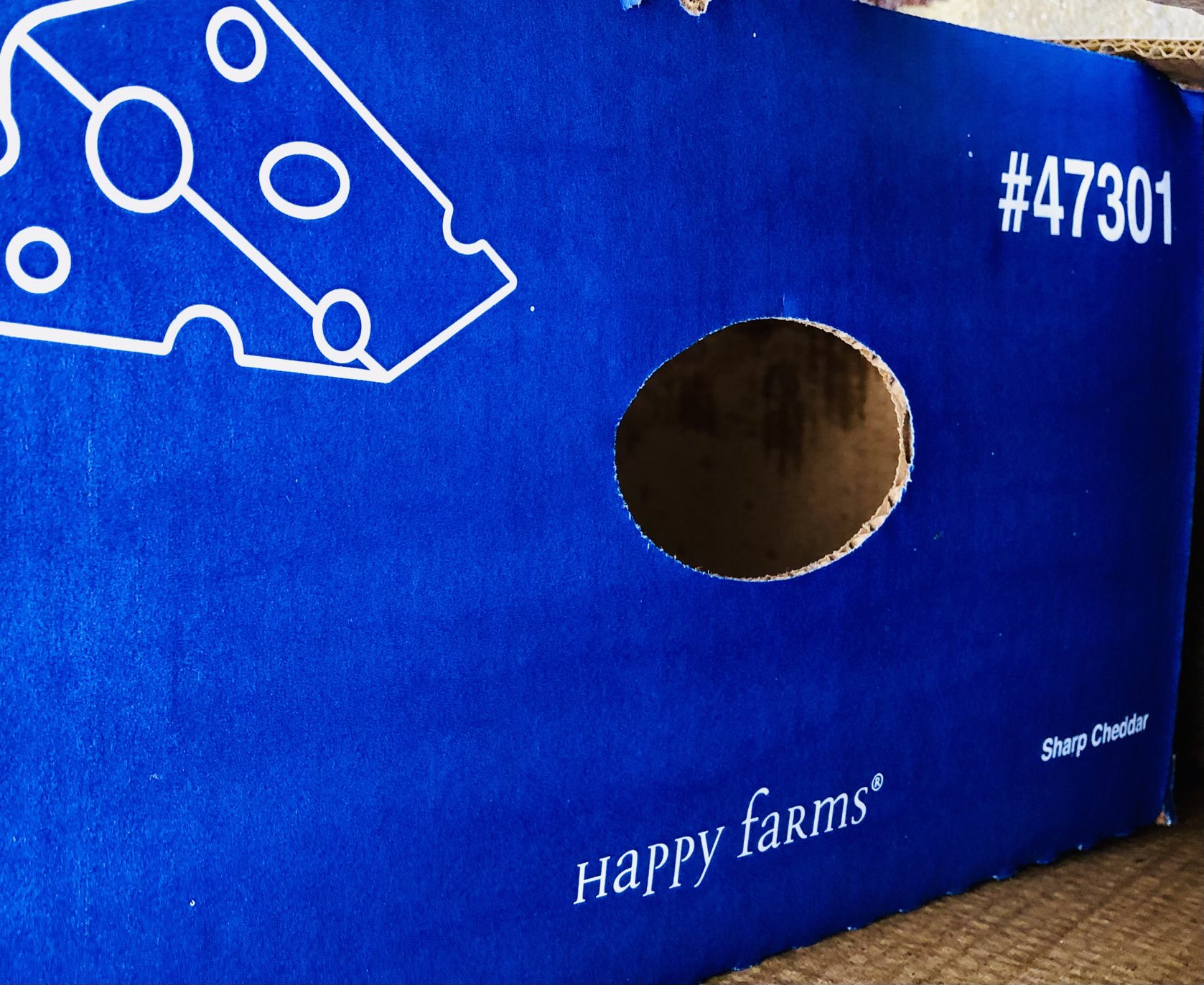
What’s so happy about purpose-bred animals confined for life, forced to endure serial pregnancies so human primates can cart their babies away and make snacks out of their maternal milk?
Someone went to work one day, and the task was to design this for the box printer. Precious human hours slid into the lies like sands through a minute timer.
That’s all for now. Thank you for keeping our hope for a better and honestly much happier culture alive.
When someone asks me about the key resolutions to make in this time of environmental crisis, I say be vegan. That relates to everything. Every other commitment that’s mindful of the living planet emerges from that.
Resist the subjugation of other species by ours.
For a day, carry a notepad. Jot down any instances of subjugation you find in a single day. Note the forms of systematic bullying or erasure of others which exist as ordinary realities. Try this, talk about this. Let these notes inform personal, integrated, minute-by-minute thoughts, words, actions.
Work for all aspects of justice at the root. It’s the same root.
It’s Solstice Day, and I want to say something uplifting, but oh, dear friends, I can’t absorb this nonsense any more. And I don’t believe any of us ought to. This is not fair. This is not love.
The law fails to do what people aren’t ready to do. Yet Earth’s living communities can’t wait. They urgently need us to change. Whether we, the ultimate crafters of social hierarchies, acknowledge it or not, we can never alienate ourselves from the nature we destroy. So, what are we doing to reconcile ourselves to it?
Vegan was coined in 1944, by a small group previously called the non-dairy vegetarians. They said it was not their intent to break away from the vegetarian movement that arose in Britain and the United States in the 1800s. But they couldn’t live with patchy respect for nonhuman animals. They set out to “renounce absolutely their traditional and conceited attitude that they had the right to use them” to serve human purposes.
It’s Not a “Stop Factory Farming” Campaign…
The Vegan Society’s founding members considered the animal farms of England unacceptable. So what if these farms were free-range and familiar features on the landscape? Covering the land with purpose-bred animals had ruined ages of natural evolution of animal life in untamed habitat.
Vegans acknowledge the health and environmental hazards of animal agribusiness as well as its unjust treatment of other conscious beings. We’ve decided not to participate. Nor do we want to be at war with free-living animals, as ranchers and “free-range” farmers are.
It’s a Call for Liberation.
Defining veganism in 1951, proponents explicitly connected their vegetarianism with a liberation call, based on their stated conviction that humanity has no right to exploit other living, feeling communities.
They would opt out of “flesh, fish, fowl, eggs, honey and animal milk and its derivatives.” What would they eat? “Fruits, nuts, vegetables, grains and other wholesome, non-animal products.” The results they sought? Honestly humane agriculture. And the rise of a movement to stop humanity from continuing to derail other animals’ evolution.
Why the First of November?
The Vegan Society first considered making the 2nd of September a celebration day. That was the birthday of Donald Watson, the best known of the Society’s founders. But the group ultimately settled on the anniversary of their first newsletter publication.
Turned out Watson wanted nothing to do with the “great person” narrative. It’s up to every vegan to be veganism’s representative.
⬆️Donald Watson in the garden—like every other vegan.
Why the Word Vegan?
The word vegan was adopted as a name by The Vegan Society founding members Donald Watson and Elsie Shrigley. Dorothy (Morgan) Watson had first offered the word to Donald—at a dance they both attended.
The word came from the first three and last two letters of vegetarian—“because veganism starts with vegetarianism and carries it through to its logical conclusion.” Vegetarianism is a dietary path. Veganism is a commitment to respect other animals on their terms.
Once We Commit to Veganism, What’s Next?
We must each ask ourselves what striving has to mean. As for me? I think: Do the opposite of what the masters do, the opposite of what the fascists are doing out there right now. Stand for kindness, solidarity, and respect. Live simply. Live in harmony with nature as much as possible.
I’m trying. I think I’m getting better at it.
We might disagree on what to do and how to do it and what initiatives to support, but I hope we can figure out how to disagree without hurting, and to agree without competing.
Here’s One Thing We Should All Agree On.
Turning animals into our things is a ruthless habit, regardless of whether the results strike us as cruel or cute. And it’s a habit humanity can break.
Of course, the vast scale of animal use is overwhelming. But it runs on profits. “Consumers” have torque. As a movement, we’re here to say people can make our own decisions about what sorts of consumption we’ll accept.
Veganism Is Direct Action.
Donald Watson said the vegan movement would be essential to any future on Earth that includes humanity. We’re here and we’re human, so let’s do this thing.
Happy World Vegan Day, friends. Love and liberation,
Lee. ___
Image credits: The Vegan Society. Thanks to Patricia Fairey and George D. Rodger for the information on the origins of the word vegan.
This weekend’s edition of CounterPunch included my piece on the topic of feeding cats. It’s my commentary on a study done through Winchester University that asserts a vegan diet is good for cats.
Catriona Gold says:
I hope my fellow vegans will read Lee’s piece and consider where our energy is best spent: On debating the merits of vegan pet food? Or on challenging petkeeping itself? Discussion about the former risks obscuring the latter, dividing us and making us easy targets for ridicule. We can do better. ✊
And on a related note, Patricia Fairey spotted this cartoon…
Cartoon by Mike Ellis (commenting on the Winchester University study by Andrew Knight et al. which asserts that cats thrive on vegan diets). ALT: Drawing shows cat telling dog `Yes, I eat the prof’s veggie bits then nip out the catflap to snaffle a quick bluetit!’
Yes, we know. Mice and other small animals lose their spaces to make way for our homes. Our crops use land that might have been habitat. Even the gentlest gardener dispaces a few snails or worms.
Plus, most vegans I know use cars. Roads mean deforestation and fragmentation. Toads, deer, and many others can’t get from their birthplaces to their lifetime habitats. This is changing the course of evolution as well as displacing living communities. And what about the oil runoff?
And so on.
Maybe we’ll make changes as our discomfort with this reality grows. Yet even bike components and book glues are not always vegan; the list is long.
We’re serious about opting out of deliberate exploitation, in any case. And we needn’t accept the domestication of wolves, wildcats, ferrets, fish, and rabbits or the breeding and breaking of horses. Veganism means we strive as diligently as possible to avoid harming and manipulating conscious life, and we do the best we can to ensure other living beings are enabled to thrive in their ways.
We never said it was easy. (And if we did, maybe we need to rethink that.)
We are making a difference in the world. A vegan spares more animals a year than most any sanctuary in the world can take in! If the sanctuary is doing something real by helping animals in a hands-on way, then the vegan is also accomplishing something real—and working at the very roots of the troubles that force animals to need rescue.
All the while, we’re human. Yes, we vegans harm animals too. It’s part of the structure humans have built for more than ten thousand years, a structure which we inherited.
I ask myself: In what ways can I tread more lightly on Earth, buy less, waste less, use less, keep it local and get more into nature’s scheme of things? Gotta list the changes I will make. Gotta keep adding to the list.
Meanwhile, a note to those who seem to think we should throw up our hands because perfection isn’t achievable. Please understand that vegans try to challenge the idea of humanity as Commander-in-Chief over Earth’s living beings. We’d like to transcend all those thousands of years of playing the master role. We’ll never be perfect but that’s not the point.
Could a transformed human identity release us, and every other community still evolving on Earth, from a spiral of ever-worsening emergencies? That’s the key question for us today. The time we live in cries out for a paradigm shift. I’d love to find out what veganism can do.



 Vegan Place